
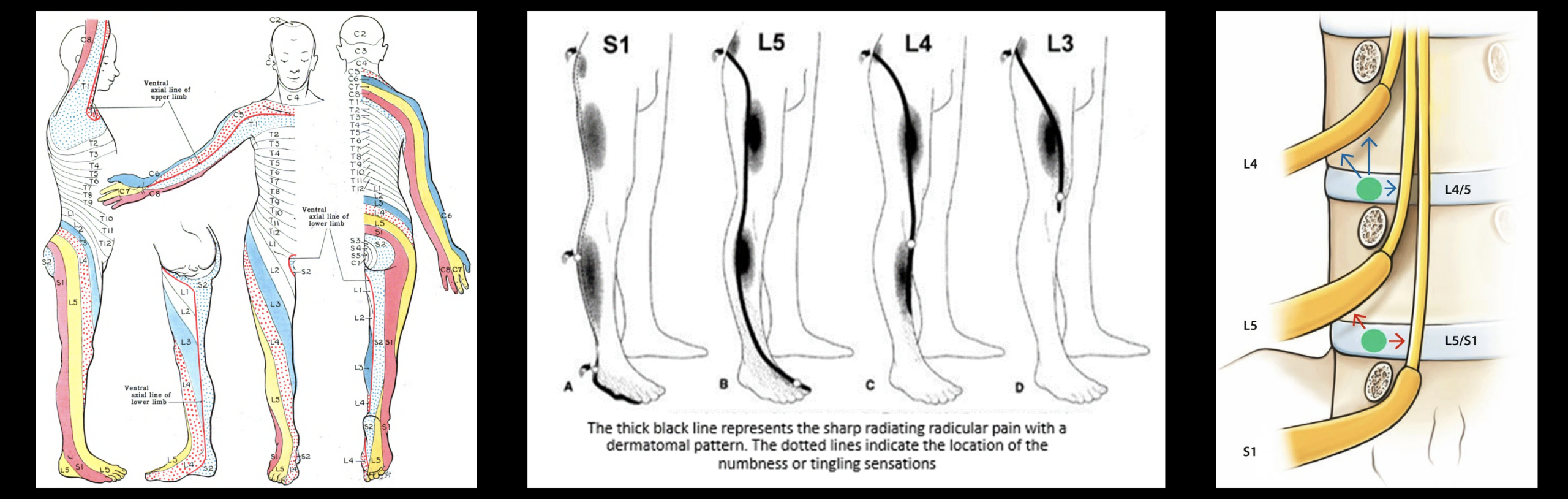
L5 Nerve Root Pain: Symptoms, Causes & Treatment
If pain travels from your lower back or buttock down the outside of the leg toward the top of the foot or big toe, the L5 nerve root may be involved.
L5 nerve root pain is one of the most common patterns of lumbar radicular pain. Some patients feel severe back and leg pain. Others have almost no back pain and notice mostly burning, tingling, numbness, or weakness in the leg or foot.
You may hear the same problem described as L5 radiculopathy, L5 sciatica, a pinched L5 nerve, or an L5 nerve-root compression. These terms overlap, but they are not perfectly interchangeable.
The important question is not simply whether an MRI contains the words “disc bulge” or “stenosis.” The goal is to determine whether the L5 nerve root actually explains your symptoms and, if so, where along its course the nerve is being affected.
Quick Summary: L5 nerve root irritation commonly causes pain, tingling, or numbness along the outer leg and top of the foot toward the big toe. Weakness may affect great-toe extension, foot movement, and sometimes walking on the heel. The same L5 nerve can be compressed by an L4-5 disc problem while it is traveling through the spinal canal or by L5-S1 foraminal narrowing as it exits the spine.
Where Is the L5 Nerve Root?
The anatomy is slightly counterintuitive, and understanding it explains one of the most confusing features of L5 radiculopathy.
The spinal cord itself usually ends around the L1-L2 vertebral level. Below that point, lumbar and sacral nerve fibers continue downward through the spinal canal as a bundle called the cauda equina.
The nerve fibers that become the L5 spinal nerve therefore travel downward within the spinal canal before leaving the spine through the L5-S1 neural foramen.
Along that journey, the L5 nerve root can be affected in two particularly important places:
- At L4-5: The L5 nerve is still traveling downward through the canal. Here it is called the traversing L5 nerve root.
- At L5-S1: The same L5 nerve leaves the spine through the neural foramen. Here it is the exiting L5 nerve root.
One nerve, two common compression sites: an L4-5 disc herniation can compress the traversing L5 root, while L5-S1 foraminal narrowing can compress the exiting L5 root.
This is why someone can have classic L5 symptoms even when the most obvious MRI abnormality is at L4-5 rather than L5-S1.
What Does L5 Nerve Root Pain Feel Like?
No patient follows a dermatome diagram perfectly. Nerve distributions overlap, and individual anatomy varies. But L5 symptoms tend to follow a recognizable pattern.
Common symptoms include:
- Pain beginning in the low back or buttock and traveling down the outer or anterolateral leg
- Burning, electric, sharp, or shooting pain below the knee
- Numbness or tingling over the outer lower leg
- Symptoms across the top of the foot
- Numbness or altered sensation involving the big toe or first web space
- Weakness extending the big toe upward
- Weakness moving the foot upward or outward
- Occasionally difficulty heel-walking or a tendency for the foot to slap
Some people have substantial leg pain with very little low-back pain. That does not rule out a lumbar nerve-root problem.
In fact, the leg symptoms may dominate the clinical picture when the nerve root itself is the primary pain generator.
L5 Pain, Sciatica, and Radiculopathy: Are They the Same Thing?
Not exactly.
Sciatica is a commonly used term for pain traveling from the lower back or buttock into the leg along the general course of the sciatic nerve.
Radicular pain refers more specifically to pain generated by irritation of a spinal nerve root.
Radiculopathy generally implies that nerve-root dysfunction has produced neurologic findings such as weakness, sensory loss, or reflex changes in addition to or instead of pain.
Therefore, a patient can have L5 radicular pain without significant weakness, while another patient with L5 radiculopathy may have numbness or motor loss as the dominant problem.
For the broader distinction, see our guide to radiculopathy.
Which Muscles Does the L5 Nerve Root Control?
The L5 nerve root contributes to several movements in the hip, leg, ankle, and toes. No single muscle belongs exclusively to one nerve root, which is why neurologic examination relies on a pattern rather than one isolated strength test.
Useful L5-associated movements include:
- Great-toe extension: lifting the big toe upward, particularly through the extensor hallucis longus
- Foot eversion: turning the sole outward
- Ankle dorsiflexion: lifting the foot toward the shin, although this also receives important contribution from L4
- Hip abduction: moving the leg outward at the hip
Weakness of great-toe extension is particularly useful when the rest of the history suggests an L5 pattern.
Unlike L4 and S1, L5 does not have a routinely reliable deep-tendon reflex that cleanly identifies it. That makes the combination of pain distribution, sensation, strength, gait, and imaging particularly important.
Can L5 Nerve Compression Cause Big Toe Numbness?
Yes. Numbness, tingling, burning, or altered sensation involving the top of the foot and big toe is one of the classic clues to L5 nerve-root involvement.
But big-toe or dorsal-foot numbness does not automatically prove that the problem is in the spine.
Peripheral nerve disorders, including problems involving branches of the peroneal nerve, can produce overlapping sensory symptoms.
This becomes especially important when a patient has foot weakness without much back or thigh pain. In that situation, the examination has to distinguish an L5 nerve-root problem from a peripheral nerve lesion rather than assuming every foot symptom is “sciatica.”
Common Causes of L5 Nerve Root Compression
L4-5 Disc Herniation
This is one of the classic causes of L5 radicular pain.
A posterolateral or paracentral disc herniation at L4-5 can compress the traversing L5 nerve root before it reaches its exit foramen.
This explains an apparent paradox that frequently confuses patients:
An L4-5 disc problem can produce L5 nerve symptoms.
The spinal level named on the MRI and the nerve root affected are not always the same number.
L5-S1 Foraminal Stenosis
The L5 nerve root exits through the L5-S1 neural foramen.
Loss of disc height, facet-joint enlargement, osteophytes, spondylolisthesis, or a foraminal or far-lateral disc herniation can reduce the available space and compress the exiting L5 nerve.
Foraminal disease can sometimes be less obvious than a large central disc herniation, particularly if the MRI is reviewed only for central spinal stenosis.
Degenerative Disc Collapse
As a lumbar disc loses height, the neural foramen can become vertically narrower.
At L5-S1, significant disc-height loss can reduce space around the exiting L5 nerve even without a dramatic focal disc extrusion.
Spondylolisthesis
Slippage between adjacent vertebrae can narrow the central canal, lateral recess, or neural foramen.
Depending on the level and anatomy, this may affect the traversing or exiting L5 nerve root.
Facet and Synovial Cysts
Degenerative facet joints can occasionally form synovial cysts that project into the spinal canal or lateral recess and compress a nearby nerve root.
Less Common Causes
Tumor, infection, trauma, inflammatory disease, postoperative scarring, and other structural abnormalities can occasionally affect the L5 nerve root.
These are much less common than degenerative and disc-related causes, but they become important when the history contains appropriate warning signs.
Dr. Amit Sharma & our minimally invasive pain & spine team.
L4 vs L5 vs S1: Why the Pattern Matters
Patients understandably call many forms of radiating leg pain “sciatica,” but identifying the likely nerve root can substantially narrow the diagnosis.
| Nerve Root | Typical Sensory Pattern | Typical Weakness | Useful Reflex |
|---|---|---|---|
| L4 | Front of thigh, knee, medial lower leg | Knee extension; sometimes dorsiflexion | Patellar reflex |
| L5 | Outer leg, top of foot, big toe/first web space | Great-toe extension, eversion, dorsiflexion | No consistently reliable routine reflex |
| S1 | Posterior calf, lateral or plantar foot | Plantar flexion; difficulty toe-walking | Achilles reflex |
These are useful patterns, not rigid boundaries. Dermatomes overlap, and pain does not always read the anatomy textbook.
That is precisely why diagnosis should combine the history, physical examination, and imaging rather than relying on a pain diagram alone.
How Is L5 Radiculopathy Diagnosed?
The diagnosis begins with the clinical pattern.
A specialist will typically ask:
- Where does the pain begin?
- Does it travel below the knee?
- Does it reach the top of the foot or big toe?
- Is there numbness or tingling?
- Has the foot become weak?
- Can you walk normally on your heels?
- Do coughing, sneezing, sitting, or certain spine positions reproduce the pain?
- Is there significant back pain, or almost exclusively leg pain?
Neurologic Examination
The examination can include:
- Great-toe extension
- Ankle dorsiflexion
- Foot inversion and eversion
- Hip abduction
- Heel walking
- Sensation over the lateral leg, dorsal foot, and big toe
- Straight-leg-raise testing
- Comparison with the opposite leg
The objective is not to find one magical “L5 test.” It is to determine whether several findings point toward the same nerve root.
When Is MRI Useful?
Not every new episode of radiating leg pain requires immediate MRI.
Imaging becomes particularly useful when symptoms are severe or persistent, significant or progressive neurologic findings are present, the diagnosis remains uncertain, or an epidural procedure or surgery is being considered.
When evaluating suspected L5 symptoms, the MRI should answer two separate anatomical questions:
- What is happening at L4-5 around the traversing L5 nerve?
- What is happening at L5-S1 around the exiting L5 nerve?
Looking at only one level can miss the actual source.
What If the MRI Shows Several Abnormal Levels?
This is extremely common.
An MRI may show an L4-5 disc protrusion, L5-S1 foraminal narrowing, facet arthritis, disc degeneration, and additional abnormalities at neighboring levels.
The challenge is deciding which finding actually matters.
We use the same principle throughout spine diagnosis:
Pain pattern + neurologic examination + matching anatomy on imaging.
If all three point toward L5, confidence rises substantially.
If the symptoms suggest L5 but the MRI shows several possible sources, further diagnostic work may occasionally be useful rather than simply treating every abnormal level.
Can a Selective L5 Nerve Root Block Confirm the Diagnosis?
Sometimes.
A selective nerve root block places medication around a particular spinal nerve under image guidance.
When symptoms and imaging do not clearly identify which nerve or level is responsible, a carefully interpreted diagnostic block can sometimes provide additional information.
For example, if a patient has classic L5 leg pain but MRI abnormalities at more than one level, temporary relief after selectively anesthetizing the L5 nerve may support the conclusion that L5 is an important pain generator.
A block is not an infallible test, however. The result still needs to be interpreted in the context of the clinical examination and imaging.
Treatment for L5 Nerve Root Pain
Treatment depends on the cause, severity, neurologic findings, duration of symptoms, and how much the problem is affecting function.
Many episodes of lumbar radicular pain improve without surgery.
Activity and Conservative Care
When no urgent neurologic problem is present, initial treatment may include:
- Remaining reasonably active rather than prolonged bed rest
- Temporary modification of activities that substantially aggravate symptoms
- Appropriate anti-inflammatory or other pain medication when medically suitable
- Physical therapy
- Progressive core, hip, and lower-extremity strengthening
- Education about bending, lifting, sitting, and movement
The specific rehabilitation program should reflect the actual diagnosis rather than forcing every patient with “sciatica” through the same exercises.
Epidural Steroid Injection
When inflammation around a lumbar nerve root is contributing to persistent radicular pain, an appropriately targeted epidural steroid injection may be considered.
The injection does not mechanically remove a disc herniation or enlarge a narrowed foramen. Its purpose is primarily to reduce inflammation around the affected nerve and create an opportunity for symptoms and function to improve.
Selective L5 Nerve Root Injection
When greater diagnostic or anatomical precision is needed, a selective L5 nerve-root injection may be appropriate.
This can be especially useful when the MRI contains several abnormalities and the clinical question is not simply “does the patient have degeneration?” but rather which nerve is actually producing the leg symptoms?
When Is Surgery Considered?
Surgery may be considered when a clearly identified structural lesion is producing persistent disabling symptoms despite reasonable nonsurgical treatment, or when neurologic loss requires more urgent decompression.
The operation depends on the anatomy.
- A large L4-5 disc herniation compressing the traversing L5 nerve may require disc decompression.
- Severe L5-S1 foraminal narrowing affecting the exiting L5 nerve may require foraminal decompression.
- Instability or significant spondylolisthesis can require a different surgical strategy.
There is no single operation called “L5 surgery.” The treatment should address the lesion actually compressing the nerve.
Can L5 Radiculopathy Cause Foot Drop?
Yes, although foot drop has several possible causes.
If L5 motor function becomes significantly impaired, the muscles responsible for lifting the foot and toes may weaken. Patients may notice:
- The toes catching on the floor
- The foot slapping down while walking
- Difficulty clearing the foot during a step
- New difficulty walking on the heel
- Weakness lifting the big toe
But L5 radiculopathy is not the only cause of foot drop. Peroneal neuropathy, sciatic-nerve injury, plexopathy, and certain neurologic diseases can produce similar weakness.
New or progressive foot drop deserves prompt medical evaluation.
When L5 Symptoms Need Urgent Attention
Most L5 radicular pain is not an emergency, even when the pain is severe.
Seek prompt or emergency medical evaluation for:
- Rapidly progressive leg or foot weakness
- New significant foot drop
- Loss of bowel or bladder control
- New difficulty initiating urination or significant urinary retention
- Numbness around the groin, perineum, or saddle region
- Severe bilateral leg weakness or numbness
- Fever or systemic illness with severe back and leg pain
- Significant trauma
- Known cancer accompanied by new severe or progressive neurologic symptoms
Bowel or bladder dysfunction and saddle sensory changes can indicate compression of multiple cauda equina nerve roots rather than isolated L5 radiculopathy and require emergency evaluation.
The Most Important Question Is Not “What Does My MRI Say?”
The more useful question is:
Does the abnormality on the MRI match the nerve pattern found in the patient’s symptoms and examination?
A large disc herniation that perfectly matches an L5 pain pattern and L5 weakness may be highly meaningful.
A small disc bulge discovered incidentally in a patient whose symptoms follow an entirely different nerve distribution may not be the answer at all.
This distinction is why a careful neurologic examination remains important even in an era when MRI is readily available.
Related L5 and Sciatica Questions
This page explains the overall L5 nerve-root pattern. Several related questions deserve their own deeper discussions, including:
- How L4, L5, and S1 nerve-root symptoms differ
- How L5 differs from S1 radiculopathy
- Whether big-toe numbness really comes from L5
- Why an L4-5 disc herniation affects the L5 nerve
- How L5 radiculopathy differs from peroneal neuropathy
- What causes foot drop and when it becomes urgent
- Whether leg pain can come from L5 even without low-back pain
For broader information about nerve-root symptoms, see our radiculopathy guide and low-back pain resource.
Dr. Amit Sharma & our minimally invasive pain & spine team.
Frequently Asked Questions
Where do you feel L5 nerve root pain?
L5 nerve-root symptoms commonly travel from the buttock or outer leg toward the top of the foot and big toe. Numbness or tingling may involve the dorsal foot or first web space. Individual patterns vary because neighboring nerve distributions overlap.
Can L5 cause big toe numbness?
Yes. Altered sensation involving the top of the foot and big toe is a classic clue to L5 nerve-root involvement. Peripheral nerve conditions can produce overlapping symptoms, so location alone does not prove that the problem originates in the spine.
Why does an L4-5 disc herniation affect the L5 nerve?
At the L4-5 level, the L5 nerve root is traveling downward through the spinal canal before it exits at L5-S1. A posterolateral L4-5 disc herniation can therefore compress the traversing L5 nerve root.
Can L5 be pinched at L5-S1?
Yes. The L5 nerve exits through the L5-S1 neural foramen. Foraminal stenosis, loss of disc height, bone spurs, spondylolisthesis, or a far-lateral disc herniation can compress the exiting L5 nerve at this level.
What weakness does L5 radiculopathy cause?
L5 involvement can weaken great-toe extension, foot eversion, ankle dorsiflexion, and sometimes hip abduction. Great-toe extension weakness is particularly useful clinically. Severe motor involvement can contribute to foot drop.
Does L5 radiculopathy always cause back pain?
No. Some patients have low-back and leg pain together, while others have predominantly leg or foot symptoms. The absence of substantial back pain does not exclude a lumbar nerve-root problem.
Is L5 radiculopathy the same as sciatica?
L5 radicular pain can be described as a form of sciatica, but sciatica is a broader lay term for radiating leg pain. Radiculopathy more specifically refers to dysfunction of a spinal nerve root and may include numbness or weakness in addition to pain.
Does L5 nerve pain require an MRI?
Not every new episode requires immediate imaging. MRI becomes particularly useful when symptoms persist, significant or progressive neurologic deficits are present, the diagnosis is uncertain, or an injection or surgical treatment is being considered.
Can an L5 nerve root block tell if L5 is causing the pain?
In selected cases, a carefully performed selective L5 nerve-root block can provide additional diagnostic information, particularly when more than one MRI abnormality could explain the symptoms. The response should still be interpreted together with the examination and imaging.
References
- Berry JA, Elia C, Saini HS, Miulli DE. A Review of Lumbar Radiculopathy, Diagnosis, and Treatment. Cureus. 2019. PMC
- Khorami AK, et al. Recommendations for Diagnosis and Treatment of Lumbosacral Radicular Pain: A Systematic Review of Clinical Practice Guidelines. Journal of Clinical Medicine. 2021. PMC
- North American Spine Society. Diagnosis and Treatment of Lumbar Disc Herniation with Radiculopathy: Clinical Guideline. NASS
- American College of Radiology. ACR Appropriateness Criteria: Low Back Pain. ACR
- Nori SL, Stretanski MF. Foot Drop. StatPearls. Updated 2025. NCBI Bookshelf