Herniated Disc: 7 Critical Insights for Lasting Pain Relief
If you’ve been told you have a herniated disc, you’re not alone.
This condition is one of the leading causes of chronic back pain, neck pain, and sciatica, especially in adults between the ages of 30 and 60. Whether you’re experiencing sharp nerve pain, numbness, or persistent stiffness, a herniated disc can significantly impact daily life.
The good news? Modern advances in diagnostics, non-surgical treatments, and regenerative medicine are transforming how spine specialists manage this condition—often eliminating the need for invasive surgery.
In this guide, we reveal 7 game-changing facts about herniated disc treatment to help you better understand your options and make informed decisions about your care. Let’s start by understanding what a spinal disc is, and how disc problems like bulges or herniations develop.
What is a Disc Herniation?
The human spine is a complex structure designed to provide both support and flexibility. Between most of the 33 vertebrae—especially in the neck, mid-back, and lower back—are soft cushions called intervertebral discs. These discs act as shock absorbers, allowing smooth movement while protecting the bones and spinal cord from daily stresses.
Each disc has two key components:
- Annulus Fibrosus: A tough, outer ring providing structural integrity.
- Nucleus Pulposus: A soft, gel-like center that absorbs pressure and allows flexibility.
Throughout life, these discs endure constant motion, bending, twisting, lifting, and compressive forces. Over time, due to aging, repetitive strain, poor posture, trauma, or genetic factors, discs can weaken and become prone to injury.
What is a Disc Herniation?
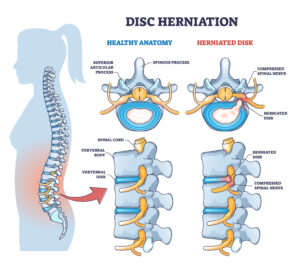 |
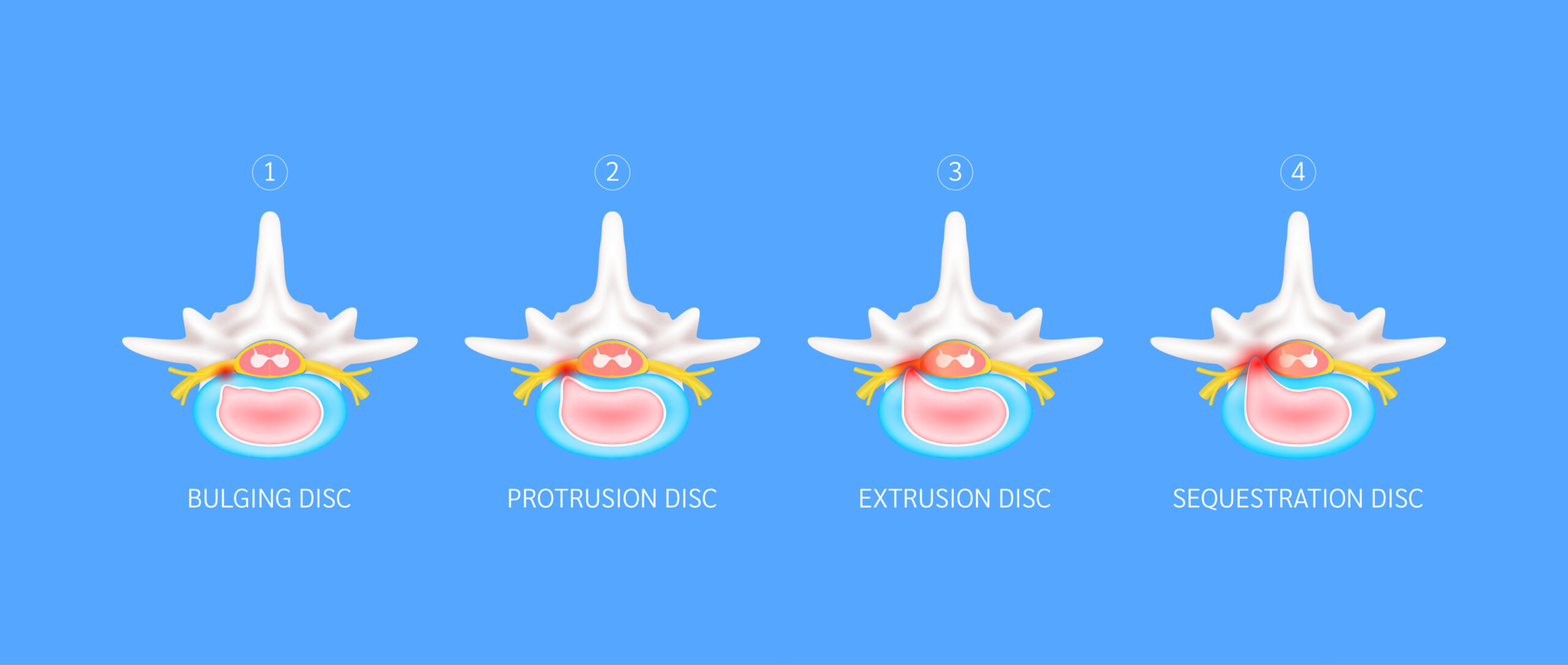
A disc herniation occurs when the outer layer (annulus fibrosus) develops a tear, allowing the inner gel (nucleus pulposus) to protrude.
This escaped material can press against nearby spinal nerves, often leading to pain, numbness, tingling, or muscle weakness. Review the image for a better understand the relevance of disc bulge or a disc herniation. |
Disc Bulge vs Disc Herniation
Patients frequently hear both terms and wonder about the difference. A disc bulge is when the disc extends outward uniformly but the outer layer remains intact—similar to a slightly flattened tire. In contrast, a herniated disc involves a rupture, where inner material leaks out through a tear.
Which is Worse?
While a herniation generally has a higher chance of irritating nerves, size doesn’t always dictate severity. Some large bulges cause no symptoms, while a small herniation in a sensitive area can trigger significant pain. The impact depends on factors like nerve involvement, location, and individual anatomy.
What Causes a Disc to Herniate?
Common causes include:
- Natural aging and disc degeneration
- Repetitive bending or lifting
- Sudden trauma or injury
- Poor posture and prolonged sitting
- Genetic predisposition to weaker connective tissue
Common Symptoms of a Herniated Disc
Not all herniated discs cause symptoms, but when they do, patients may experience:
- Localized neck or back pain
- Sciatica — sharp, shooting pain down the leg
- Arm pain, especially with cervical disc herniation
- Numbness, tingling, or burning sensations
- Muscle weakness in the arms or legs
- Pain worsening with coughing, sneezing, or sitting
Where Do Herniated Discs Commonly Occur?
Herniated discs most often occur in the lumbar spine (lower back) and cervical spine (neck), where flexibility and load-bearing demands are greatest. Herniations in the thoracic spine (mid-back) are less common due to the stabilizing effect of the rib cage.
Are All Disc Herniations Serious?
Many disc herniations are found incidentally during imaging and cause no symptoms at all. Even when symptoms occur, most cases improve with conservative, non-surgical treatments. Severe complications are rare, especially when addressed early by a specialist.
For a deeper understanding of spinal structure, visit our full guide on Spine Anatomy or learn about Degenerative Disc Disease, another common disc-related condition.
How is a Herniated Disc Diagnosed?
One of the biggest misconceptions about herniated discs is that if it shows up on an MRI, it must be causing your pain. In reality, studies show that many adults—especially over age 30—have disc bulges or herniations without experiencing any symptoms at all.
We understand how overwhelming it can be to hear terms like “herniated disc” or see concerning MRI reports. Our goal is to guide you with clear answers—not fear—so you can make confident decisions about your care.
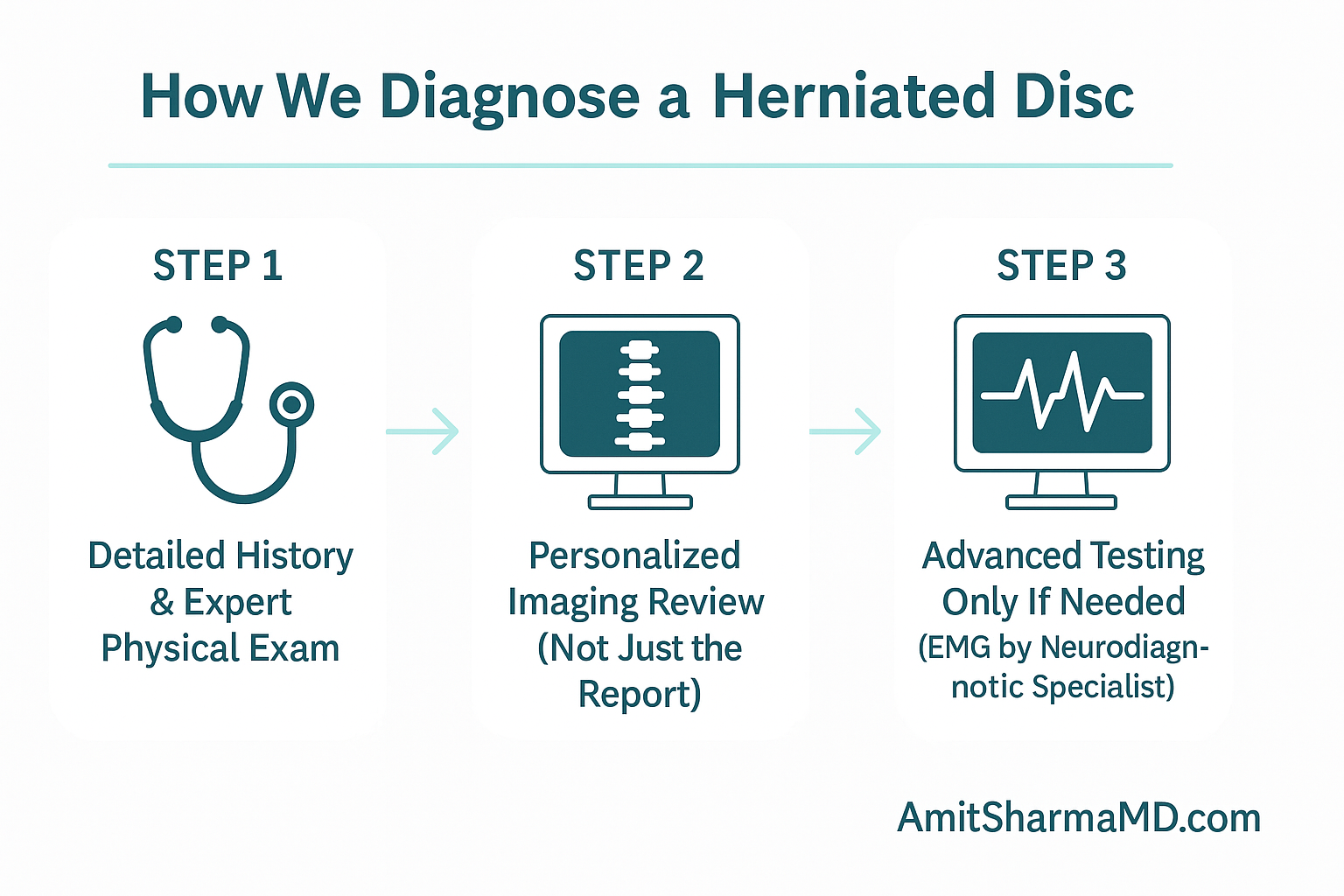
At SpinePain Solutions, we believe that seeing a disc herniation on a scan is only meaningful if it explains your specific symptoms. That’s why we don’t just rely on radiology reports—we personally review your imaging, combine it with a detailed medical history, and perform a thorough examination to determine if a herniation is truly clinically relevant.
Why MRI Findings Alone Aren’t Enough
Research in the New England Journal of Medicine shows that more than 50% of adults without back pain have disc abnormalities on MRI. A scan is a tool—not a diagnosis. Proper care starts with understanding your story and matching it to what we see on imaging.
Clinical Scenario 1: Sciatica and Lumbar Disc Herniation
A patient presents with right-sided lower back pain radiating down the leg into the foot. A detailed history reveals pain following the L5 nerve root distribution. On exam:
- Positive Straight Leg Raise Test (SLRT)
- Numbness along the L5 dermatome
- Weakness in right Extensor Hallucis Longus (EHL)
- Reflex changes
When we review the MRI and see a right L4-5 paracentral disc herniation, this confirms a relevant finding. A left-sided herniation, however, would likely be incidental.
Unsure If Your MRI Tells the Full Story?
Many patients are told they have a disc herniation—but is it truly causing your pain? At SpinePain Solutions, we offer expert evaluations and trusted second opinions to bring clarity to your diagnosis.
Clinical Scenario 2: Neck Pain with Arm Symptoms
A patient reports neck pain radiating into the right arm, with tingling in the thumb and index finger. Examination shows:
- Reduced biceps reflex
- Sensory loss in C6 dermatome
- Weakness in elbow flexion
- Positive Spurling’s test
Our MRI review reveals a right C5-C6 disc herniation compressing the C6 nerve—making this herniation clinically significant.
Clinical Scenario 3: Incidental Thoracic Disc Herniation
A patient undergoes imaging after minor trauma and is found to have a small thoracic disc herniation at T7-T8—but no nerve symptoms. In this case, the herniation is an incidental finding requiring no intervention.
Advanced Diagnostics—When Necessary
In select complex cases, we may recommend advanced tests like EMG (Electromyography) to assess nerve function. However, we recognize that EMG has limitations and is not routinely required for most patients.
When an EMG is truly warranted, we don’t refer to just any provider. We work exclusively with a neurologist who holds specialty certification in neurodiagnostics—a physician board-certified in neurology with advanced training in electrodiagnostic medicine, including techniques like EMG, EEG, and related imaging modalities.
This focused expertise ensures that electrodiagnostic findings are interpreted with precision and integrated effectively into your overall care plan—avoiding misdiagnosis and unnecessary interventions.
Offering Trusted Second Opinions
Even if you don’t choose us as your long-term provider—whether due to distance, insurance, or personal preference—we are happy to offer comprehensive second opinions. Our goal is to provide clarity about your diagnosis and treatment options. Sometimes, a fresh set of expert eyes can make all the difference in avoiding unnecessary procedures or identifying better solutions.
For patients across Long Island seeking accurate diagnosis of back or neck pain, SpinePain Solutions is committed to providing precision care and personalized treatment strategies.
Learn more about our patient-first approach by visiting our services page or contact us directly for a consultation.
Herniated Disc Treatment Options
A diagnosis of a herniated disc does not mean surgery is inevitable. In fact, the majority of disc herniations can be managed successfully with advanced non-surgical and minimally invasive treatments—when evaluated by a specialist who understands when surgery is truly necessary.
At SpinePain Solutions, we offer a comprehensive, evidence-based approach designed to relieve pain, restore function, and help you avoid unnecessary procedures.
Conservative Treatments: The First Step
For many patients, initial treatment focuses on relieving symptoms and supporting natural healing through:
- Activity Modification: Balancing rest with safe movement.
- Physical Therapy: Customized programs to improve spinal stability and reduce nerve irritation.
- Medications: Short-term use of anti-inflammatories or muscle relaxants.
- Chiropractic Care: We maintain strong collaborative relationships with trusted chiropractors across Long Island to ensure coordinated, patient-centered care when appropriate.
Precision Interventional Spine Care
When conservative care isn’t enough, we utilize advanced interventional techniques to directly target the source of pain:
- Transforaminal Epidural Steroid Injections (TF ESI): Delivering medication precisely into the ventral epidural space, where herniated discs typically compress nerves—offering superior relief compared to traditional approaches.
- Selective Nerve Root Blocks: Both diagnostic and therapeutic for radicular pain.
- Versa-Kath Directed Epidural Injections: Exclusively performed by Dr. Sharma on Long Island, this technique allows safe, effective treatment even at challenging cervical levels like C2-3 and C3-4, where few—if any—other specialists operate.
Advanced Step-Up Options for Chronic Radiculopathy
For patients with persistent nerve pain where surgery has failed or is not warranted, we offer:
- Pulsed Radiofrequency Ablation (PRF) of the Dorsal Root Ganglion (DRG): A non-destructive technique to modulate chronic nerve pain.
- DRG Stimulation: Neuromodulation therapy for refractory radicular pain syndromes.
Regenerative Medicine: Emerging Therapies
We are exploring innovative biologic treatments such as Platelet-Rich Plasma (PRP), Stem Cells and other regenerative options, particularly for discogenic pain. These therapies aim to support the body’s natural healing processes.
Disclaimer: Regenerative medicine treatments are considered investigational and are not FDA-approved for treating herniated discs. Individual results may vary and these options should be discussed thoroughly.
Learn more through our regenerative medicine division, Bloom Infusions & Wellness.
Minimally Invasive Spine Procedures
When intervention is needed beyond injections, we specialize in procedures designed to minimize tissue trauma:
- Transforaminal Full Endoscopic Discectomy: A state-of-the-art outpatient procedure using a tiny incision and camera-guided precision to remove herniated disc material—preserving healthy structures and promoting rapid recovery.
Ensuring Surgery is Truly Necessary
Spine surgeons play a vital role in managing complex spinal conditions, and surgery can be life-changing when appropriately indicated. However, we recognize that patients are sometimes recommended for surgery based primarily on MRI findings—without thorough correlation to clinical symptoms and examination.
Studies have shown that the United States performs significantly more spine surgeries compared to other developed nations. For instance, a comparative study found that the rate of back surgery in the U.S. was at least 40% higher than in any other country and more than five times that in England and Scotland. [PubMed Study]
Additionally, research comparing spine surgery utilization between New York and Ontario revealed that elective spine surgery rates were approximately 300% higher in New York. [PMC Article]
Occasionally, patients come to us after hearing alarming statements such as:
- “This is the worst herniation I’ve ever seen.”
- “You could be paralyzed without immediate surgery.”
- “We don’t know how you’re not already in a wheelchair.”
In many cases, these concerns are based on imaging that reveals disc herniations which may not be clinically relevant—that is, they don’t match the patient’s actual symptoms or neurological findings.
Our role at SpinePain Solutions is to provide a thoughtful, comprehensive evaluation to determine whether non-surgical or minimally invasive options can effectively address your condition before considering operative intervention.
Even neurosurgical literature agrees: true indications for spine surgery in disc herniation cases are limited to:
- Severe or progressive neurological deficits
- Intractable pain unresponsive to conservative care
- Emergencies such as cauda equina syndrome
That’s why we offer urgent appointments daily—often within 24-72 hours—to provide second opinions and prevent unnecessary surgeries.
If we can help even one patient avoid an unwarranted operation, our mission is fulfilled. Our team is committed to going beyond the norm to advocate for your best outcome.
When Surgery Is Truly Needed
In rare cases where surgery is appropriate, we collaborate with select spine surgeons who share our patient-first philosophy, ensuring you receive balanced, evidence-based recommendations.
Why Choose SpinePain Solutions?
- Leader in advanced interventional spine techniques
- Exclusive provider of Versa-Kath procedures on Long Island
- Minimally invasive endoscopic discectomy expertise
- Access to emerging regenerative therapies via Bloom Infusions & Wellness
- Rapid second opinions to prevent unnecessary surgeries
- Personalized, ethical care focused on long-term outcomes
Get Clarity Before Considering Surgery
If you’ve been told you need spine surgery—or you’re unsure about your treatment options—schedule a consultation with SpinePain Solutions. Our team will provide a comprehensive evaluation and explore all non-surgical and minimally invasive solutions first.
When to See a Spine Specialist
While mild back or neck pain often improves with time, certain symptoms should prompt evaluation by a spine specialist—especially to prevent long-term issues or unnecessary interventions. You should seek professional care if you experience:
- Pain lasting more than 2–3 weeks despite rest and conservative measures
- Numbness, tingling, or weakness in your arms or legs
- Difficulty performing daily activities, work tasks, or sleep disturbances due to pain
- Loss of bowel or bladder control — seek immediate medical attention
At SpinePain Solutions, we provide expert evaluations and personalized treatment plans across our convenient locations in Commack, Bay Shore, Bethpage, and Huntington, NY—serving patients throughout Long Island.
Conclusion: Relief Without Unnecessary Surgery
A herniated disc doesn’t mean your life has to stop—or that surgery is your only option. With an accurate diagnosis, advanced interventional treatments, and emerging regenerative therapies, most patients can achieve lasting relief without invasive procedures.
If you’re experiencing back pain, neck pain, or sciatica symptoms, don’t delay care. Early evaluation can prevent worsening issues and help you return to full activity safely.
Take the First Step Toward Relief
Schedule Appointment
Same-day and urgent appointments are available to ensure you get the care—and clarity—you deserve.
Frequently Asked Questions About Herniated Discs
What is the fastest way to heal a herniated disc?
While there’s no instant cure, combining activity modification, physical therapy, and targeted interventional treatments can speed up recovery. Early evaluation by a spine specialist ensures you’re on the right path.
Do all herniated discs require surgery?
No, most herniated discs improve without surgery. Non-surgical options like physical therapy, epidural injections, and minimally invasive procedures are effective for the majority of patients.
Can a herniated disc heal on its own?
Yes, many herniated discs naturally improve over weeks to months as inflammation decreases. However, persistent or worsening symptoms should be evaluated by a specialist.
How do I know if my herniated disc is serious?
If you experience severe pain, numbness, weakness, or loss of bowel/bladder control, seek immediate medical attention. These could indicate significant nerve compression.
What activities should I avoid with a herniated disc?
Avoid heavy lifting, repetitive bending, twisting motions, and prolonged sitting. Staying gently active with guided exercises is often better than complete rest.
Is walking good for a herniated disc?
Yes, light walking can help maintain mobility and reduce stiffness. It’s a low-impact activity that supports spinal health when done in moderation.
What is the best treatment for a herniated disc without surgery?
A personalized combination of physical therapy, transforaminal epidural injections, and, in some cases, regenerative medicine offers excellent non-surgical outcomes.
When should I see a doctor for a herniated disc?
If pain persists beyond 2-3 weeks, or if you experience numbness, weakness, or radiating pain, it’s time to consult a spine specialist for proper diagnosis and treatment options.