
Lamina of the Spine: Anatomy, Pain & Laminectomy
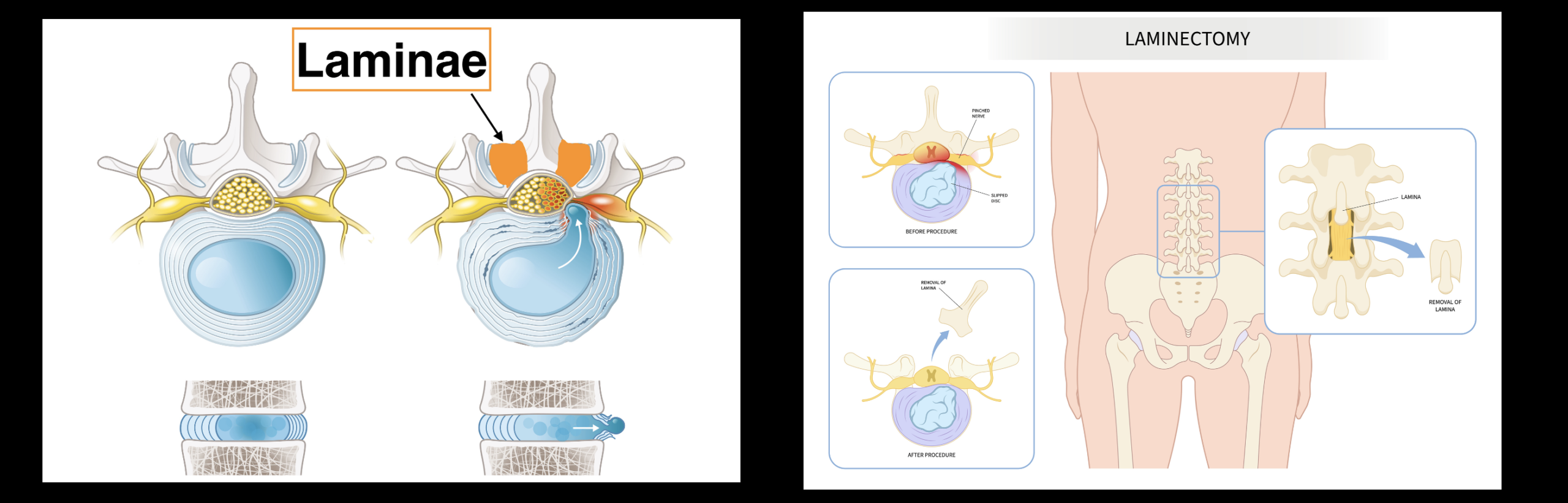
The lamina of the spine is a thin but important bony plate forming the back portion of each typical vertebral arch. Together with the pedicles and other vertebral structures, the lamina helps surround and protect the spinal canal.
Patients often encounter this term in an MRI report or during discussions about spinal stenosis, a laminectomy, or previous back surgery.
However, an abnormality involving the lamina does not automatically explain back pain. The more important question is whether the finding affects spinal stability, irritates surrounding tissues, or contributes to pressure on the spinal cord or nerve roots.
Quick answer: The lamina is part of the protective bony arch behind the spinal canal. It provides structural support and attachment sites for ligaments and muscles. In selected patients with spinal stenosis, removing a portion of the lamina can create more room for compressed nerves. This procedure is called a laminotomy or laminectomy, depending on how much bone is removed.
Where Is the Lamina Located in the Spine?
Each typical vertebra has two laminae, one on the left and one on the right. These flattened plates extend from the posterior portions of the vertebral arch and meet toward the midline, where they contribute to the base of the spinous process.
The laminae form much of the posterior boundary of the spinal canal. In the neck and upper back, the spinal canal contains the spinal cord. In the lower lumbar region, below the end of the spinal cord, it contains the cauda equina and associated nerve roots.
To understand the anatomy, it helps to distinguish four structures:
- Vertebral body: The large anterior, weight-bearing portion of the vertebra.
- Pedicles: Short, strong bony bridges connecting the vertebral body with the posterior arch.
- Laminae: Paired plates forming the posterior portion of the arch.
- Spinous process: The projection extending backward from the midline.
The lamina also lies near the facet joints and pars interarticularis. These are related but distinct structures.
For additional anatomical context, see our vertebral pedicle guide and spinous process anatomy and pain resource.
What Does the Lamina Actually Do?
The lamina serves three important functions.
Protects Neural Structures
The paired laminae form a protective bony roof behind the spinal canal. This provides structural protection for the spinal cord, cauda equina, and nerve roots.
Contributes to Spinal Stability
The lamina is part of the posterior vertebral arch. Together with the facet joints, ligaments, muscles, and other structures, it contributes to normal spinal mechanics.
Its removal does not necessarily make the spine unstable, but the amount of supporting tissue removed during surgery matters.
Provides Attachment for Ligaments and Muscles
The ligamentum flavum attaches between adjacent laminae. Other posterior ligaments and muscles attach to the lamina or neighboring vertebral structures, contributing to movement control and stability.
Lamina vs. Ligamentum Flavum: Why the Difference Matters
These two structures are frequently mentioned together in lumbar MRI reports, but they are not interchangeable.
The lamina is bone. The ligamentum flavum is a ligament.
The ligamentum flavum connects the laminae of adjacent vertebrae and helps support normal spinal movement. With degeneration, this ligament may thicken or buckle inward, reducing the available space within the spinal canal.
This is one of several mechanisms contributing to lumbar spinal stenosis.
Other important causes of narrowing include:
- Facet joint enlargement and osteophytes
- Disc bulging or herniation
- Degenerative spondylolisthesis
- Congenitally narrow spinal anatomy
- Thickening or inward buckling of the ligamentum flavum
The clinical distinction matters because a patient with primarily ligament-related central stenosis may be a candidate for a different decompression technique than someone with extensive bony narrowing or severe foraminal stenosis.
Can the Lamina Cause Back Pain?
Yes, but not every abnormality near the lamina causes pain.
A fracture, infection, tumor, or other pathological process involving the lamina may cause localized pain. More commonly, pain felt in the posterior spine arises from adjacent muscles, facet joints, discs, ligaments, or nerve structures.
Several diagnoses deserve consideration.
Lamina Fracture
A lamina fracture may occur after trauma, sometimes as part of a more complex spinal injury. Its significance depends on the complete fracture pattern, spinal alignment, ligament integrity, and neurological examination.
Unlike an uncomplicated isolated transverse process fracture, a lamina fracture cannot automatically be assumed to be stable.
Facet Joint Arthritis
Facet joints are adjacent posterior structures that can develop degenerative changes and become a source of axial back pain.
Facet-mediated pain often overlaps with muscular pain and cannot be confirmed by the location of tenderness or MRI findings alone.
Read more about facet joint syndrome.
Spondylolysis and Pars Defects
Spondylolysis involves a defect in the pars interarticularis, a portion of the posterior vertebral arch between the superior and inferior articular processes.
It is not simply a fracture of the lamina, although the structures are anatomically close.
Pars defects can occur in athletes exposed to repeated spinal extension and rotation. Some are asymptomatic, while others cause mechanical back pain or contribute to spondylolisthesis.
Infection or Tumor
Less commonly, infection or tumors can involve posterior vertebral elements, including the lamina. Persistent unexplained pain, fever, cancer history, or neurological deterioration may require further investigation.
What Does Lamina Removal Mean in an MRI or Surgical Report?
An MRI may describe a laminectomy defect, particularly in a patient who has undergone previous spinal decompression.
This means that part of the posterior bony arch has been surgically removed. It is an anatomical description, not necessarily evidence of a complication.
Other terms include:
- Prior laminotomy: A smaller surgically created opening through the lamina.
- Hemilaminectomy: Removal of the lamina on one side of the vertebral arch.
- Bilateral laminectomy: Removal of posterior laminar structures on both sides at the treated level.
- Postoperative scar tissue: Tissue changes that may be visible near a previous surgical site.
- Residual or recurrent stenosis: Continued or newly developed narrowing despite previous decompression.
The important question is not merely whether the lamina has been removed, but whether adequate space remains for the neural structures and whether the spine is mechanically stable.
Patients with ongoing symptoms after surgery may find our post-laminectomy syndrome resource helpful.
Dr. Amit Sharma & our minimally invasive pain & spine team.
How Are Lamina Abnormalities Diagnosed?
The appropriate imaging study depends on the suspected problem. Imaging should answer a clinical question rather than simply identify age-related abnormalities.
X-Rays
Radiographs help evaluate alignment, deformity, and some fractures. Selected standing or flexion-extension views may be useful when instability is suspected, although they are not required for every patient.
CT Scan
CT provides detailed visualization of cortical bone, including lamina fractures, pars defects, postoperative bony anatomy, and osteophytes.
MRI
MRI is especially useful for assessing spinal stenosis, nerve-root compression, the spinal cord, ligamentum flavum, discs, infection, tumors, and postoperative soft tissues.
For patients with leg pain, weakness, or neurogenic claudication, MRI frequently provides the most useful information about neural compression.
Laminotomy vs. Laminectomy vs. Laminoplasty
These procedures modify the posterior vertebral arch, but they have different objectives and preserve different amounts of anatomy.
| Procedure | What It Does | Typical Purpose |
|---|---|---|
| Laminotomy | Removes a limited portion of the lamina | Targeted access or nerve decompression |
| Laminectomy | Removes a larger portion or the entire lamina at a level | Creates more room for compressed neural structures |
| Laminoplasty | Repositions and reconstructs the lamina to enlarge the canal | Often used for selected multilevel cervical spinal cord compression |
A laminotomy may preserve more posterior bone and ligamentous attachments, but the appropriate operation depends on the location, severity, and mechanism of compression.
A smaller operation is not automatically better if it fails to decompress the affected nerves adequately.
When Is Laminectomy Necessary for Spinal Stenosis?
Laminectomy may be considered when significant spinal canal narrowing produces symptoms that remain disabling despite appropriate nonsurgical care, or when neurological deterioration warrants more urgent decompression.
Common symptoms of lumbar stenosis include:
- Leg pain or heaviness with walking
- Numbness or tingling in one or both legs
- Reduced walking or standing tolerance
- Relief when sitting or leaning forward
- Weakness or neurological deficits in more advanced cases
This walking-related pattern is called neurogenic claudication.
The decision to decompress depends on symptoms, functional limitations, neurological findings, imaging, overall health, and patient preferences.
A radiology report showing severe stenosis does not automatically require surgery in a patient without corresponding symptoms. Conversely, progressive neurological loss may require urgent assessment even when conservative treatment has not been exhausted.
Can Spinal Stenosis Be Treated Without Removing the Entire Lamina?
Yes. Many patients do not require a traditional open laminectomy, and some do not need surgery at all.
The appropriate treatment depends on what is actually narrowing the canal and which symptoms it produces.
Physical Therapy and Medical Management
Selected patients benefit from activity modification, rehabilitation, conditioning, and appropriate medications. Treatment goals include improving mobility, strength, function, and symptom tolerance.
Epidural Steroid Injections
Epidural injections may offer temporary symptom relief in selected patients with nerve-related pain or inflammatory irritation.
They do not remove enlarged bone, reverse advanced spinal stenosis, or permanently widen the spinal canal. Benefits for neurogenic claudication from central stenosis may be limited.
Percutaneous Lumbar Decompression
When hypertrophic ligamentum flavum is an important cause of lumbar central canal stenosis, carefully selected patients may be considered for percutaneous lumbar decompression (MILD).
This technique removes a small amount of lamina to access and reduce thickened ligamentum flavum. It is not equivalent to a full laminectomy and does not address every type of stenosis.
Endoscopic or Microscopic Decompression
Selected patients may undergo targeted decompression through a smaller approach, sometimes using unilateral laminotomy to decompress both sides of the canal.
Depending on the technique, the surgeon may remove portions of lamina, ligamentum flavum, or medial facet bone to create adequate space for the nerves.
Our minimally invasive lumbar decompression guide explains these approaches in greater detail.
Does Laminectomy Always Require Spinal Fusion?
No. Decompression and fusion are different procedures.
Decompression creates more room for compressed nerves. Fusion aims to stabilize motion between vertebrae.
Fusion may be considered when significant instability, deformity, certain types of spondylolisthesis, or the planned extent of bone removal makes stabilization necessary.
However, decompression alone is appropriate for many patients.
In the randomized NORDSTEN-DS trial, decompression alone was noninferior to decompression with instrumented fusion at two years for the primary disability outcome in the studied population with degenerative lumbar spondylolisthesis. Reoperations occurred somewhat more frequently after decompression alone.
These findings do not mean fusion is never necessary. They emphasize that fusion should be selected for a specific mechanical indication rather than automatically added whenever the lamina is removed.
What About Radiofrequency Ablation and Other Pain Procedures?
Radiofrequency ablation does not treat the lamina itself. Lumbar medial branch radiofrequency ablation targets sensory nerves supplying the facet joints when facet-mediated pain has been appropriately established.
Similarly, an epidural injection targets a nerve-related inflammatory pain mechanism rather than the lamina.
This distinction is important when a patient has both axial back pain and leg symptoms. More than one pain generator may be present, and treating one mechanism does not necessarily resolve the other.
Procedural selection should follow the diagnosis, not merely an abnormal MRI term.
Dr. Amit Sharma & our minimally invasive pain & spine team.
When Should Lamina-Related Symptoms Be Evaluated Urgently?
Seek emergency evaluation for new urinary retention, loss of bladder or bowel control, saddle numbness, or rapidly progressive leg weakness. These may indicate serious compression of neural structures.
Significant trauma, especially with neck or back pain and neurological symptoms, also requires prompt assessment.
Fever with severe spinal pain, a history of spinal infection, or concerning symptoms in an immunocompromised patient should prompt urgent evaluation for infection.
Frequently Asked Questions
What is the lamina in the spine?
The lamina is a flat bony plate forming part of the posterior vertebral arch. Each typical vertebra has two laminae, which meet toward the spinous process and help form the protective posterior wall of the spinal canal.
Can the spinal lamina cause back pain?
A lamina fracture or other abnormality can cause pain, but many symptoms attributed to the lamina arise from nearby muscles, facet joints, ligaments, discs, or compressed nerves. Imaging findings must be interpreted alongside symptoms and examination.
What is the difference between lamina and ligamentum flavum?
The lamina is bone. The ligamentum flavum is an elastic ligament connecting adjacent laminae. Thickening or inward buckling of this ligament can contribute to narrowing of the spinal canal.
What is the difference between laminotomy and laminectomy?
Laminotomy removes or creates an opening through a limited portion of the lamina, whereas laminectomy removes a larger portion or the entire lamina at the treated level to decompress neural structures. The extent depends on the anatomy and surgical objective.
Does removing the lamina cause spinal instability?
Not necessarily. Stability depends on the amount of bone and supporting tissue removed, facet preservation, preexisting instability, and other factors. Many decompressions are performed without fusion.
Can spinal stenosis be treated without a full laminectomy?
Yes, in selected patients. Options may include rehabilitation, medications, epidural injections for appropriate symptoms, percutaneous lumbar decompression when thickened ligamentum flavum is a major cause, or targeted endoscopic or microscopic decompression. Treatment depends on the actual source and severity of narrowing.
When is urgent evaluation necessary?
New urinary retention, loss of bowel or bladder control, saddle numbness, rapidly progressive weakness, significant trauma, or symptoms concerning for spinal infection require urgent evaluation.
References and Further Reading
- North American Spine Society. Diagnosis and Treatment of Degenerative Lumbar Spinal Stenosis. Clinical guideline summary.
- Austevoll IM, Hermansen E, Fagerland MW, et al. Decompression with or without Fusion in Degenerative Lumbar Spondylolisthesis. N Engl J Med. 2021;385:526-538. PubMed.
- North American Spine Society. Evidence-Based Clinical Guidelines.
- SpinePain Solutions. Lumbar Spinal Stenosis: Pathology-Driven Treatment Selection.
- SpinePain Solutions. Minimally Invasive Lumbar Decompression.