
Intracept Procedure
“My MRI shows Modic changes. Does that mean I am a candidate for the Intracept procedure, and how long will recovery take?”
These are the two most important practical questions about Intracept. Qualifying MRI findings are necessary, but imaging alone does not establish the diagnosis. The symptoms, examination, treatment history and competing causes of low back pain must also fit.
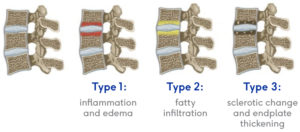
The Intracept procedure is an FDA-cleared, minimally invasive outpatient treatment that uses radiofrequency energy to ablate the basivertebral nerve inside selected lumbar vertebral bodies. It is intended for carefully selected patients with chronic vertebrogenic low back pain associated with Modic Type 1 or Type 2 endplate changes.
Intracept is one specific system used to perform basivertebral nerve ablation. For the broader diagnosis, evidence and comparison with other BVN-ablation systems, visit the parent guide to basivertebral nerve ablation.
The Quick Answer
- Intracept targets the basivertebral nerve inside the vertebral body.
- It treats vertebrogenic endplate pain, not every type of lower-back pain.
- Typical candidacy includes chronic axial low back pain, failed conservative care and Modic Type 1 or Type 2 changes from L3 through S1.
- Modic changes must correspond to the clinical pain pattern; they are not sufficient by themselves.
- The procedure is implant-free and usually performed on an outpatient basis.
- Many patients resume ordinary daily activities within one to two weeks.
- Pain improvement may begin within several weeks and may continue developing over two to three months.
- Intracept does not decompress a pinched nerve or treat classic sciatica.
What Is the Intracept Procedure?
Vertebral endplates form the boundary between each spinal disc and the adjacent vertebral body. When an endplate becomes damaged, inflammatory and degenerative changes can develop in the nearby bone marrow. Pain signals from these injured endplates may travel through the basivertebral nerve located inside the vertebral body.
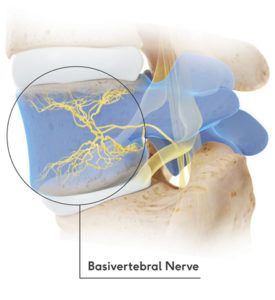
The Intracept system allows the physician to reach the trunk of the basivertebral nerve through a small channel created within the vertebral body. A specialized probe then delivers controlled radiofrequency energy to interrupt pain transmission through that nerve.
The procedure does not remove a disc, fuse the spine, place a permanent implant or repair the endplate. It treats a specific sensory pathway associated with vertebrogenic pain.
Is Intracept the Same as Basivertebral Nerve Ablation?
Basivertebral nerve ablation is the general procedure category. Intracept is a branded, purpose-built system used to perform that procedure. The distinction is similar to the difference between a treatment category and one device platform used to deliver it.
Who Is a Candidate for the Intracept Procedure?
A potential Intracept procedure candidate generally has a combination of clinical symptoms, treatment history and MRI findings rather than one isolated abnormality.
Features That Support Candidacy
- Skeletally mature patient
- Predominantly axial lower-back pain rather than dominant radiating leg pain
- Symptoms lasting at least six months
- Inadequate improvement after an appropriate course of conservative treatment
- Deep central low back pain that may worsen with sitting, bending, lifting or transitioning from sitting to standing
- Modic Type 1 or Type 2 changes involving one or more vertebral endplates from L3 through S1
- Symptoms and MRI abnormalities that correspond anatomically
- No more convincing untreated fracture, infection, tumor, instability, nerve-root compression, facet-joint pain or sacroiliac-joint pain explanation
Are Modic Changes Enough to Qualify?
No. Modic Type 1 and Type 2 changes are important imaging biomarkers, but they do not prove that the vertebral endplates are the dominant source of pain. Modic changes can coexist with facet arthritis, spinal stenosis, sacroiliac-joint pain, discogenic pain and other abnormalities.
| More Consistent With Vertebrogenic Pain | Suggests Another or Additional Pain Generator |
|---|---|
| Deep, central axial low back pain | Dominant electric or shooting pain below the knee |
| Pain aggravated by sitting, bending or lifting | Progressive weakness, dermatomal numbness or neurological loss |
| Modic Type 1 or Type 2 changes matching the painful region | Neurogenic claudication caused by significant spinal stenosis |
| Persistent pain despite appropriate nonsurgical treatment | Predominantly extension-rotation pain with strongly positive medial branch blocks |
| No alternative diagnosis better explains the dominant symptoms | Active infection, fracture, tumor or substantial instability |
When Intracept May Not Be the Right Treatment
Intracept is designed for vertebrogenic pain. It is not a general treatment for every abnormal lumbar MRI or every patient with chronic low back pain.
The procedure is unlikely to address symptoms caused primarily by:
- Facet-joint pain
- Sacroiliac-joint pain
- Classic radiculopathy or sciatica from nerve-root compression
- Neurogenic claudication from lumbar spinal stenosis
- Symptomatic instability or high-grade spondylolisthesis
- Acute or unhealed compression fracture
- Active infection, tumor or another destructive vertebral process
- Predominantly myofascial pain
- Hip disease or another nonspinal condition
Some patients have more than one pain generator. In those cases, treatment should be prioritized according to the dominant symptoms rather than assuming that one procedure must address every pain complaint.
How Is the Intracept Procedure Performed?
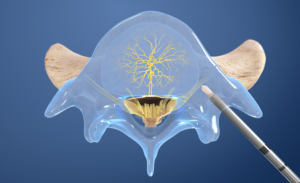
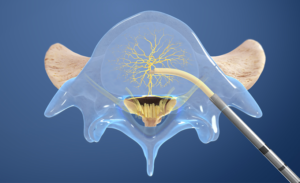
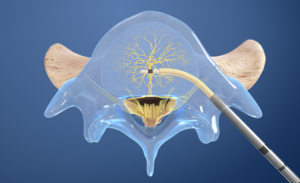
The Intracept procedure is performed using fluoroscopic guidance. Through a small incision, the physician advances purpose-built instruments through the pedicle and into the vertebral body. A curved channel is created toward the basivertebral nerve trunk, and an RF probe is positioned at the planned treatment location.
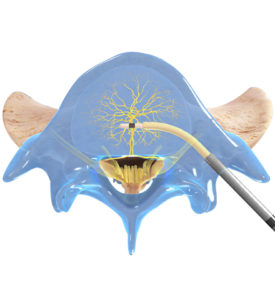
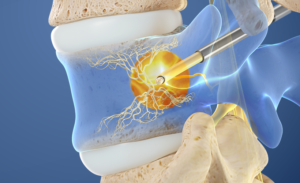
Controlled radiofrequency energy is delivered through the probe to ablate the basivertebral nerve. The instruments are then removed and the small incision is closed or covered. No permanent device remains inside the spine.
The Four Procedure Steps
- Access the pedicle: The introducer cannula is advanced through the pedicle under fluoroscopic guidance.
- Create the channel: A curved cannula creates a controlled path toward the basivertebral nerve trunk.
- Position the RF probe: The radiofrequency probe is advanced through the channel to the planned treatment location.
- Ablate the basivertebral nerve: Controlled radiofrequency energy is delivered to interrupt pain transmission through the BVN.
Anesthesia, Procedure Time and Discharge
Anesthesia is individualized according to the facility, number of levels, medical history and procedural requirements. Deep sedation or general anesthesia may be used. The procedure commonly takes approximately 60 to 90 minutes, although anatomy and the number of vertebral bodies treated can change the duration.
The complete visit is longer because it includes preparation, anesthesia, positioning and postoperative monitoring. Most patients return home the same day and require a responsible adult to drive them.
Preparing for the Intracept Procedure
The treating team should review anticoagulants, antiplatelet medication, diabetes, infection symptoms, allergies, implanted electronic devices, pregnancy status and the anesthesia plan before the procedure.
Do not stop aspirin, warfarin or another blood thinner independently.
Any interruption must be coordinated with the prescribing clinician and procedural physician. The risk of bleeding must be balanced against the risk of stopping the medication.
Fasting and medication instructions depend on the planned anesthesia. Follow the facility’s individualized instructions rather than relying on a general online schedule. Review the practice guide to planning for a procedure.
Intracept Procedure Recovery Time
Recovery is usually shorter than recovery from open lumbar surgery, but Intracept still involves access through the pedicle and treatment inside the vertebral body. Patients should expect a genuine recovery period rather than assuming that an outpatient procedure produces no soreness.
| Time After Intracept | What Patients May Experience | General Interpretation |
|---|---|---|
| Procedure day | Monitoring after anesthesia, incision soreness and deeper aching near treated levels | A driver is required; follow discharge and medication instructions |
| First several days | Local tenderness, bruised sensation, muscle soreness or temporary increase in familiar back pain | Early procedural soreness does not determine the final outcome |
| One to two weeks | Many patients resume ordinary daily activities as soreness improves | Work and lifting restrictions depend on symptoms and job demands |
| Two to six weeks | Some patients begin noticing meaningful improvement in their familiar vertebrogenic pain | Assess both pain and function rather than pain score alone |
| Six to twelve weeks | Improvement may continue developing as activity and conditioning progress | A better interval for judging the overall response |
| Beyond three months | Persistent unchanged pain, a different pain pattern or neurological symptoms | Reassessment may be appropriate rather than assuming the BVN remains the only generator |
How Long Does Intracept Take to Work?
Some patients improve within several weeks. Others notice gradual change over six to twelve weeks or longer. Immediate local-anesthetic relief is not the therapeutic result, and a temporary postoperative flare does not necessarily indicate failure.
The most meaningful measures include:
- Improvement in the patient’s familiar central low back pain
- Longer sitting, standing or walking tolerance
- Easier bending, lifting or transitions
- Improved sleep and work capacity
- Greater ability to participate in rehabilitation and ordinary activity
When Should You Contact the Treating Team?
Contact the treating team promptly for severe or rapidly escalating pain, fever, chills, drainage, increasing redness or swelling, new weakness, spreading numbness, loss of balance, bowel or bladder dysfunction, saddle-region numbness or another symptom that differs substantially from the expected recovery instructions.
Potential Benefits and Clinical Evidence
For appropriately selected patients, potential advantages include:
- Targets a specific vertebrogenic pain pathway
- Minimally invasive and usually outpatient
- No permanent spinal implant
- Preserves spinal motion and does not fuse a segment
- Can produce meaningful improvement in pain and function
- Published prospective trials report durability in selected patients through five years
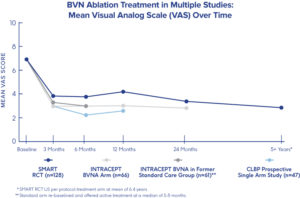
Randomized trials have compared basivertebral nerve ablation with sham treatment and nonsurgical standard care. Longer-term follow-up and pooled prospective data report sustained average improvements among selected study participants. These findings support effectiveness for the studied population, but they do not guarantee success for every patient or prove that every person with Modic changes should undergo the procedure.
Study selection matters.
The clinical trials used defined inclusion and exclusion criteria. Results should not be generalized to patients whose dominant pain comes from nerve compression, instability, fracture, infection, tumor or another untreated generator.
Intracept Procedure Risks and Limitations
Possible risks include:
- Temporary incision or procedural soreness
- Temporary increase in back pain
- Bleeding or hematoma
- Infection
- Allergic or medication reaction
- Transient numbness, tingling or weakness
- Injury to a nearby neural or vascular structure
- Pedicle or vertebral injury
- Incomplete, temporary or absent pain relief
- Anesthesia-related complications
- Need for treatment of another pain generator
The procedure may be contraindicated or require additional review in patients with active systemic or local infection, pregnancy, skeletal immaturity, severe medical compromise, unsafe proximity between the planned treatment zone and a sensitive structure, or certain implanted electronic devices. The current device labeling, anatomy, medical history and anesthesia assessment determine final eligibility.
Alternatives to the Intracept Procedure
The appropriate alternative depends on the actual pain generator. Options may include:
- Diagnosis-specific physical therapy and graded conditioning
- Medication appropriate to the suspected pain mechanism
- Facet medial branch blocks and facet radiofrequency ablation for confirmed facet-mediated pain
- Epidural treatment for selected radicular inflammation
- Sacroiliac-joint evaluation and treatment
- Minimally invasive decompression for qualifying spinal stenosis
- Endoscopic or conventional surgery when nerve compression, instability or another structural indication requires correction
- Continued observation when clinically safe and symptoms remain manageable
Intracept should not be selected merely because several other treatments failed. Prior treatment failure is useful only when the diagnosis and target are reassessed carefully.
A Patient’s Intracept Experience
Individual patient experiences do not predict another patient’s result. Candidacy, anatomy, competing pain generators, rehabilitation and medical history all influence outcome.
Frequently Asked Questions About the Intracept Procedure
What is the Intracept procedure?
The Intracept procedure is an FDA-cleared, minimally invasive outpatient treatment that uses radiofrequency energy to ablate the basivertebral nerve inside selected lumbar vertebral bodies. It is designed for carefully selected patients with chronic vertebrogenic low back pain associated with Modic Type 1 or Type 2 endplate changes.
Who is a candidate for the Intracept procedure?
A potential candidate is generally a skeletally mature patient with predominantly axial low back pain lasting at least six months, inadequate improvement after appropriate conservative treatment and MRI evidence of Modic Type 1 or Type 2 changes from L3 through S1 that correspond to the clinical pain pattern. Competing pain generators must also be considered.
Are Modic changes enough to qualify for Intracept?
No. Modic Type 1 or Type 2 changes support the diagnosis, but they do not prove that the vertebral endplates are the dominant pain generator. Symptoms, examination, treatment history, actual MRI images and competing diagnoses must be reviewed together.
How long does the Intracept procedure take?
The procedure commonly takes approximately 60 to 90 minutes, although treatment time varies with anatomy and the number of vertebral bodies treated. The complete facility visit is longer because it includes preparation, anesthesia, recovery and discharge.
What is the recovery time after the Intracept procedure?
Recovery varies, but many patients resume ordinary daily activities within one to two weeks. Return to work depends on post-procedure soreness, job demands, the number of levels treated and individualized restrictions.
How long does Intracept take to work?
Some patients notice improvement within several weeks, while others improve more gradually over six to twelve weeks or longer. Immediate post-procedure soreness should not be used to judge the final result.
Is Intracept the same as facet radiofrequency ablation?
No. Intracept treats the basivertebral nerve inside the vertebral body for vertebrogenic endplate pain. Facet radiofrequency ablation treats medial branch nerves outside the vertebral body for pain arising from facet joints.
Does Intracept treat sciatica or spinal stenosis?
Intracept does not decompress spinal nerves or enlarge a narrowed spinal canal. It is not a treatment for classic radicular sciatica, progressive weakness or neurogenic claudication caused by spinal stenosis.
Is the Intracept procedure FDA approved?
The Intracept system is FDA-cleared. FDA clearance is the accurate regulatory description; it should not be described as FDA-approved.
Does insurance cover the Intracept procedure?
Coverage varies by insurer and benefit plan. Authorization commonly requires documentation of chronic axial low back pain, failed conservative treatment, qualifying Modic Type 1 or Type 2 changes and exclusion of another dominant pain generator.
Related Intracept and Vertebrogenic Pain Resources
- Basivertebral Nerve Ablation: Parent Guide
- Vertebrogenic Pain
- Discogenic Pain
- Degenerative Disc Disease
- Diagnosing Back Pain
- Radiofrequency Ablation
- OptAblate Basivertebral Nerve Ablation
- Preparing for a Procedure
Dr. Amit Sharma & our minimally invasive pain & spine team.
References
- Sayed D, Naidu RK, Patel KV, et al. Best Practice Guidelines on the Diagnosis and Treatment of Vertebrogenic Pain With Basivertebral Nerve Ablation From the American Society of Pain and Neuroscience. Journal of Pain Research. 2022;15:2801-2819. Read source →
- Fischgrund JS, Rhyne A, Franke J, et al. Intraosseous Basivertebral Nerve Ablation for the Treatment of Chronic Low Back Pain: A Prospective Randomized Double-Blind Sham-Controlled Multi-Center Study. European Spine Journal. 2018;27(5):1146-1156. Read source →
- Khalil JG, Smuck M, Koreckij T, et al. A Prospective, Randomized, Multicenter Study of Intraosseous Basivertebral Nerve Ablation for the Treatment of Chronic Low Back Pain: 12-Month Results. The Spine Journal. 2019;19(10):1620-1632. Read source →
- Fischgrund JS, Rhyne A, Macadaeg K, et al. Long-Term Outcomes Following Intraosseous Basivertebral Nerve Ablation for the Treatment of Chronic Low Back Pain: Five-Year Treatment Arm Results From a Prospective Randomized Double-Blind Sham-Controlled Multi-Center Study. European Spine Journal. 2020;29(8):1925-1934. Read source →
- Khalil JG, Truumees E, Macadaeg K, et al. Intraosseous Basivertebral Nerve Ablation: A Five-Year Pooled Analysis From Three Prospective Clinical Trials. Interventional Pain Medicine. 2024;3(4):100529. Read source →
- Boston Scientific. The Intracept Procedure: Clinical and Product Information. Read source →
- Cleveland Clinic. Intracept Procedure: Preparation, Recovery and Risks. Read source →
- Hospital for Special Surgery. Basivertebral Nerve Ablation: Intracept Procedure. Read source →
About the Author
Amit Sharma, MD is an interventional spine and pain-management physician specializing in image-guided procedures, basivertebral nerve ablation, endoscopic spine procedures and minimally invasive treatment of chronic spinal pain.
Medical disclaimer: This page is educational and does not replace individualized medical evaluation, diagnosis or treatment. Intracept is not appropriate for every patient with chronic low back pain or Modic changes. Candidacy, preparation, anesthesia, risks, recovery instructions and insurance coverage vary according to anatomy, medical history, diagnosis, facility requirements and current coverage policies. Seek urgent medical attention for new weakness, bowel or bladder dysfunction, saddle-region numbness, fever with worsening spinal pain or rapidly progressive neurological changes.
Last medically reviewed: August 2026