
DRG Stimulation vs Spinal Cord Stimulation: Uses, Trial & Risks
{
“@context”:”https://schema.org”,
“@graph”:[
{
“@type”:”MedicalWebPage”,
“@id”:”https://amitsharmamd.com/services/drg-stimulation/#webpage”,
“url”:”https://amitsharmamd.com/services/drg-stimulation/”,
“name”:”DRG Stimulation vs SCS: Focused Pain, Candidacy, Trial and Risks”,
“description”:”An evidence-aware patient guide comparing dorsal root ganglion stimulation with spinal cord stimulation and explaining focused lower-extremity pain applications.”,
“lastReviewed”:”2026-09-12″,
“about”:[“Dorsal root ganglion stimulation”,”DRG stimulation versus spinal cord stimulation”,”Complex regional pain syndrome”,”Causalgia”,”Focused neuropathic pain”,”DRG stimulation for foot pain”,”DRG stimulation for knee pain”,”DRG stimulation for groin pain”],
“medicalSpecialty”:”PainManagement”,
“audience”:{“@type”:”MedicalAudience”,”audienceType”:”Patient”},
“mainEntity”:{“@id”:”https://amitsharmamd.com/services/drg-stimulation/#procedure”},
“author”:{“@type”:”Person”,”name”:”Amit Sharma, MD”,”url”:”https://amitsharmamd.com/amit-sharma-md/”},
“publisher”:{“@type”:”Organization”,”name”:”Amit Sharma MD”,”url”:”https://amitsharmamd.com/”},
“breadcrumb”:{“@id”:”https://amitsharmamd.com/services/drg-stimulation/#breadcrumb”}
},
{
“@type”:”MedicalProcedure”,
“@id”:”https://amitsharmamd.com/services/drg-stimulation/#procedure”,
“name”:”Dorsal Root Ganglion Stimulation”,
“alternateName”:”DRG Stimulation”,
“procedureType”:”Implantable neuromodulation procedure”,
“bodyLocation”:”Dorsal root ganglion near the spinal nerve root”,
“howPerformed”:”A temporary trial is performed using leads positioned under fluoroscopic guidance near selected dorsal root ganglia. Permanent implantation may be considered when the trial produces meaningful benefit.”
},
{
“@type”:”BreadcrumbList”,
“@id”:”https://amitsharmamd.com/services/drg-stimulation/#breadcrumb”,
“itemListElement”:[
{“@type”:”ListItem”,”position”:1,”name”:”Home”,”item”:”https://amitsharmamd.com/”},
{“@type”:”ListItem”,”position”:2,”name”:”Services”,”item”:”https://amitsharmamd.com/services/”},
{“@type”:”ListItem”,”position”:3,”name”:”DRG Stimulation”,”item”:”https://amitsharmamd.com/services/drg-stimulation/”}
]
},
{
“@type”:”FAQPage”,
“@id”:”https://amitsharmamd.com/services/drg-stimulation/#faq”,
“mainEntity”:[
{“@type”:”Question”,”name”:”Is DRG stimulation better than spinal cord stimulation?”,”acceptedAnswer”:{“@type”:”Answer”,”text”:”Neither is better for every patient. DRG stimulation may be favored when chronic neuropathic pain is concentrated in a small lower-extremity region, particularly with CRPS or causalgia. SCS is generally better established for broader back, leg, trunk or bilateral pain patterns. Diagnosis, pain distribution, anatomy, previous treatment and the temporary trial response should guide the choice.”}},
{“@type”:”Question”,”name”:”Can DRG stimulation treat focused foot, groin or knee pain?”,”acceptedAnswer”:{“@type”:”Answer”,”text”:”It may help selected focal neuropathic pain patterns, but location alone does not establish candidacy. The strongest established U.S. indication is chronic lower-extremity pain from CRPS I or CRPS II. Evidence for other postsurgical or focal foot, groin and knee pain is more limited and may involve off-label treatment.”}},
{“@type”:”Question”,”name”:”What is the established U.S. indication for DRG stimulation?”,”acceptedAnswer”:{“@type”:”Answer”,”text”:”The established U.S. indication is management of moderate-to-severe chronic intractable lower-limb pain in adults with complex regional pain syndrome types I or II. CRPS II is also called causalgia.”}},
{“@type”:”Question”,”name”:”Does the painful location determine which DRG level is treated?”,”acceptedAnswer”:{“@type”:”Answer”,”text”:”Pain location and dermatomal maps help plan possible targets, but they are not exact treatment maps. Diagnosis, examination, prior surgery, anatomy and trial coverage all influence which DRG levels are considered.”}},
{“@type”:”Question”,”name”:”What happens during a DRG stimulation trial?”,”acceptedAnswer”:{“@type”:”Answer”,”text”:”Temporary leads are positioned near selected dorsal root ganglia under X-ray guidance and connected to an external system. During the trial, the patient tracks pain, coverage of the targeted region and meaningful functional activities before permanent implantation is considered.”}},
{“@type”:”Question”,”name”:”Does a successful DRG trial guarantee long-term relief?”,”acceptedAnswer”:{“@type”:”Answer”,”text”:”No. A successful trial supports permanent implantation, but it cannot guarantee that the permanent system will reproduce the same benefit or remain equally effective indefinitely.”}},
{“@type”:”Question”,”name”:”What are the main risks of DRG stimulation?”,”acceptedAnswer”:{“@type”:”Answer”,”text”:”Risks include infection, bleeding, dural puncture and headache, neurological injury, lead migration or damage, uncomfortable stimulation, generator-pocket pain, hardware failure, loss of benefit, revision and removal.”}}
]
}
]
}
Interventional Pain Management Physician, Chief, Division of Pain Medicine at Good Samaritan University Hospital, and Founder of SpinePain Solutions. Dr. Sharma completed fellowship training at Johns Hopkins and has practiced interventional pain medicine since 2004.
Dorsal root ganglion stimulation, usually shortened to DRG stimulation, is a form of neuromodulation designed to target selected sensory nerve structures near the spine. Its most established role is chronic, intractable lower-extremity pain associated with complex regional pain syndrome (CRPS) types I or II. There is frequent confusion between DRG Stimulation vs Spinal Cord Stimulation.
Quick answer
Neither DRG stimulation nor spinal cord stimulation is universally better. DRG may fit a small, stable and anatomically coherent lower-extremity pain region, particularly CRPS or causalgia. SCS is generally better established for broader back, leg, trunk or bilateral pain patterns. The diagnosis, distribution, anatomy, prior treatment and temporary trial response should drive the choice.
What Is Dorsal Root Ganglion Stimulation?
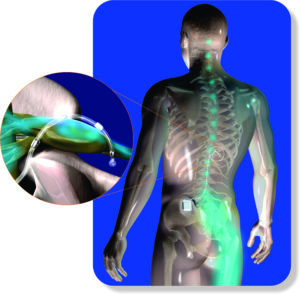
The dorsal root ganglion is a collection of sensory nerve-cell bodies near the opening where a spinal nerve exits. DRG leads deliver programmed electrical stimulation near one or more selected ganglia. The goal is to alter pain processing in a focused region without repairing the injured nerve or correcting a structural problem.
DRG targeting is more specific than assuming that every painful foot, knee or groin maps neatly to a single spinal level. Dermatomes overlap, real pain patterns vary and the painful location may reflect joint, vascular, peripheral-nerve, spinal or other disease.
DRG Stimulation Vs Spinal Cord Stimulation
| Decision factor | DRG stimulation | Spinal cord stimulation |
|---|---|---|
| Typical pain distribution | Small, stable, anatomically coherent lower-extremity region | Broader, bilateral, multiregional or combined back-and-limb pain |
| Most established application | Lower-limb CRPS I or CRPS II/causalgia | Persistent neuropathic pain after spine surgery, painful diabetic neuropathy and selected refractory back or limb pain |
| Target | One or more dorsal root ganglia | Dorsal spinal cord pathways |
| Foot, knee or groin coverage | May provide focused coverage when diagnosis and target correspond | Small or difficult regions may be less precise with some systems |
| Back-dominant pain | Not the established primary indication | More commonly considered |
| Trial | Temporary DRG trial before permanent implantation | Temporary SCS trial before permanent implantation |
| Evidence limit | Strongest comparative evidence concerns lower-extremity CRPS and causalgia | Evidence varies substantially by diagnosis, waveform and system |
In the randomized ACCURATE trial, DRG stimulation produced higher treatment success than traditional SCS in the selected population with lower-extremity CRPS or causalgia. That finding should not be generalized to every diagnosis, body region, waveform or patient.
Which Pain Patterns May Favor DRG Stimulation?
CRPS and Causalgia
The established U.S. indication is moderate-to-severe chronic intractable lower-limb pain in adults with CRPS I or CRPS II. CRPS II is also called causalgia and involves a known nerve injury. Diagnosis should use accepted CRPS criteria and exclude competing explanations; disproportionate pain alone is not sufficient.
Focused Foot and Ankle Pain
A small, stable region of neuropathic foot or ankle pain may be targetable. Before considering DRG, evaluate CRPS, radiculopathy, peripheral neuropathy, named-nerve injury, tarsal tunnel syndrome, arthritis, tendon disease, fracture and vascular disease.
Focused Knee Pain
Selected neuropathic or CRPS-related knee pain may be discussed, including some persistent postsurgical presentations. Prosthetic infection, loosening or instability, arthritis and genicular or peripheral-nerve pain require diagnosis-specific evaluation first. Ordinary arthritic knee pain is not automatically a DRG indication.
Groin and Postsurgical Nerve Pain
Evidence outside lower-extremity CRPS relies more heavily on smaller studies and case series. Chronic focal groin pain requires evaluation for ilioinguinal, iliohypogastric or genitofemoral neuralgia as well as hip disease, hernia, lumbar radiculopathy and pelvic or urologic causes. DRG use may be off-label, and evidence quality and coverage should be discussed candidly.
Location Is Not the Same as Diagnosis
| Pain location | Problems to evaluate before DRG |
|---|---|
| Foot or ankle | CRPS, peripheral neuropathy, nerve injury, radiculopathy, tarsal tunnel syndrome, arthritis, tendon pathology, fracture or vascular disease |
| Knee | CRPS, postsurgical neuropathic pain, prosthetic complication, infection, instability, arthritis or genicular nerve pain |
| Groin | Ilioinguinal, iliohypogastric or genitofemoral neuralgia; hip disease; hernia; radiculopathy; pelvic or urologic pathology |
| Lower-limb CRPS | Confirm accepted diagnostic criteria and consider competing neurological, vascular and musculoskeletal diagnoses |
| Pelvic or pudendal region | Confirm the neural structure and diagnosis; DRG evidence is limited and treatment may be off-label |
Who May Be a Candidate?
- A defined chronic neuropathic pain diagnosis
- A small, stable and reasonably targetable painful region
- Meaningful functional impairment
- Inadequate benefit from diagnosis-appropriate lower-risk care
- No active infection or clearly preferable structural treatment
- Acceptable bleeding, anesthesia and procedural risk
- Realistic goals and ability to manage the system
- Meaningful pain and functional improvement during the DRG trial
When DRG May Not Be Appropriate
DRG is generally not the first treatment for acute pain, untreated infection, poorly defined generalized pain, a correctable structural problem or predominantly mechanical joint pain. A patient unable to operate the system or who does not receive effective trial relief should not proceed to permanent implantation.
What Happens During a DRG Trial?
- Confirm the diagnosis, painful region and measurable goals.
- Review medications, bleeding and infection risks, allergies and procedural instructions.
- Place one or more temporary leads near selected DRG targets using fluoroscopic guidance.
- Connect the leads to an external generator and program the targeted region.
- Track pain, walking or standing, sleep, shoe or clothing tolerance, limb use, medication requirements and satisfaction.
- Remove the trial leads and decide whether the multidimensional benefit justifies implantation.
The dedicated neuromodulation trial guide includes questions to ask and functional goals to choose before either an SCS or DRG trial.
Permanent Implantation and Recovery
Permanent implantation adds incisions and a subcutaneous generator pocket. Patients need wound care, temporary limits on bending, lifting and twisting, and follow-up programming. DRG lead placement differs technically from dorsal-column SCS, so exact restrictions are individualized. Review broader implant recovery, MRI, travel and long-term device precautions with the treating team because device-specific instructions can differ.
Alternatives to DRG Stimulation
Depending on the diagnosis, alternatives include medication optimization, rehabilitation and desensitization, psychological or interdisciplinary pain care, sympathetic blocks, epidural or selective nerve-root injection, named peripheral-nerve blocks, peripheral nerve stimulation, spinal cord stimulation, joint-directed treatment or decompression of a correctable nerve lesion.
Evidence and Important Limitations
- DRG is not proven superior for every pain condition.
- The pivotal comparison with SCS involved lower-extremity CRPS and causalgia.
- Evidence for non-CRPS groin, knee, foot and pelvic indications is less mature and may be off-label.
- Dermatomal maps guide planning but do not guarantee treatment coverage.
- A successful trial cannot guarantee identical or lifelong benefit.
- Neither DRG nor SCS repairs nerve damage or corrects structural pathology.
- Insurance authorization may differ for off-label applications.
Risks and Long-Term Device Management
Risks include infection, bleeding, dural puncture and spinal headache, epidural hematoma, neurological injury, temporary pain flare, uncomfortable stimulation, lead migration, fracture or damage, generator-pocket pain, hardware or battery failure, loss of benefit, revision and removal. Long-term effectiveness is not guaranteed, and repeated programming may be necessary.
Seek urgent evaluation for fever, drainage, spreading redness, exposed hardware, rapidly increasing swelling, severe escalating spinal pain, new weakness or numbness, or bowel or bladder dysfunction. Review the current manufacturer indications and safety information for system-specific details.
Frequently Asked Questions
Is DRG stimulation better than spinal cord stimulation?
Neither is better for every patient. DRG stimulation may be favored when chronic neuropathic pain is concentrated in a small lower-extremity region, particularly with CRPS or causalgia. SCS is generally better established for broader back, leg, trunk or bilateral pain patterns. Diagnosis, pain distribution, anatomy, previous treatment and the temporary trial response should guide the choice.
Can DRG stimulation treat focused foot, groin or knee pain?
It may help selected focal neuropathic pain patterns, but location alone does not establish candidacy. The strongest established U.S. indication is chronic lower-extremity pain from CRPS I or CRPS II. Evidence for other postsurgical or focal foot, groin and knee pain is more limited and may involve off-label treatment.
What is the established U.S. indication for DRG stimulation?
The established U.S. indication is management of moderate-to-severe chronic intractable lower-limb pain in adults with complex regional pain syndrome types I or II. CRPS II is also called causalgia.
Does the painful location determine which DRG level is treated?
Pain location and dermatomal maps help plan possible targets, but they are not exact treatment maps. Diagnosis, examination, prior surgery, anatomy and trial coverage all influence which DRG levels are considered.
What happens during a DRG stimulation trial?
Temporary leads are positioned near selected dorsal root ganglia under X-ray guidance and connected to an external system. During the trial, the patient tracks pain, coverage of the targeted region and meaningful functional activities before permanent implantation is considered.
Does a successful DRG trial guarantee long-term relief?
No. A successful trial supports permanent implantation, but it cannot guarantee that the permanent system will reproduce the same benefit or remain equally effective indefinitely.
What are the main risks of DRG stimulation?
Risks include infection, bleeding, dural puncture and headache, neurological injury, lead migration or damage, uncomfortable stimulation, generator-pocket pain, hardware failure, loss of benefit, revision and removal.
References
- Deer TR, et al. ACCURATE randomized comparative trial of DRG stimulation and SCS.
- Proclaim DRG indications, contraindications and safety information.
- Graham RD, et al. Hypothesized mechanisms of DRG stimulation.
Dr. Amit Sharma & our minimally invasive pain & spine team.
This content is for educational purposes only and is not a substitute for professional medical advice, diagnosis or treatment. Always consult a licensed healthcare provider.