
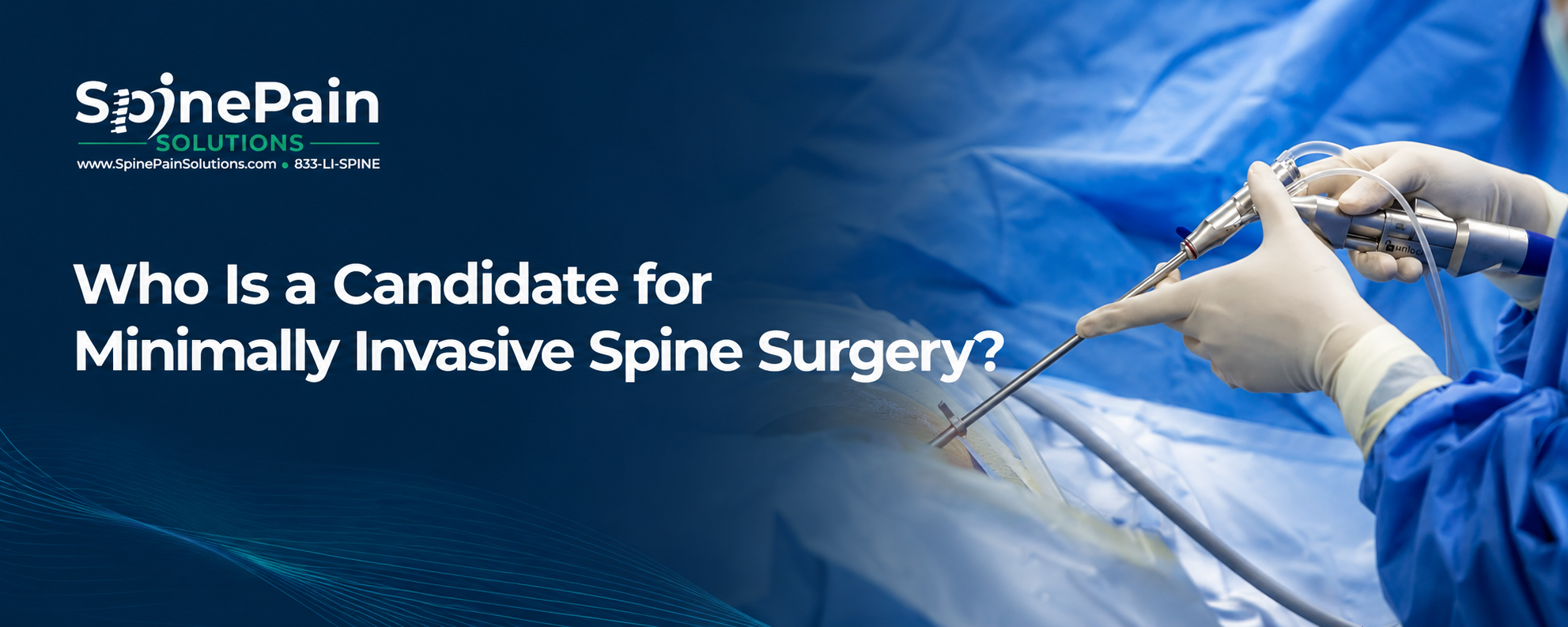
Who Is a Candidate for Minimally Invasive Spine Surgery?
“Minimally invasive” describes how the physician reaches and treats a spinal structure. It is not one operation, one technology or a guarantee of a better result.
The term may refer to procedures as different as percutaneous lumbar decompression, endoscopic discectomy, basivertebral nerve ablation, vertebral augmentation, sacroiliac-joint stabilization, neuromodulation or minimally invasive fusion. Each treats a different diagnosis.
The critical question is therefore not simply:
Can this procedure be performed through a small incision?
It is:
Can the least invasive reasonable procedure fully address the confirmed problem without sacrificing safety or completeness?
Who Is a Candidate for Minimally Invasive Spine Surgery?
A patient is more likely to be an appropriate candidate when:
- The dominant pain or neurological problem has been reasonably identified
- The symptoms, examination and imaging correspond anatomically
- The pathology is accessible through the proposed approach
- The procedure can accomplish the necessary objective—such as decompression, stabilization or interruption of a confirmed pain pathway
- Appropriate nonsurgical treatment has failed or is unlikely to correct the problem
- The expected benefit justifies the procedural and anesthetic risks
- Bone quality and surrounding anatomy can support any planned implant
- The patient understands what the procedure can and cannot treat
Severe pain alone does not establish candidacy. Neither does the presence of disc degeneration, arthritis, stenosis or another abnormality in an MRI report.
A technically elegant procedure directed at the wrong pain generator is still the wrong procedure.
What Does “Minimally Invasive” Actually Mean?
Minimally invasive spine procedures generally use smaller access corridors, specialized instruments and imaging or endoscopic visualization to reduce disruption of muscles and other surrounding tissues.
Depending on the procedure, potential advantages may include:
- Smaller incisions
- Less muscle stripping or tissue disruption
- Reduced blood loss
- Shorter hospitalization or outpatient treatment
- Earlier return to selected activities
- Less postoperative discomfort in some patients
These are potential advantages—not promises. Minimally invasive surgery can still cause bleeding, infection, nerve injury, dural tear, spinal-fluid leakage, incomplete relief, instability, implant complications or the need for revision surgery.
A smaller incision also does not necessarily mean a smaller operation internally. The physician may still be working close to the spinal cord, nerve roots or major blood vessels.
A Surgical Approach Is Not a Diagnosis
Patients are sometimes told that they “qualify for laser surgery,” “need an endoscopic procedure” or are candidates for a specific implant before the pain generator has been established.
That reasoning is backward.
The correct sequence is:
- Identify the diagnosis and treatment objective
- Determine whether intervention is necessary
- Compare the approaches capable of adequately treating the problem
- Select the option with the most appropriate balance of effectiveness, burden and risk
The availability of a technology should not determine the diagnosis.
Which Minimally Invasive Procedure Fits Which Diagnosis?
| Clinical problem | Possible minimally invasive option | What it is designed to treat | Important limitation |
|---|---|---|---|
| Focal disc herniation causing matching sciatica | Endoscopic discectomy | Removes selected herniated disc material compressing a nerve | Does not treat every form of axial back pain, instability or multilevel stenosis |
| Focal foraminal or lateral-recess stenosis | Endoscopic or tubular decompression | Directly removes selected bone, ligament or disc compressing the nerve | A limited corridor may be insufficient for extensive multilevel compression or deformity |
| Neurogenic claudication with central stenosis substantially caused by thickened ligamentum flavum | MILD procedure | Removes selected portions of hypertrophied ligament to increase space in the central canal | Does not adequately treat every bony, foraminal or unstable form of stenosis |
| Chronic vertebrogenic low-back pain with qualifying endplate changes | Basivertebral nerve ablation | Interrupts pain signals carried by the basivertebral nerve within selected vertebral bodies | Does not decompress a nerve or treat instability, generalized degeneration or nonspecific back pain |
| Selected painful vertebral compression fracture | Kyphoplasty or vertebral augmentation | Stabilizes a selected painful fracture; some systems may also restore part of the lost height | Not every fracture is painful or appropriate for augmentation, and osteoporosis still requires treatment |
| Confirmed sacroiliac-joint pain with inadequate response to conservative care | Minimally invasive SI-joint stabilization or fusion | Stabilizes the painful SI joint | Will not treat pain actually arising from the hip, lumbar spine or surrounding soft tissues |
| Selected chronic neuropathic pain | Spinal cord, dorsal-root-ganglion or peripheral-nerve stimulation | Modifies transmission of selected chronic pain signals | Does not remove structural nerve compression or stabilize an unstable spine |
| Selected instability or symptomatic spondylolisthesis | Percutaneous or minimally invasive stabilization or fusion | Stabilizes a carefully selected painful or unstable segment | The smallest fixation system is not necessarily adequate for every degree of instability, deformity or poor bone quality |
These treatments are not interchangeable. A patient who qualifies for basivertebral nerve ablation does not therefore qualify for endoscopic decompression, and a patient with stenosis does not automatically qualify for MILD.
Five Questions That Determine Candidacy
1. Is There a Specific Diagnosis?
Back pain is a symptom, not a diagnosis. Possible sources include spinal nerves, discs, facet joints, vertebral endplates, the sacroiliac joint, muscles, the hip and peripheral nerves.
A procedure should address a supported pain generator or structural problem—not merely an abnormal phrase in a radiology report.
Read how physicians approach diagnosing back pain and identifying the pain source.
2. Do the Symptoms, Examination and Imaging Match?
A left-sided disc herniation compressing the left L5 nerve becomes more convincing when the patient has corresponding left-leg pain, sensory change, weakness or nerve-tension findings.
The same finding may be incidental when the symptoms occur entirely on the right or remain confined to the back.
Degenerative MRI findings are common in people without symptoms. Imaging should confirm a clinically suspected diagnosis rather than replace the clinical evaluation.
3. What Must the Procedure Accomplish?
The objective may be to:
- Remove disc material pressing on a nerve
- Remove bone or ligament causing stenosis
- Stabilize an unstable joint or spinal segment
- Stabilize a painful vertebral fracture
- Interrupt a confirmed pain pathway
- Modify chronic neuropathic pain signaling
A procedure designed for one objective should not be substituted for another. Radiofrequency treatment does not decompress a nerve. Neuromodulation does not correct instability. Decompression does not necessarily treat axial pain from another structure.
4. Can a Limited Approach Treat the Problem Completely?
A small approach is worthwhile only when it provides sufficient visualization, access and correction.
If the procedure removes only part of the compression or stabilizes only part of an unstable construct, the apparent short-term advantage may be offset by persistent symptoms or revision surgery.
The appropriate operation is the least invasive approach that can adequately accomplish the necessary objective—not automatically the operation with the smallest incision.
5. Is the Expected Benefit Reasonable for This Patient?
Candidacy also depends on:
- Cardiovascular, pulmonary and other medical conditions
- Medication and anticoagulant use
- Frailty and fall risk
- Diabetes control and infection risk
- Smoking or nicotine use, particularly when fusion is planned
- Bone density and fracture risk
- Ability to participate in rehabilitation
- Realistic expectations regarding pain and function
A limited procedure may reduce some surgical burden, but it does not eliminate the need for careful medical preparation.
Minimally Invasive Options for Lumbar Spinal Stenosis
“Spinal stenosis” describes narrowing around the nerves, but it does not specify what is causing the narrowing.
Possible contributors include:
- Thickened ligamentum flavum
- Enlarged facet joints
- Disc bulging or herniation
- Foraminal collapse
- Spondylolisthesis or instability
- Degenerative scoliosis
- A combination of several abnormalities
The anatomy determines which procedure is reasonable.
When MILD May Be Appropriate
The MILD procedure is designed for selected patients with neurogenic claudication and central lumbar stenosis in which ligamentum flavum hypertrophy is an important contributor.
It removes small portions of thickened ligament and adjacent bone through a percutaneous approach. It does not involve an implant or fusion.
MILD may be insufficient when symptoms are primarily caused by:
- Severe bony lateral-recess or foraminal stenosis
- A large focal disc herniation
- Significant instability
- Major deformity
- Compression that requires direct visualization and broader removal
When Endoscopic Decompression May Be Appropriate
Endoscopic lumbar decompression permits direct visualization and removal of selected disc, ligament and bone compressing a spinal nerve.
It may be considered for selected:
- Disc herniations
- Foraminal stenosis
- Lateral-recess stenosis
- Central stenosis
- Recurrent focal compression after previous surgery
The approach must provide adequate access to the full area requiring decompression. Severe multilevel disease, instability or deformity may require a tubular, microscopic or open operation instead.
Review the broader guide to minimally invasive lumbar decompression options.
Minimally Invasive Treatment for Back Pain Without Nerve Compression
Not every minimally invasive spinal procedure is a decompression.
Basivertebral Nerve Ablation for Vertebrogenic Pain
Basivertebral nerve ablation may be considered for selected chronic axial low-back pain associated with vertebral endplate damage and qualifying Modic type 1 or type 2 MRI changes, generally from L3 through S1.
The clinical pain pattern must also fit vertebrogenic pain. The presence of Modic changes alone does not establish that the endplates are the dominant pain generator.
This procedure does not treat:
- Leg symptoms caused by nerve compression
- Facet-joint pain
- Sacroiliac-joint pain
- Instability or deformity
- Every form of disc degeneration
Sacroiliac-Joint Stabilization or Fusion
Minimally invasive SI-joint fusion may be considered when the history, a cluster of examination maneuvers and appropriately performed diagnostic injections support the sacroiliac joint as the dominant pain generator.
An SI-joint implant should not be selected merely because pain occurs near the posterior pelvis. Hip disease, lumbar radiculopathy, facet pain, cluneal neuropathy and muscular disorders can produce symptoms in a similar area.
Neuromodulation for Selected Neuropathic Pain
Neuromodulation may be considered for carefully selected chronic neuropathic pain, complex regional pain syndrome or persistent pain after previous surgery.
A temporary trial generally helps determine whether stimulation meaningfully improves pain and function before permanent implantation.
Neuromodulation should not replace necessary decompression when a correctable lesion is producing progressive neurological loss.
When a Minimally Invasive Approach May Not Be Appropriate
A limited approach may be inadequate or unsafe when the patient has:
- Extensive multilevel compression that cannot be fully addressed through the proposed corridor
- Major spinal deformity or sagittal imbalance requiring broader reconstruction
- Significant or progressive instability requiring more substantial fixation
- High-grade spondylolisthesis
- Severe osteoporosis that cannot reliably support the planned implant
- An unstable or destructive fracture
- Spinal infection, epidural abscess, tumor or another destructive process
- Complex revision anatomy that cannot be safely accessed through a limited route
- Diffuse pain without a reasonably established anatomical target
This does not mean every patient in these categories requires open surgery. It means that the word “minimally invasive” should not override the need for adequate correction.
Conditions That Require Urgent Evaluation
Some urgent conditions can ultimately be treated through a minimally invasive approach. However, emergency assessment and adequate decompression take priority over pursuing a particular technique.
Can You Qualify After Previous Spine Surgery?
Previous surgery does not automatically exclude another minimally invasive procedure.
A focused endoscopic or percutaneous treatment may sometimes address:
- Recurrent or residual disc herniation
- Focal foraminal or lateral-recess stenosis
- Adjacent-level disease
- Selected persistent neuropathic pain
- A painful vertebral fracture or SI joint
Revision cases require particular caution. Scar tissue, altered landmarks, removed bone, implants, instability and the location of the current compression can make a limited approach more difficult or inappropriate.
The physician should review the actual current images and prior operative report rather than relying only on a new MRI report.
How Age, Weight and Bone Quality Affect Candidacy
Age
Chronological age alone does not determine candidacy. Physiological health, frailty, neurological status, treatment goals and the burden of the proposed procedure are more meaningful.
A limited outpatient treatment may be attractive for an older patient who faces higher risk from extensive surgery—but only if the smaller procedure can address the actual problem.
Body Weight
Obesity does not automatically disqualify a patient. It can, however, affect:
- Anesthetic and airway risk
- Positioning and imaging quality
- The working distance to the spine
- Equipment limitations
- Wound healing and infection risk
- Postoperative rehabilitation
These considerations are procedure-specific and should be evaluated individually.
Bone Quality
Osteoporosis matters most when the procedure depends on screws, anchors, spacers or another implant maintaining purchase in bone.
Bone-density testing, fracture history, CT appearance and other clinical factors may be relevant before stabilization or fusion. Untreated osteoporosis can increase the risk of fixation failure, subsidence and additional fractures.
What Testing May Be Needed Before a Decision?
The evaluation may include:
- A detailed history and neurological examination
- Direct review of MRI images
- Standing X-rays to assess alignment
- Flexion-extension X-rays when instability is suspected
- CT when detailed bony anatomy is important
- Electromyography and nerve-conduction studies when the nerve diagnosis remains uncertain
- Bone-density testing when an implant or fusion is being considered
- Selected diagnostic blocks when more than one pain generator remains plausible
Not every patient requires every test. Testing should answer a defined clinical question and should be ordered when the answer could change treatment.
Potential Benefits and Important Limitations
| Potential advantage | Necessary qualification |
|---|---|
| Smaller incision | Does not prove that the internal treatment is minor or complete |
| Less tissue disruption | Depends on the procedure, anatomy and technical execution |
| Shorter initial recovery | Biological healing, fusion and nerve recovery still take time |
| Outpatient treatment | Same-day discharge is not appropriate for every patient or operation |
| Lower blood loss in selected operations | Other procedural risks remain and long-term outcomes may be similar to open surgery |
| Preservation of anatomy | Preserving tissue is valuable only when enough pathology is removed or stabilized |
Published comparisons do not establish that every minimally invasive operation is superior to its open counterpart. Outcomes vary according to the diagnosis, technique, surgeon experience and patient selection.
How Long Is Recovery?
Recovery depends much more on what was treated than on the label “minimally invasive.”
| Procedure category | General recovery pattern | Why it varies |
|---|---|---|
| Percutaneous, implant-free procedure | Often shorter initial restrictions | Depends on access route, anesthesia and treated tissue |
| Endoscopic decompression | Walking usually begins early, with gradual activity progression | Nerve recovery depends on severity and duration of compression |
| Implant or stabilization procedure | More restrictions may be needed while tissues and bone heal | Bone quality, implant location and weight-bearing forces matter |
| Minimally invasive fusion | The incision may recover quickly, but fusion develops over months | Biological fusion cannot be accelerated merely by using a smaller incision |
Claims that every patient returns to work or normal activity within a fixed number of days should be viewed cautiously.
Questions to Ask Before Agreeing to a Procedure
- What is the specific diagnosis?
- Which symptoms and examination findings match the imaging?
- What structure will the procedure treat?
- Is the goal decompression, stabilization, pain-signal interruption or something else?
- What can this procedure not correct?
- Why is this approach preferable to continued nonsurgical care?
- Could a less invasive option adequately accomplish the same objective?
- Could an open approach provide a more complete or durable correction?
- What is the plan if symptoms do not improve?
- What are the physician’s experience and outcomes with this exact procedure?
A physician should be able to explain both why a minimally invasive procedure fits and why competing options are less appropriate.
When Is Another Procedure or Surgical Opinion Appropriate?
A spine-surgical opinion may be appropriate when:
- Weakness, walking difficulty or another neurological deficit is progressing
- Imaging demonstrates severe compression matching the symptoms
- Instability, deformity or a destructive lesion may require reconstruction
- A limited procedure cannot adequately reach the pathology
- Persistent disabling radicular pain continues despite reasonable nonsurgical care
- Several procedures have failed and the diagnosis needs reconsideration
- A major operation has been recommended and the patient wants to compare alternatives
Obtaining an opinion does not commit a patient to surgery. It can establish whether continued conservative care is reasonable and whether a minimally invasive option can adequately treat the problem.
Review treatment options that may be considered before spine surgery.
Frequently Asked Questions
Who is a candidate for minimally invasive spine surgery?
A potential candidate has a reasonably established diagnosis, corresponding symptoms, examination and imaging, and a target that can be safely and adequately treated through the proposed approach. Overall health, neurological status, bone quality, prior surgery and realistic expectations also affect candidacy.
What conditions can minimally invasive spine surgery treat?
Depending on the anatomy and procedure, minimally invasive treatment may be considered for selected disc herniations, spinal stenosis, foraminal narrowing, vertebrogenic pain, painful compression fractures, SI-joint dysfunction, instability and chronic neuropathic pain. These diagnoses require different procedures.
Is minimally invasive spine surgery always better than open surgery?
No. A minimally invasive approach may reduce tissue disruption, blood loss or initial recovery burden in selected cases. Open surgery may be safer or more complete for extensive compression, deformity, instability or anatomy that cannot be adequately treated through a limited corridor.
Can minimally invasive spine surgery treat spinal stenosis?
Yes, in selected patients. MILD may treat central stenosis caused substantially by thickened ligament, while endoscopic or tubular decompression can directly remove selected disc, ligament or bone. Extensive multilevel disease, instability or deformity may require a broader operation.
Can I qualify after previous back surgery?
Possibly. Previous surgery is not an automatic exclusion. The decision depends on the present diagnosis, scar tissue, implants, stability and whether the new target can be reached safely. Revision anatomy can sometimes require an open approach.
Does age or obesity disqualify someone?
Not automatically. Physiological health, frailty, medical conditions, anesthesia risk, bone quality and the proposed procedure are generally more important than age alone. Body habitus can affect positioning, imaging, access and wound risk.
Can minimally invasive spine surgery prevent a fusion?
Sometimes a focused decompression can relieve nerve compression without fusion when the spine remains stable. It cannot reliably replace fusion when true instability, deformity or another genuine need for stabilization is present.
Is laser spine surgery the same as minimally invasive spine surgery?
No. A laser is one possible surgical tool. It does not define the operation or make treatment inherently safer or more effective. The diagnosis, visualization, anatomical access and completeness of treatment are more important than whether a laser is used.
What if my MRI shows abnormalities at several levels?
Multiple abnormalities do not mean that every level requires treatment. The physician should identify which finding corresponds with the symptoms, examination and functional limitation. Image review, updated studies, EMG or a targeted diagnostic block may sometimes help.
Minimally Invasive Spine Evaluation on Long Island
Amit Sharma, MD evaluates patients with complex back, neck, joint and nerve pain across Long Island.
The evaluation focuses first on establishing the diagnosis and then comparing conservative care, targeted interventions, endoscopic treatment, minimally invasive stabilization and conventional surgical options.
The objective is not to make every patient a candidate for a procedure. It is to determine whether a less-invasive option can adequately treat the confirmed problem—and to recognize when it cannot.
Learn more about interventional and minimally invasive spine surgery or view our Long Island office locations.
References
- Hussain I, et al. Patient Selection for Minimally Invasive Spine Surgery. Neurosurg Clin N Am. 2021;32(1):1-9. Read source →
- Wang MY, et al. Advances and Challenges in Minimally Invasive Spine Surgery. J Clin Med. 2024;13(11):3329. Read source →
- Goldstein CL, Macwan K, Sundararajan K, Rampersaud YR. Comparative Outcomes of Minimally Invasive Surgery for Posterior Lumbar Fusion: A Systematic Review. Clin Orthop Relat Res. 2014;472(6):1727-1737. Read source →
- Staats PS, et al. Long-Term Safety and Efficacy of Minimally Invasive Lumbar Decompression Procedure for the Treatment of Lumbar Spinal Stenosis: Two-Year Results of MiDAS ENCORE. Reg Anesth Pain Med. 2018;43(7):789-794. Read source →
- Kreiner DS, et al. Diagnosis and Treatment of Degenerative Lumbar Spinal Stenosis: A Review. JAMA. 2022;327(17):1688-1699. Read source →
- American College of Radiology. ACR Appropriateness Criteria®: Low Back Pain. Read source →
- Brinjikji W, et al. Systematic Literature Review of Imaging Features of Spinal Degeneration in Asymptomatic Populations. AJNR Am J Neuroradiol. 2015;36(4):811-816. Read source →
- Cleveland Clinic. Minimally Invasive Spine Surgery. Read source →
Medical content reviewed by Amit Sharma, MD. This page is educational and does not replace an individualized medical evaluation. New or rapidly progressive neurological symptoms require urgent medical attention.
Dr. Amit Sharma & our minimally invasive pain & spine team.