Amit Sharma, MD | Interventional Spine & Pain Physician
Interventional Spine and Pain Medicine
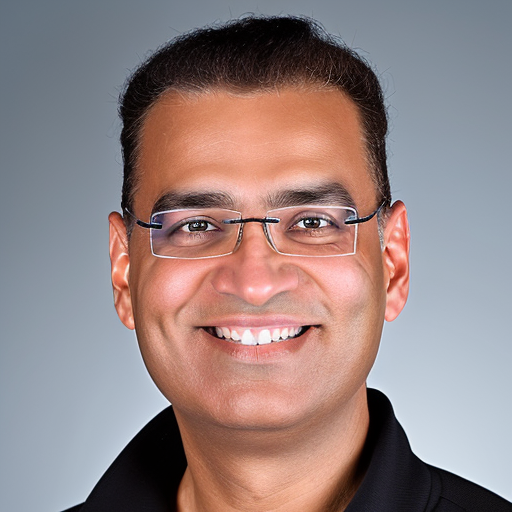
Dr. Sharma specializes in the diagnosis and treatment of complex spinal, musculoskeletal and neuropathic pain. His clinical work spans conventional interventional procedures, neuromodulation and advanced minimally invasive spine care.
- Board Certified in Pain Medicine
- Chief, Division of Pain Medicine at Good Samaritan University Hospital
- Founder and Medical Director of SpinePain Solutions
- Medical Director of the Minimally Invasive Center of New York
- Former Assistant Professor at Columbia University
- Johns Hopkins fellowship-trained in multidisciplinary pain medicine
- More than 60,000 interventional procedures performed
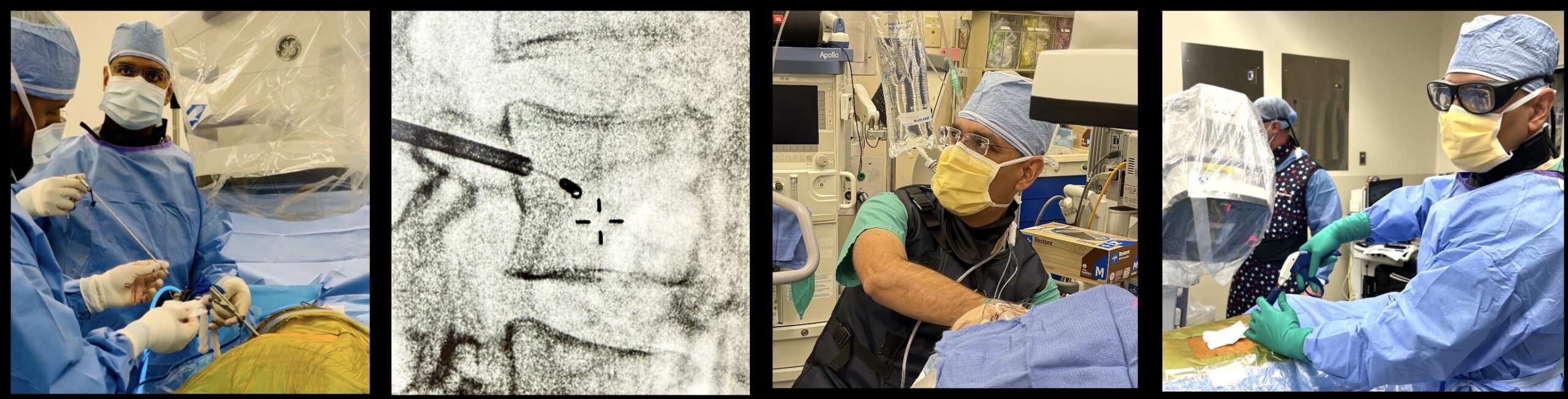
Dr. Sharma’s practice includes image-guided diagnostic and therapeutic procedures, radiofrequency treatment, neuromodulation, vertebral augmentation, minimally invasive lumbar decompression and selected endoscopic spine procedures.
His goal is not to direct every patient toward a procedure. It is to identify the most likely pain generator, explain the reasonable options and select the least invasive treatment capable of addressing the underlying problem.
Clinical Leadership on Long Island
Dr. Sharma has served as Chief of the Division of Pain Medicine at Good Samaritan University Hospital since 2012. In this role, he has helped lead the hospital’s approach to interventional pain medicine and the treatment of patients with complex spinal and pain conditions.
He founded SpinePain Solutions to provide a broader continuum of care outside the hospital setting. The practice evaluates patients across four Long Island locations and offers treatment ranging from diagnostic procedures and conventional pain interventions to advanced minimally invasive and endoscopic spine care.
Dr. Sharma is also Medical Director of the Minimally Invasive Center of New York in Commack, where selected procedures are performed in an accredited office-based procedural environment.
Before founding SpinePain Solutions, Dr. Sharma directed interventional spine and pain programs at SpineCare Long Island and Long Island Brain & Spine. His experience across academic medicine, hospital leadership, multidisciplinary spine practices and independent clinical care gives him a broad perspective on when intervention is appropriate—and when another form of treatment is preferable.
Education, Fellowship and Academic Training
Dr. Sharma’s medical education began at the All India Institute of Medical Sciences in New Delhi, where he earned his medical degree. Before coming to the United States, his early postgraduate experience included work in family medicine, diagnostic radiology and neurosurgery. That exposure contributed to his interest in anatomy, imaging and neurological diagnosis.
After completing a preliminary internal medicine internship at New York Medical College and Metropolitan Hospital, Dr. Sharma continued residency training at the University of Cincinnati and subsequently at the Columbia University College of Physicians and Surgeons and the University Hospitals of Columbia and Cornell.
At Columbia, he received recognition for academic leadership and research, including the Team Captain of the Year Award, Best Resident Research Award and Best Oral Presentation Award.
Dr. Sharma then completed a multidisciplinary pain medicine fellowship at the Johns Hopkins University School of Medicine. He received the Pfizer Scholar in Pain Management Award during his fellowship.
Following fellowship, he returned to Columbia University as an Assistant Professor and member of the Division of Pain Medicine and Regional Anesthesiology. He participated in patient care, resident education, clinical research and academic publication before moving into full-time clinical practice.
Clinical Philosophy
Dr. Sharma’s approach begins with a basic but frequently overlooked question:
An MRI may identify several abnormalities without establishing which finding is clinically important. Conversely, a patient may have significant nerve or musculoskeletal pain that is not fully explained by routine imaging. Dr. Sharma therefore correlates the history, pain distribution, neurological examination and imaging before recommending treatment.
When appropriate, diagnostic injections may be used to test a suspected pain generator. Treatment can then be directed toward the most likely source rather than simply toward the most prominent finding in a radiology report.
Dr. Sharma believes patients should understand:
- The most likely diagnosis
- Which findings may be incidental
- The realistic goals and limitations of each treatment
- Whether further conservative treatment remains appropriate
- When an interventional procedure may be helpful
- When a surgical or neurological opinion should not be delayed
His treatment plans may incorporate physical therapy, rehabilitation, medication management, complementary care, image-guided procedures, minimally invasive treatment or referral to another specialist.
More Than 60,000 Interventional Procedures
Across more than two decades of clinical practice, Dr. Sharma’s cumulative procedural experience exceeds 60,000 interventional procedures.
Procedure count alone does not determine whether a treatment is appropriate or predict an individual result. However, substantial procedural experience contributes to technical familiarity, patient selection, recognition of unusual anatomy and an understanding of when a planned intervention should be modified or avoided.
Dr. Sharma’s experience includes routine image-guided pain procedures as well as advanced treatment for patients who have complex diagnoses, previous spine surgery or unsuccessful prior interventions.
Areas of Clinical Expertise
Precision Diagnosis and Image-Guided Procedures
- Epidural and selective nerve root injections
- Diagnostic medial branch and facet procedures
- Sacroiliac joint procedures
- Peripheral nerve blocks and hydrodissection
- Radiofrequency ablation
- Evaluation of conditions that mimic spinal disease
Minimally Invasive and Endoscopic Spine Care
- Endoscopic spine surgery
- Endoscopic lumbar discectomy and decompression
- MILD® minimally invasive lumbar decompression
- Intradiscal procedures
- Basivertebral nerve ablation
- Selected minimally invasive stabilization procedures
Vertebral Fracture and Structural Spine Treatment
- Kyphoplasty
- SpineJack vertebral augmentation
- Radiofrequency-targeted vertebral augmentation
- Evaluation and longitudinal care of vertebral compression fractures
Neuromodulation
- Spinal cord stimulation
- Dorsal root ganglion stimulation
- Peripheral nerve stimulation
- Intrathecal drug-delivery systems
Musculoskeletal and Regenerative Care
- Ultrasound-guided joint, tendon and bursa procedures
- Platelet-rich plasma treatment
- Percutaneous needle tenotomy and TenJet
- Radiofrequency treatment for selected joint pain
- Evaluation of peripheral nerve and musculoskeletal conditions that resemble spinal pain
Professional Recognition
Dr. Sharma’s professional recognition includes:
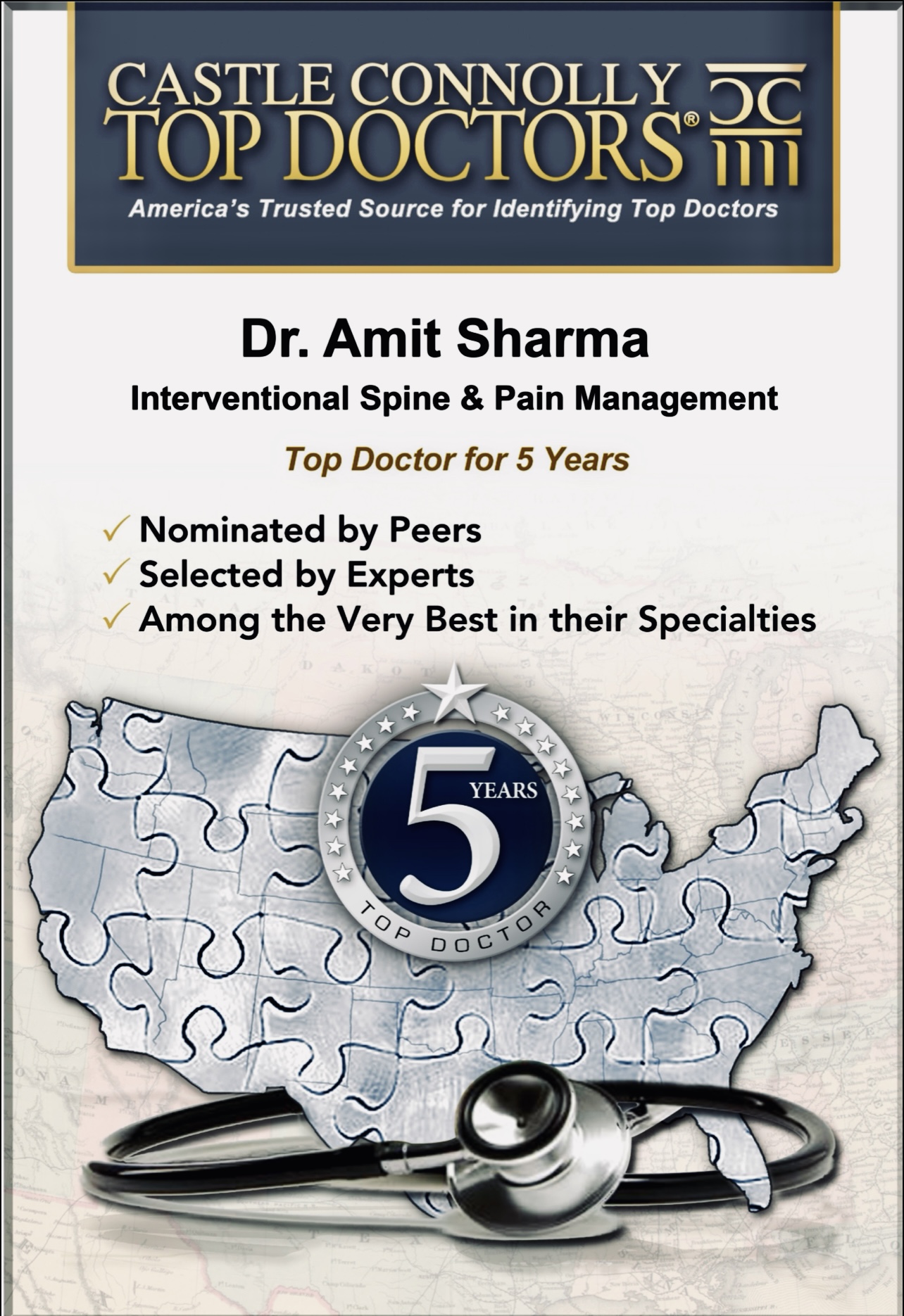
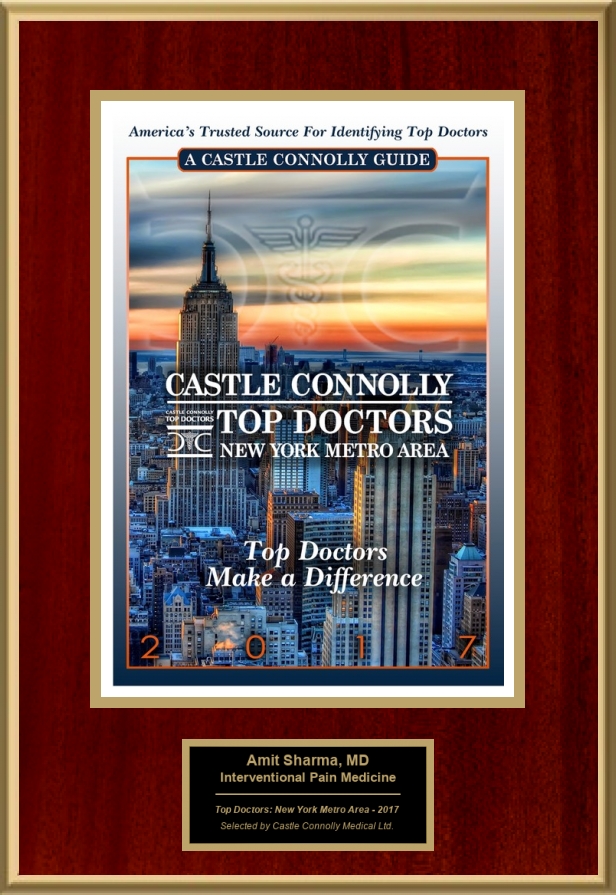
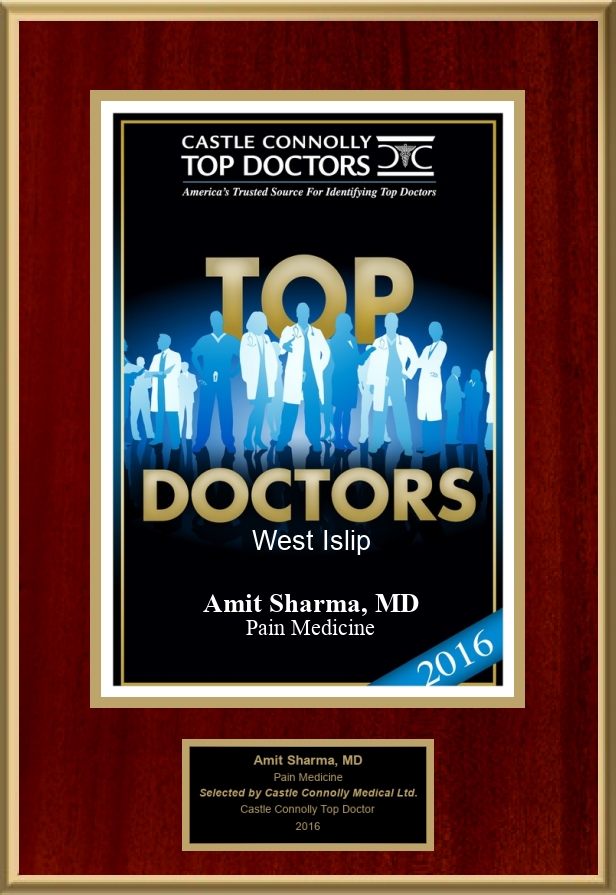
- Castle Connolly Regional Top Doctor: 2016–2026
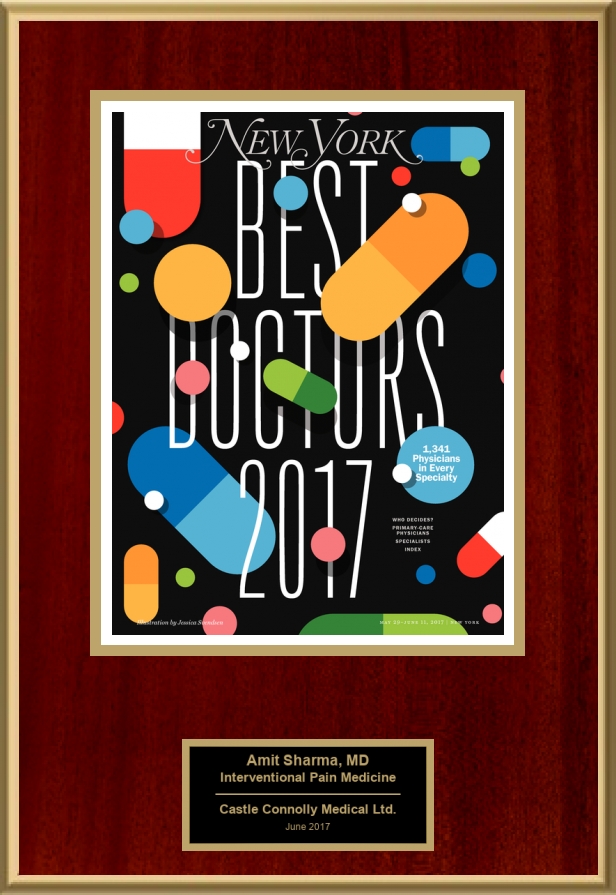
- New York Magazine Top Doctors: 2017–2026
- Newsday Top Doctors on Long Island: 2016–2026
- Pfizer Scholar in Pain Management Award: Johns Hopkins University School of Medicine, 2005
- Team Captain of the Year Award: Columbia University College of Physicians and Surgeons, 2004
- Best Resident Research and Best Oral Presentation Awards: Columbia University
- India Today Scholarship: Awarded for placement among the country’s highest-ranked students
- Award of Special Academic Achievement: First rank in India in the Central Board of Senior Secondary Education Examination


Research and Academic Contributions
Dr. Sharma has contributed to peer-reviewed research involving complex regional pain syndrome, interventional pain practice, neuropharmacology, perioperative medicine and cardiovascular complications. His academic work also includes national presentations, textbook chapters, editorial work and scientific peer review.
Peer-Reviewed Publications
- Gharibo C, Sharma A, Soin A, et al. Triaging interventional pain procedures during COVID-19 or related elective surgery restrictions: Evidence-informed guidance from the American Society of Interventional Pain Physicians. Pain Physician. 2020;23:S183-S204.
- Sharma A, Agarwal S, Broatch JW, Raja SN. A web-based epidemiological survey of complex regional pain syndrome. Regional Anesthesia and Pain Medicine. 2009;34(2):110-115.
- Sharma A, Williams K, Raja SN. Advances in treatment of complex regional pain syndrome: Recent insights on a perplexing disease. Current Opinion in Anaesthesiology. 2006;19(5):566-572.
- Sharma A, Pagel PS, Bhatia A. Intraoperative iatrogenic acute pericardial tamponade: Use of rescue transesophageal echocardiography in a patient undergoing orthotopic liver transplantation. Journal of Cardiothoracic and Vascular Anesthesia. 2005;19(3):364-366.
- Jooste EH, Sharma A, Zhang Y, Emala CW. Rapacuronium augments acetylcholine-induced bronchoconstriction via positive allosteric interactions at the M3 muscarinic receptor. Anesthesiology. 2005;103(6):1195-1203.
- Christo PJ, Hobelman JG, Sharma A. Aging and the neurobiology of addiction. Journal of Geriatrics & Aging. 2005;8(10):48-52.
Selected Scientific Presentations
- A web-based survey of the spread of symptoms in complex regional pain syndrome, presented at the Annual Scientific Meeting of the American Pain Society.
- Rapacuronium and acetylcholine-induced bronchoconstriction, presented at the American Society of Anesthesiologists Annual Meeting. The related work received first prize in the Residents’ Research Essay Contest.
- Research examining positive allosteric effects at the M3 muscarinic receptor, presented at the American Society of Anesthesiologists Annual Meeting and Columbia University’s academic meeting.
- Research evaluating preoperative portable transthoracic echocardiography compared with intraoperative transesophageal echocardiography.
- Transesophageal echocardiography-assisted management of acute cardiovascular collapse during liver transplantation, presented at national and regional scientific meetings.
Selected Textbook Chapters
- Sharma A, Raja SN. Assessment and Management of Chronic Pain and Palliative Care. In: Geriatric Anesthesia. McGraw-Hill, 2007.
- Sharma A. Rule out facet arthropathy before initiating expensive and invasive maneuvers for back and spine pain. In: Avoiding Common Anesthesia Errors. Lippincott Williams & Wilkins, 2008.
- Sharma A. Do not guess at the equivalent dose when determining an opioid conversion. In: Avoiding Common Anesthesia Errors. Lippincott Williams & Wilkins, 2008.
- Sharma A. Management of perioperative pain in the opioid-dependent patient. In: Avoiding Common Anesthesia Errors. Lippincott Williams & Wilkins, 2008.
- Sharma A, Campbell JN, Raja SN. Sympathetic Blocks for Pain. In: The Senses: A Comprehensive Reference. Elsevier, 2007.
- Sharma A, Raja SN. Chronic Pain and the Sympathetic Nervous System: Mechanisms and Potential Implications for Pain Therapies. In: Translational Pain Research. Nova Science Publishers, 2006.
Editorial Experience
- Section Editor, Acute and Chronic Pain: Avoiding Common Anesthesia Errors. Lippincott Williams & Wilkins, 2008.
- Scientific Referee: Cochrane Pain, Palliative and Supportive Care Review Group.
Professional Memberships
- Lifetime Member, American Society of Interventional Pain Physicians
- American Academy of Pain Medicine
- International Pain and Spine Intervention Society
- International Neuromodulation Society
Practice and Patient Consultations
Dr. Sharma evaluates patients with spinal, joint, nerve and complex pain conditions at SpinePain Solutions locations in Farmingdale, Bay Shore, Commack and Huntington.
Patients commonly seek consultation for persistent pain despite conservative care, uncertain diagnoses, symptoms that do not correlate clearly with imaging, previous unsuccessful procedures, or evaluation of options between conventional pain treatment and major spine surgery.
Learn about SpinePain Solutions and our approach to interventional spine care »
View Long Island office locations »
Dr. Amit Sharma & our minimally invasive pain & spine team.
This biography describes Dr. Sharma’s education, professional experience and areas of clinical practice. It does not guarantee a particular treatment recommendation or outcome. Medical decisions require an individualized evaluation.