Post-Ablation Neuritis: Burning Pain After Radiofrequency Ablation
- Posted on: Jul 17 2026
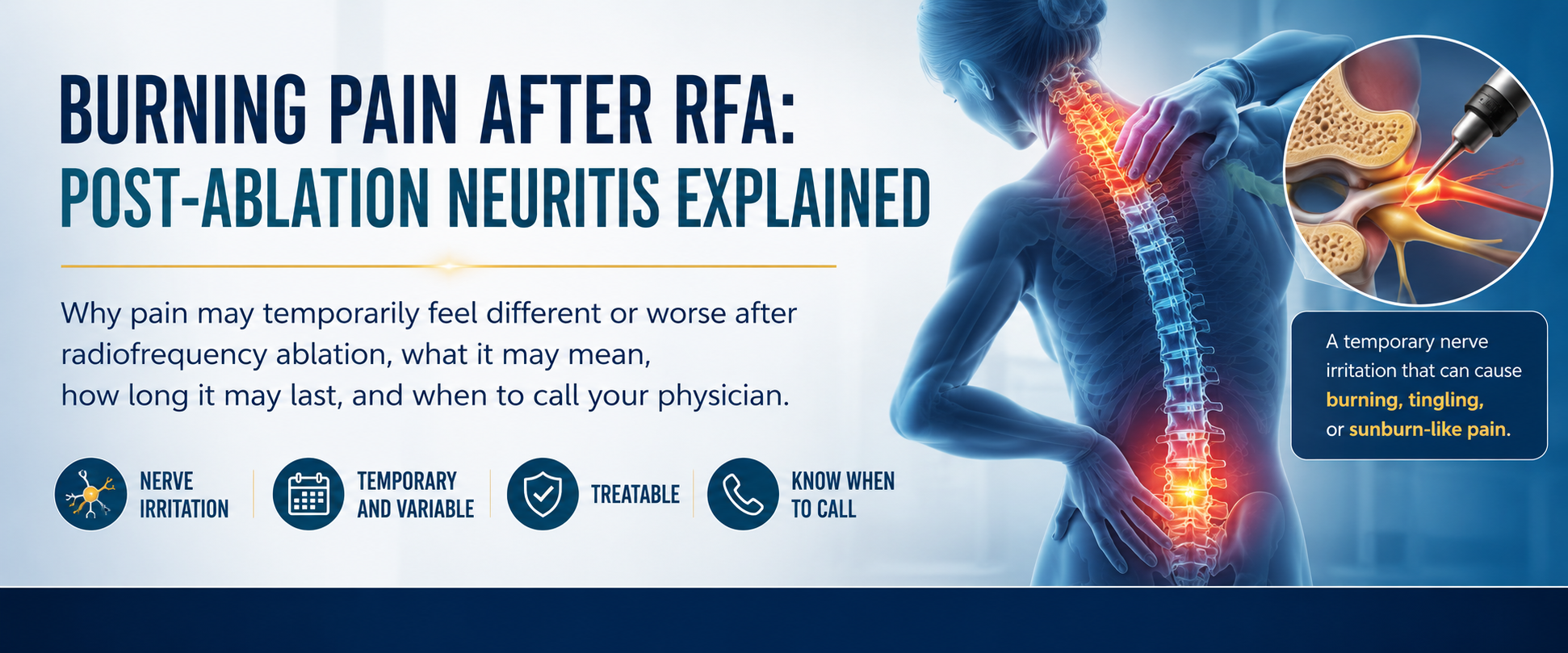
Why pain may temporarily feel different or worse after RFA, how to distinguish nerve irritation from ordinary procedural soreness, and when you should call your physician.
If your back or neck develops a burning, raw, or sunburn-like sensation after radiofrequency ablation, one possible explanation is post-ablation neuritis, also called post-neurotomy neuritis. This is a temporary neuropathic pain response that can occur after thermal treatment of a sensory nerve. It does not necessarily mean that the procedure failed, but it also should not automatically be assumed to prove that the ablation was successful.
Written and medically reviewed by Amit Sharma, MD
Last reviewed July 17, 2026
The Short Version
- Post-ablation neuritis, also called post-neurotomy neuritis, is a temporary burning, tingling, hypersensitive, or sunburn-like pain that may occur after radiofrequency ablation.
- It is different from the bruised or achy discomfort caused by needles passing through the skin, fascia, and muscle.
- Symptoms may begin during the days following treatment or become more noticeable after the initial procedural soreness starts improving.
- It does not necessarily mean that the procedure failed, but neuritis also does not prove that the ablation was technically successful.
- Most reported cases are temporary, although the duration varies by the nerve treated, the procedure performed, and the individual patient.
- Treatment may include observation, topical medication, or prescription treatment selected by the treating physician. Evidence supporting any single preventive medication strategy remains limited.
- Contact your physician promptly for new weakness, progressive numbness, fever, drainage, severe headache, loss of coordination, or pain that is rapidly escalating.
The Phone Call We Get Every Week
A patient, let’s call her Susan, had L3, L4 and L5 medial branch ablations on a Tuesday. She initially felt better because the local anesthetic was still working. By the weekend, she was sore, which she expected.
Several days later, she called the office genuinely frightened. She had developed a hot, raw, burning band across her low back that felt like a sunburn beneath the skin.
The sensation was nothing like her original facet-joint pain. Because the new discomfort appeared after she had initially begun improving, she was certain something had gone wrong.
Her symptoms were consistent with post-ablation neuritis. After the temporary irritation settled, she experienced substantial improvement in the pain for which the ablation had originally been performed.
Most patient-education pages about radiofrequency ablation devote only a brief sentence to the possibility of burning discomfort after treatment.
That may be technically accurate, but it does little to explain why the pain feels different, how it differs from ordinary soreness, or when the patient should contact the physician.
Two Different Pains, Two Different Clocks
One of the most useful things to understand about RFA recovery is that procedural soreness and neuropathic irritation are different pain processes. They may have different timing, character, and treatment.
Pain One: Procedural Soreness
This is mechanical. Needles pass through the skin, fascia, and muscle to reach the target nerve. Those tissues may become bruised, irritated, or inflamed.
Procedural soreness usually feels like a deep bruise or muscular ache. It may worsen with movement or pressure and may improve with rest, ice, and ordinary anti-inflammatory measures when those treatments are medically appropriate.
Pain Two: Neuritis
Neuritic pain has a different character. It may feel burning, raw, tingling, hypersensitive, electric, or sunburn-like.
The skin over the treated region may become unusually sensitive to light touch. A waistband, bedsheet, shirt collar, or even water from a shower may feel unexpectedly uncomfortable.
In some patients, these symptoms become more noticeable after the initial procedural soreness has already started improving.
This creates the unsettling impression that recovery had begun and then abruptly reversed.
Why Can Post-Ablation Neuritis Happen?
Conventional radiofrequency ablation creates a controlled thermal lesion around the electrode tip. The purpose is to interrupt pain transmission through a carefully selected sensory nerve.
Following thermal injury, the treated nerve and surrounding tissues undergo biological changes that may include local inflammation, axonal disruption, and degeneration of injured nerve fibers.
During this period, the treated region or nearby sensory fibers may temporarily become irritable, producing burning pain, tingling, numbness, or sensitivity to light touch.
This is one proposed explanation for post-ablation neuritis, but the exact mechanism cannot usually be determined in an individual patient.
Similar symptoms can occasionally arise from local tissue irritation, irritation of an adjacent sensory branch, or a less common procedural complication.
Most importantly, the presence of neuritis does not prove that the lesion was successful, and the absence of neuritis does not mean that the procedure failed.
The result of an ablation is judged after the recovery period by whether the patient’s original facet-mediated pain improves.
How Long Does Neuritis Last After RFA?
There is no single duration that applies to every patient. Published reports describe many cases as temporary, lasting from several days to a few weeks.
Symptoms involving the third occipital nerve have sometimes lasted longer and may require medication.
Contact your physician if the pain is severe, continues worsening, lasts longer than expected, or is accompanied by weakness, progressive numbness, fever, drainage, loss of balance, or other new neurologic symptoms.
Why the Third Occipital Nerve Deserves Special Attention
The risk and character of post-procedural sensory symptoms vary according to the nerve being treated.
Lumbar medial branch nerves are relatively deep structures associated with the facet joints and multifidus muscle. They do not have the same clearly defined superficial skin territory as certain upper cervical nerves.
The third occipital nerve, or TON, crosses the C2-3 facet joint and also supplies sensation to part of the skin over the back of the head.
Because it has a cutaneous sensory distribution, treating it may produce a clearly defined patch of numbness, burning, itching, hypersensitivity, or dysesthesia.
In a retrospective Mayo Clinic study, 12 of 64 patients developed new neuropathic pain in the third occipital nerve distribution following C2-3 or TON radiofrequency ablation, an incidence of approximately 19%.
Symptoms were described as burning, tingling, or numbness, and the patients had normal neurologic examinations.
An earlier third occipital neurotomy series reported temporary dysesthesia or hypersensitivity in a larger proportion of patients. Those sensory effects generally resolved within 7 to 10 days, although one patient had symptoms lasting as long as four weeks.
These figures should not be combined into a single incidence range because the studies used different techniques, definitions, and outcome measures.
How Is Post-Ablation Neuritis Managed?
Treatment depends on the severity, distribution, timing, and associated symptoms.
The physician should first determine whether the pain is consistent with expected post-procedural irritation or whether another diagnosis needs to be considered.
Observation and Activity Modification
Mild symptoms may improve without prescription treatment. Avoiding pressure or friction over a hypersensitive area and temporarily modifying activities that aggravate the pain may be sufficient.
Topical Treatment
A physician may consider a topical anesthetic, such as lidocaine, when the principal symptom is localized skin sensitivity or allodynia.
Suitability depends on the patient’s health history, skin condition, allergies, and other medications.
Prescription Medication
For more significant neuropathic symptoms, a physician may consider a short course of medication based on the individual patient’s risks and medical history.
Options sometimes used in clinical practice include neuropathic pain medication or, in selected patients, an oral corticosteroid.
Direct evidence establishing the best medication, dose, or treatment duration specifically for post-ablation neuritis remains limited. These treatments should therefore be understood as individualized clinical options rather than guaranteed solutions.
Do Steroids Injected After Ablation Prevent Neuritis?
Some physicians administer a small amount of corticosteroid through the radiofrequency cannula after completing the lesion, intending to reduce local inflammation and post-procedural discomfort.
Evidence supporting this practice is limited. In a retrospective study of 164 patients undergoing lumbar facet radiofrequency neurotomy, post-neurotomy neuritis occurred in 6.4% of patients who received steroid and 6.9% of those who did not.
The difference was not statistically significant.
The same study did not find a statistically significant protective effect from concurrent use of neuropathic pain medication.
Because the study was retrospective, relatively small, and performed by a single interventionalist, it cannot settle the question completely.
For now, routine steroid administration after every ablation is best described as a practice that varies among physicians rather than a proven method of preventing neuritis.
When Burning Pain May Not Be Neuritis
The discussion above describes a typical pattern of post-procedural nerve irritation. Certain symptoms require direct medical assessment.
- New weakness in an arm or leg. This should never automatically be attributed to neuritis.
- New pain radiating down an arm or leg, particularly in a nerve-root pattern that was not present before the procedure.
- Fever, chills, drainage, or an injection site that is hot, red, or increasingly swollen, which may suggest infection.
- Pain that continues escalating rapidly rather than stabilizing or beginning to improve.
- Numbness in an unexpected or expanding distribution, especially when accompanied by weakness, poor balance, or loss of coordination.
- Severe or unusual headache following a cervical procedure, especially when accompanied by other neurologic symptoms.
- New bowel or bladder dysfunction, saddle numbness, or rapidly developing leg weakness.
These findings do not necessarily mean that a serious complication has occurred, but they are reasons to contact the treating physician rather than relying solely on an internet search.
What We Tell Patients Before the Procedure
The best preparation for post-ablation neuritis is a conversation that occurs before the ablation rather than after it.
We tell patients that they may experience ordinary bruised or achy procedural soreness, but that a smaller number may develop a different burning, tingling, hypersensitive, or sunburn-like sensation.
If that occurs, they should contact the office so we can determine whether the symptoms fit ordinary post-procedural neuritis or require further evaluation.
A patient who knows this possibility exists experiences the symptoms very differently from a patient who was never warned.
The sensation may be the same. The uncertainty is not.
Related Articles
Radiofrequency Ablation
Learn how medial branch radiofrequency ablation works, who may benefit, expected recovery, and realistic outcomes.
Medial Branch Blocks
Why diagnostic medial branch blocks are performed before considering radiofrequency ablation.
Facet Joint Pain
Understanding facet-mediated neck and back pain and why it is often mistaken for muscle strain or disc disease.
Why Did My Pain Return After RFA?
Learn why pain relief after radiofrequency ablation is temporary, what nerve regeneration means, and when repeat treatment may help.
Questions After Your Procedure?
Burning discomfort after radiofrequency ablation can be alarming, especially if you were expecting to feel progressively better every day.
Fortunately, many cases represent temporary post-ablation neuritis rather than a failed procedure or permanent nerve injury.
If you have recently undergone radiofrequency ablation and are unsure whether your symptoms represent normal recovery or require further evaluation, contact your treating physician promptly.
If you would like a second opinion regarding persistent spinal pain or symptoms following an interventional spine procedure, our team can evaluate your condition.
SpinePain Solutions
(631) 310-0000
References
- Kornick C, Kramarich SS, Lamer TJ, Sitzman BT. Complications of lumbar facet radiofrequency denervation. Spine (Phila Pa 1976). 2004;29(12):1352-1354. doi:10.1097/01.BRS.0000128263.67291.A0.
- Gazelka HM, Knievel S, Mauck WD, et al. Incidence of neuropathic pain after radiofrequency denervation of the third occipital nerve. Journal of Pain Research. 2014;7:195-198. doi:10.2147/JPR.S60925.
- Govind J, King W, Bailey B, Bogduk N. Radiofrequency neurotomy for the treatment of third occipital headache. Journal of Neurology, Neurosurgery & Psychiatry. 2003;74(1):88-93. doi:10.1136/jnnp.74.1.88.
- Singh JR, Miccio VF Jr, Modi DJ, Sein MT. The impact of local steroid administration on the incidence of neuritis following lumbar facet radiofrequency neurotomy. Pain Physician. 2019;22(1):69-74.
- Dydyk AM, et al. Abnormal paresthesias associated with radiofrequency ablation of lumbar medial branch nerves: a case report. Cureus. 2023.
Medical Disclaimer
This article is provided for general educational purposes only and is not a substitute for an examination, diagnosis, or individualized medical advice. It does not establish a physician-patient relationship.
New weakness, progressive numbness, bowel or bladder dysfunction, fever, drainage, severe headache, loss of coordination, or rapidly worsening pain after a procedure should be reported promptly to the treating physician. Medication decisions must be made by a qualified clinician who knows the patient’s medical history.
Posted in: News, Special Report