

C5 Radiculopathy: Why a Pinched Nerve in Your Neck Can Feel Like Shoulder Pain
Shoulder pain is not always a shoulder problem. If discomfort starts near your neck and settles over the outside of your shoulder, an irritated nerve in your neck may be involved. C5 radiculopathy is one possible explanation, especially when you also notice that lifting your arm has become difficult.
The challenge is that a C5 nerve problem can resemble a rotator cuff injury. Both can make reaching overhead painful or weak. The safest way to choose treatment is to find out which structure is responsible, rather than relying on the location of pain alone. You can also map symptoms with our pain locator.
Quick Answer: C5 Radiculopathy
- The C5 nerve root usually exits between the C4 and C5 vertebrae.
- Typical symptoms: pain over the shoulder or outer upper arm, plus possible deltoid or biceps weakness.
- There is usually little or no finger numbness with an isolated C5 problem.
- It can mimic a rotator cuff injury, so both the neck and shoulder need examination.
- Care often starts with physical therapy and medicines; selected patients may later need a cervical epidural steroid injection or selective nerve root block.
- Urgent care / 911: sudden or progressive arm weakness, new bowel or bladder problems, saddle numbness, fever with severe pain, or new trouble walking.
What is C5 radiculopathy?
Your neck contains seven vertebrae. The C5 nerve root normally exits between the C4 and C5 vertebrae. It contributes to the muscles that lift your arm and bend your elbow, and carries sensation from part of the outer upper arm. C5 radiculopathy means that this nerve root is irritated or its function is impaired.
A disc herniation at C4-C5, arthritis-related bone spurs, or narrowing of the nerve exit opening (foraminal stenosis) can affect the C5 nerve. Sometimes inflammation contributes even when compression is not dramatic on MRI. A disc bulge on a scan is not proof that the C5 nerve is the cause of your pain.
For the broader explanation of pinched nerves in the neck, see our cervical radiculopathy guide. The related term cervicobrachial pain describes neck-to-arm pain more generally and does not, by itself, identify a specific nerve root. For general shoulder pain causes beyond the neck, see that resource as well.
Where does C5 nerve pain travel?
A common C5 pattern involves the side of the neck, the top or outer shoulder, and sometimes the outer upper arm. Pain may feel aching, burning, sharp, or deep. Tingling or altered sensation may occur over the outer upper arm, but prominent numbness in the fingers is less typical of an isolated C5 problem.
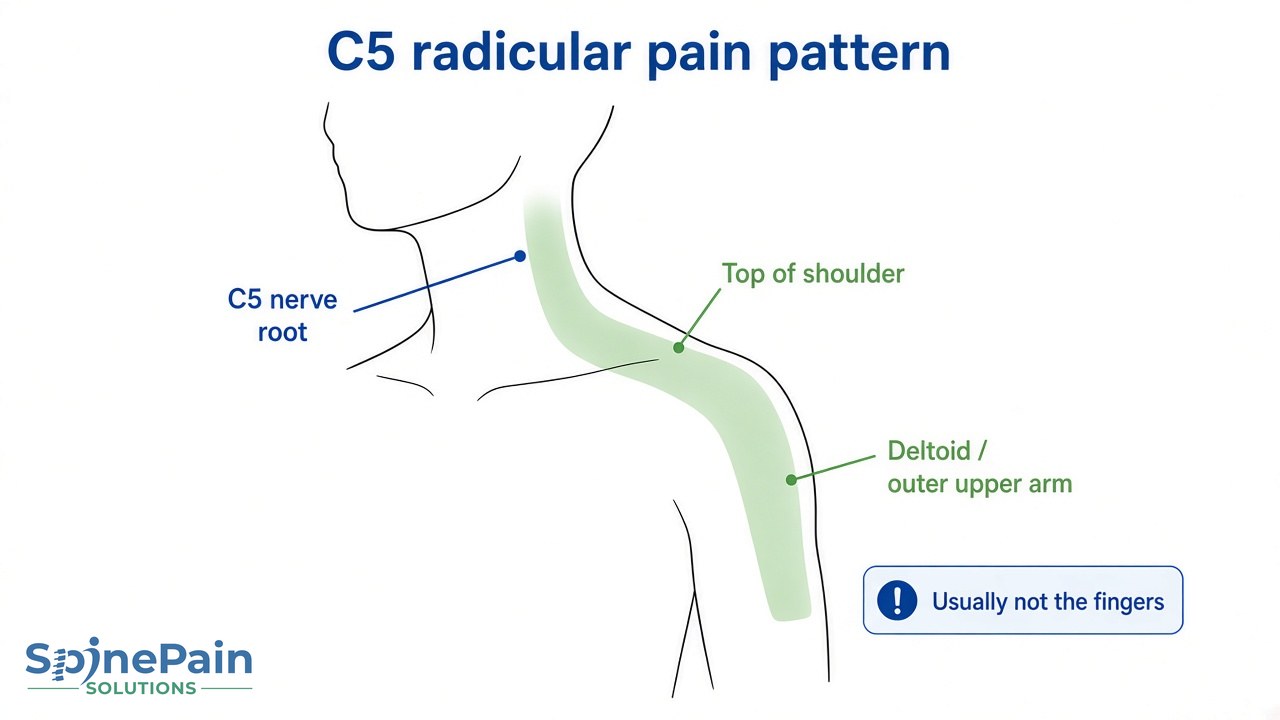
Symptoms sometimes become more noticeable when you look upward, turn your head toward the painful side, or hold your neck in one position for a long time. These triggers are clues, not a home diagnostic test. Shoulder problems can coexist with cervical nerve irritation, and pain patterns overlap.
What does C5 weakness feel like?
The deltoid muscle helps raise the arm sideways. Because C5 contributes to this movement, nerve dysfunction can make reaching a high shelf, putting on a jacket, or lifting an object away from your body more difficult. C5 also contributes to elbow bending through the biceps, although other nerve roots share that job.
A useful distinction is pain-limited movement versus true weakness. A painful shoulder tendon can stop you from lifting your arm even when the nerve is healthy. Your clinician may examine strength in several positions to determine whether the muscle is weak or simply hurts when used.
C5 radiculopathy or rotator cuff injury?
A rotator cuff problem begins in the shoulder tendons. C5 radiculopathy begins at a nerve root in the neck. Both can cause outer shoulder pain, night discomfort, and difficulty lifting an arm, so symptoms alone cannot reliably separate them.
| Clue | C5 nerve-root problem | Rotator cuff problem |
|---|---|---|
| Neck movement | May reproduce shoulder or upper-arm pain | Often less influential |
| Shoulder movement | May reveal nerve-related weakness | Often provokes tendon-related pain |
| Altered sensation | Possible over outer upper arm | Not typical of an isolated tendon injury |
| Imaging | Cervical MRI may show C4-C5 nerve compression | Shoulder imaging may show tendon injury |
Neither column is a diagnosis. Some people have age-related changes on both neck and shoulder imaging, and both abnormalities may be painless. Examination findings and the complete clinical picture matter more than any single test result.
Shoulder pain followed by arm weakness can also come from other problems. Inflammation of the brachial plexus (Parsonage-Turner syndrome / neuralgic amyotrophy), a problem of the suprascapular or axillary nerve, or frozen shoulder (adhesive capsulitis) can look similar. See our brachial plexopathy page when plexus inflammation is part of the differential.
How is C5 radiculopathy diagnosed?
Examination of both the neck and shoulder
Your clinician may test neck movement, shoulder range of motion, deltoid and biceps strength, sensation, and reflexes. Specific examination maneuvers can support a diagnosis, but no one maneuver establishes it. Testing the shoulder is important so that a tendon injury or joint disorder is not mistaken for a pinched nerve.
Dr. Amit Sharma & our minimally invasive pain & spine team.
When is a cervical MRI useful?
MRI can show a disc herniation or narrowing around the C5 nerve at C4-C5, as well as abnormalities involving the spinal cord. Imaging is especially important when there is progressive weakness, concerning neurological change, or persistent symptoms that may require a procedure or surgical evaluation. An MRI finding should match the symptoms and examination before it guides treatment.
Do you need an EMG?
Not always. Electromyography and nerve-conduction testing can be useful when the diagnosis remains uncertain or when a peripheral nerve disorder or other muscle problem is possible. When EMG is needed, it is performed at an outside lab. A normal EMG does not completely rule out cervical radiculopathy, particularly when symptoms are mostly pain or sensation changes.
What treatments help C5 radiculopathy?
Treatment depends on pain severity, function, examination findings, and whether weakness is stable or worsening. Many people improve with nonsurgical care, but significant neurological changes deserve timely assessment.
Physical therapy and practical adjustments
An individualized program may include gentle movement, neck and shoulder-blade strengthening, and gradual return to activity. Temporarily limiting positions that repeatedly trigger arm pain may help. Exercises should be modified if they worsen radiating symptoms or reveal increasing weakness.
Medication options
A clinician may recommend an appropriate pain reliever or anti-inflammatory medication. Choices depend on kidney function, blood pressure, gastrointestinal risks, other medications, and individual health history. Stronger medication is not necessarily more effective for nerve-root pain.
Cervical epidural steroid injection
For selected patients with persistent radiating pain despite appropriate initial treatment, a cervical epidural steroid injection may reduce inflammation around an irritated nerve. A selective nerve root block may also be considered when a single root is the target. These procedures do not remove a disc herniation or widen a narrowed nerve opening, and benefit varies. Cervical injections have uncommon but potentially serious complications, so the indication, imaging, technique, and alternatives require careful review.
When surgery may be discussed
A surgical opinion may be appropriate for progressive or substantial weakness, spinal cord involvement, or disabling symptoms that persist despite suitable nonsurgical treatment and match a compressive finding on imaging. The appropriate procedure depends on the anatomy; most people with uncomplicated radiculopathy do not need surgery.
How Dr. Sharma evaluates and treats C5 radiculopathy
At SpinePain Solutions, Dr. Amit Sharma examines both the neck and the shoulder so that a tendon problem is not mistaken for a pinched nerve (and vice versa). He reviews MRI when it is available or indicated, and when EMG or nerve conduction testing would answer a meaningful question, those studies are performed at an outside lab.
Care usually starts with physical therapy and medicines when they are appropriate. For selected patients with persistent radiating pain that matches a nerve-root pattern, a cervical epidural steroid injection or a selective nerve root block may be discussed. When progressive weakness, cord involvement, or failed nonsurgical care raises the need for a surgical opinion, we work with our spine surgery partners.
Appointments are available in Bay Shore, Commack, and Farmingdale (office locations). Call 631-310-0000.
When should you seek urgent care?
Seek prompt medical assessment for new or worsening objective arm weakness. Urgent evaluation is needed for rapidly progressing weakness, new trouble walking or maintaining balance, loss of hand coordination, new bladder or bowel dysfunction with neurological symptoms, fever with severe neck pain, or severe pain after significant trauma. These can suggest a condition more serious than an isolated C5 nerve-root problem.
Frequently asked questions
Can C5 radiculopathy cause shoulder pain without much neck pain?
Yes. Some people feel the discomfort mainly over the shoulder or outer upper arm. A shoulder disorder remains another possibility, so the examination should include both areas.
Dr. Amit Sharma & our minimally invasive pain & spine team.
When is C5 radiculopathy an emergency?
Call 911 or go to the nearest emergency room for sudden or rapidly progressive arm weakness, new bowel or bladder problems, saddle numbness, fever with severe neck or arm pain, sudden inability to use the arm after trauma, or new trouble walking or keeping balance with neurological symptoms. These warning signs can mean a problem more serious than an isolated C5 nerve-root issue.
Does C5 radiculopathy usually cause finger numbness?
No. Finger numbness is not a typical dominant feature of isolated C5 radiculopathy. Symptoms in the thumb or middle finger may point toward another nerve root or a peripheral nerve condition.
Can a C4-C5 disc bulge affect the C5 nerve?
Yes. The C5 nerve exits at the C4-C5 level. A disc herniation or foraminal narrowing there can irritate the nerve, but imaging findings must match symptoms and examination.
Can a rotator cuff tear and C5 radiculopathy happen together?
Yes. A person may have both a shoulder tendon injury and cervical nerve irritation. Treating only one source may not resolve all symptoms.
How long does C5 radiculopathy take to improve?
Many people improve over weeks to months, but the course varies. Persistent pain, substantial weakness, or worsening neurological findings should be reassessed rather than simply waiting.
Related SpinePain Solutions resources
- Cervical radiculopathy
- Rotator cuff tendinopathy
- Shoulder pain
- Brachial plexopathy
- Epidural steroid injection
- Selective nerve root block
- Pain locator
- Cervicobrachial pain
- Cervicobrachial syndrome vs. cervical radiculopathy
Medical references
- American Academy of Orthopaedic Surgeons (OrthoInfo): Cervical Radiculopathy (Pinched Nerve).
- American Academy of Physical Medicine and Rehabilitation: Cervical Radiculopathy.
- American Family Physician: Nonoperative Management of Cervical Radiculopathy (2016).
- ACR Appropriateness Criteria® Cervical Pain or Cervical Radiculopathy: 2024 Update. J Am Coll Radiol. 2025; doi:10.1016/j.jacr.2025.02.035. PMID: 40409873.