

C6 Radiculopathy: Thumb Tingling, Arm Pain, and Wrist Weakness
← Back to the shoulder pain locator
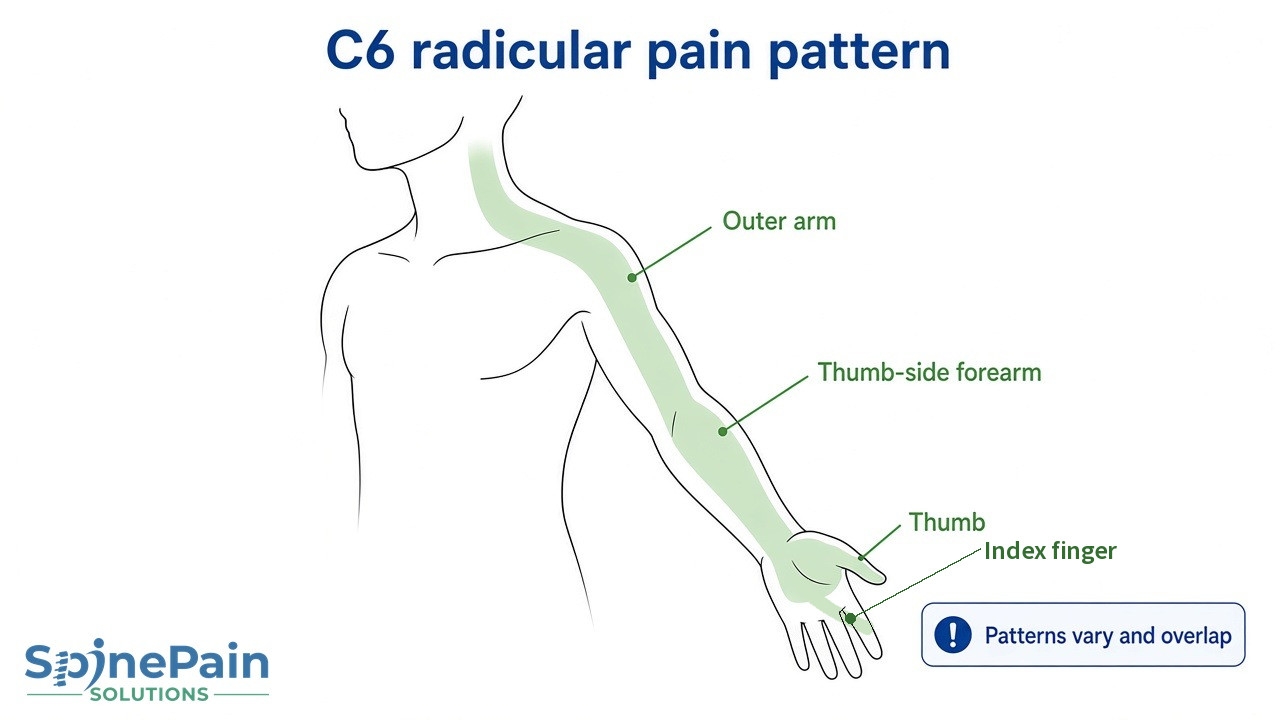
- C6 nerve irritation often causes pain from the neck into the outer arm and thumb-side forearm.
- Tingling can reach the thumb and sometimes the index finger.
- Weakness may affect wrist extension or bending the elbow.
- The brachioradialis reflex may be reduced.
- Carpal tunnel, radial nerve problems, and shoulder conditions can look similar.
- A C5-C6 MRI finding matters only if it matches the symptoms and exam.
Quick answer: C6 radiculopathy is irritation or compression of the C6 nerve root in the neck. It can cause pain down the outer arm and thumb-side forearm, tingling near the thumb, and sometimes weakness when bending the elbow or lifting the wrist. These symptoms can overlap with carpal tunnel syndrome, so the pattern alone is not a diagnosis.
You may first notice a prickling thumb while holding a phone, an ache along your forearm after working at a desk, or pain that seems to travel from your neck into your hand. The location can be confusing: a problem in the neck may feel like a wrist or hand problem. This guide focuses on the distinctive questions raised by C6, rather than repeating our broader cervical radiculopathy overview.
The C6 Pain Pattern: Where Symptoms Travel
The C6 nerve root usually leaves the spine between the C5 and C6 bones. Pain may travel from the neck or shoulder through the outer upper arm, down the thumb-side forearm, and into the thumb. Some people also feel tingling in the index finger. Symptoms do not always follow a perfect line, and a numb thumb alone cannot prove a C6 problem.
For example, holding a coffee mug may be uncomfortable because the forearm burns, while typing may trigger tingling in the thumb. Some patients notice pain near the shoulder blade before symptoms reach the hand. Others have almost no neck pain. These details are useful clues, but they must be matched with the physical examination.
Strength, sensation, and reflex map
C6 helps lift the wrist back, bend the elbow, and support certain forearm movements. During an exam, a patient may have trouble holding the wrist up against resistance. The brachioradialis reflex at the forearm can be reduced. Strength and reflex findings can overlap with C5 or C7, so several muscles must be checked.
What Else Can Look Like C6 Radiculopathy?
Carpal tunnel syndrome can cause nighttime tingling in the thumb and index finger, often without neck-to-arm pain. A radial nerve problem can also mimic part of this pattern. A higher radial nerve injury may weaken wrist extension; a superficial radial sensory nerve problem affects sensation over part of the back of the hand without causing weakness. The exact branch and location matter. A shoulder or tendon disorder can cause pain when lifting the arm, but usually does not create a matching thumb-side nerve pattern. Broad cervicobrachial pain can also occur without clear nerve-root dysfunction.
If symptoms wake you at night and improve when you shake the hand, a wrist problem becomes more likely. If turning your neck sends pain into the thumb-side forearm, the neck deserves closer attention. Neither clue is conclusive. Both conditions can exist at once, and treating only one may leave some symptoms unchanged. Read more about cervicobrachial pain versus radiculopathy, forearm pain, and arm numbness.
Where Is the C6 Nerve, and What Does It Do?
The cervical spine has seven vertebrae. The C6 nerve root usually leaves the spine through the opening between the fifth and sixth neck vertebrae, called C5-C6. A disc herniation or arthritic narrowing at that level can irritate the exiting C6 nerve. A disc finding at C5-C6 does not automatically mean that C6 is the cause of your symptoms.
C6 helps supply sensation along portions of the thumb-side forearm and hand. It also contributes to muscles involved in elbow bending and wrist extension, the movement used to lift the back of the hand toward the forearm. Nearby nerve roots share many of these jobs, so strength or numbness is rarely an exact map.
What Does C6 Radiculopathy Feel Like?
- Pain: Neck or shoulder-blade discomfort that may travel through the upper arm into the outer, thumb-side forearm.
- Tingling or numbness: Often reported around the thumb and sometimes the index finger; patterns vary.
- Weakness: Some people notice difficulty bending the elbow or extending the wrist, although pain itself can also limit effort.
- Position-related symptoms: Looking upward or turning the head toward the painful side may provoke arm symptoms in some patients.
Not everyone experiences all these findings. Some have severe radiating pain with normal strength. Others have measurable weakness with surprisingly little pain. A clinician checks both the symptom story and actual nerve function.
Why the thumb matters, but does not prove the diagnosis
Thumb tingling is a helpful clue because C6 often contributes to sensation in that region. But the median nerve also supplies parts of the thumb and index finger. Hand numbness can arise from a nerve compressed at the wrist, a problem elsewhere in the arm, or more than one condition at once.
C6 Radiculopathy or Carpal Tunnel Syndrome?
This is the central diagnostic question for many patients. Carpal tunnel syndrome involves pressure on the median nerve at the wrist; C6 radiculopathy involves a nerve root at the neck. Both may cause thumb-area symptoms, but their associated findings often differ.
| Clue | C6 nerve root | Carpal tunnel |
|---|---|---|
| Where the problem starts | Neck, often C5-C6 | Median nerve at wrist |
| Pain or tingling | May include neck, arm, radial forearm, thumb | Often thumb, index, middle finger; may wake you at night |
| What may worsen it | Certain neck positions | Wrist position, prolonged gripping, nighttime |
| Possible weakness | Elbow flexion or wrist extension | Thumb opposition or abduction in more advanced cases |
These clues are not definitive. Wrist nerve compression can coexist with cervical disease. This coexistence is sometimes described as “double crush,” but it does not by itself prove that one problem caused the other. The examination may include neck motion, arm strength, reflexes, sensation, and wrist-specific tests. Read our related forearm pain guide if pain is mostly below the elbow.
Why a C5-C6 MRI Finding May or May Not Explain Your Symptoms
A cervical MRI may show a disc protrusion, loss of disc height, or foraminal stenosis, which means narrowing of the opening through which the nerve exits. The critical questions are whether the narrowing is on the symptomatic side, whether it affects the exiting C6 nerve, and whether your examination fits.
For example, right-sided thumb tingling and reduced right brachioradialis reflex may make right C5-C6 foraminal narrowing more clinically relevant. But a mild bulge on the opposite side, or an MRI abnormality with no matching symptoms, may be incidental. Imaging is one piece of the diagnosis, not the diagnosis itself.
How Doctors Diagnose C6 Radiculopathy
History and neurological examination
Your clinician asks where the pain begins, how it travels, what brings it on, and whether it is worsening. Examination may include biceps and wrist-extensor strength, sensation, and the brachioradialis reflex. A neck-position test may reproduce familiar arm symptoms, but no single maneuver is conclusive.
When MRI or EMG is useful
MRI is not routinely needed at the first visit for uncomplicated, stable symptoms. It is often considered if symptoms fail to improve after about four to six weeks of appropriate nonsurgical care, or sooner for progressive objective weakness or concerns about spinal cord involvement, infection, cancer, or significant trauma. The timing depends on the examination; do not wait through worsening neurological symptoms. EMG and nerve-conduction testing may help separate nerve-root involvement from carpal tunnel syndrome or other peripheral nerve disorders when the answer remains uncertain. Early or predominantly sensory radiculopathy can produce a normal EMG. When radiculopathy is being assessed, nerve-conduction studies are generally paired with needle EMG rather than used alone.
Dr. Amit Sharma & our minimally invasive pain & spine team.
If symptoms extend beyond one nerve territory, the assessment may also consider cervicobrachial pain, a broader description of pain traveling from the neck toward the arm. Our comparison of cervicobrachial syndrome versus cervical radiculopathy explains why these terms should not be treated as identical.
What Treatments May Help?
First steps: movement, therapy, and medication
Many people improve over weeks to months without surgery. A clinician may recommend modifying activities that provoke symptoms, maintaining comfortable movement, and a tailored physical therapy program. Therapy may address neck mobility, shoulder-blade mechanics, and gradual strengthening. Avoid repeatedly forcing movements that trigger worsening radiating pain or weakness.
Pain medication or an anti-inflammatory may be considered when appropriate, but these are not safe for everyone. Kidney disease, stomach bleeding risk, blood-pressure problems, other medications, and pregnancy can change the options. There is no one-size-fits-all drug plan for C6 radiculopathy.
When a cervical epidural injection is considered
For persistent, clinically supported nerve-root pain, a cervical epidural steroid injection may be discussed. Its purpose is to reduce inflammation and sometimes provide temporary relief that makes rehabilitation easier. It does not repair a damaged disc or guarantee long-term improvement. Cervical injections have uncommon but potentially serious complications; the expected benefit and alternatives require individual discussion.
When surgical evaluation is appropriate
Surgery is not the default treatment. Referral becomes more important with progressive neurological weakness, signs of spinal cord involvement, or disabling symptoms that persist despite appropriate nonsurgical care and correspond to a treatable lesion on imaging. A surgeon determines whether decompression is appropriate and which operation, if any, fits the anatomy.
When Should You Seek Urgent Care?
Call 911 for sudden arm weakness with facial droop or trouble speaking, or arm pain with chest pressure, shortness of breath, or sweating. Go to the emergency department for rapidly worsening weakness, new difficulty walking or loss of balance with neurological symptoms, new bowel or bladder changes with neurological symptoms, severe neck pain after major trauma, or fever with severe neck pain and serious illness.
New arm weakness or hand clumsiness still needs prompt clinical assessment even when it is not rapidly worsening. Tell your clinician about a history of cancer, unexplained weight loss, immunosuppression, or persistent severe night pain. These findings can change the urgency and the tests needed; they are not typical uncomplicated C6 symptoms.
If symptoms are stable but persistent, especially if they interfere with sleep or work, arrange a clinical evaluation rather than guessing from a finger-numbness chart.
How Dr. Sharma Evaluates and Treats C6 Symptoms
At SpinePain Solutions, Amit Sharma, MD begins with your story: exactly where the pain travels, which fingers tingle, what makes symptoms worse, and whether strength is changing. The examination checks neck movement, shoulder and elbow joints, arm muscles, sensation, and reflexes. This matters because a painful shoulder or trapped peripheral nerve can imitate a cervical nerve-root problem.
When useful, a cervical MRI shows the discs, nerve openings, and spinal cord. An MRI finding by itself does not prove that a nerve is causing your symptoms. If the pattern is unclear, Dr. Sharma may recommend EMG and nerve conduction studies performed at an outside lab. These tests can help separate a neck nerve problem from a wrist, elbow, or other peripheral nerve condition. A normal or early EMG does not always exclude radiculopathy.
Most treatment plans begin with a practical combination of activity changes, appropriate medication, and targeted physical therapy. Therapy may focus on neck control, shoulder blade strength, posture, and safe movement. Avoid forcing stretches or exercises that clearly worsen arm symptoms. The right pace depends on pain, strength, and neurological findings.
If radiating arm pain remains limiting despite reasonable conservative care, selected patients may consider an epidural steroid injection or selective nerve root block. The choice depends on imaging, examination, the suspected nerve, and the balance of potential benefit and risk. An injection may reduce inflammation and help with rehabilitation, but it does not remove a disc or guarantee relief.
When weakness is progressing, spinal cord involvement is suspected, or disabling symptoms persist despite appropriate treatment, Dr. Sharma can coordinate an opinion with our spine surgery partners. For a consultation, call 631-310-0000. SpinePain Solutions sees patients in Bay Shore, Commack, and Farmingdale.
Frequently Asked Questions
Can C6 radiculopathy cause thumb and index finger tingling?
Yes. The thumb and thumb-side forearm are classic C6 sensory areas. The index finger can also be involved, but the pattern overlaps with carpal tunnel syndrome and is not diagnostic by itself.
When should I call 911 for arm or neck symptoms?
Call 911 for sudden arm weakness with facial droop, trouble speaking, chest pain, or other possible stroke or heart attack symptoms. Seek emergency care for rapidly worsening weakness, new trouble walking, loss of bladder or bowel control, or severe neck pain after major trauma.
Does a C5-C6 disc bulge mean the C6 nerve is damaged?
Not necessarily. A disc at C5-C6 can irritate the exiting C6 nerve, but many disc changes cause no symptoms. Dr. Sharma compares the MRI with the side of pain, strength, reflexes, and sensation.
Is C6 weakness the same as carpal tunnel weakness?
No. C6 may weaken wrist extension or elbow flexion. Carpal tunnel more often affects thumb muscles and hand sensation. An exam and, when needed, testing at an outside EMG lab can help distinguish them.
Dr. Amit Sharma & our minimally invasive pain & spine team.
Do I need an epidural injection for C6 pain?
Not always. Physical therapy, activity changes, and appropriate medication are usually considered first. A cervical epidural steroid injection or selective nerve root block may be discussed if symptoms remain limiting and the diagnosis is supported.
Can C6 radiculopathy get better without surgery?
Many patients improve with nonsurgical care, although the time course varies. New or worsening objective weakness should be assessed promptly, and our spine surgery partners can provide an opinion when needed.
Daily Activities: Practical Ways to Reduce a C6 Flare
Notice which positions make symptoms travel farther down the arm. Long periods looking down at a phone, working with the head pushed forward, or lifting overhead may aggravate some people. Short movement breaks and a more neutral screen height may help. Do not assume that one posture is the cause for everyone.
When sleeping, choose a position that keeps the neck supported rather than sharply bent. Some people are more comfortable with the arm supported on a pillow. Avoid prolonged positions that trigger hand tingling. If a prescribed exercise causes new weakness or stronger radiating pain, stop and ask your treating clinician to reassess it.
Track changes that matter: whether tingling spreads, whether objects are harder to hold, whether pushing or lifting feels weaker, and whether symptoms improve between episodes. A short symptom diary can make the office examination more informative. Severe or progressive weakness should not wait for the next routine visit.
The Bottom Line
C6 radiculopathy can connect seemingly unrelated symptoms: neck discomfort, outer forearm pain, thumb tingling, and difficulty lifting the wrist. The most useful next step is not to assume that every numb thumb is a pinched nerve, but to determine whether the pattern points to the neck, wrist, or both. SpinePain Solutions evaluates these findings in the context of your examination and imaging before recommending treatment.
Medical References
- American Academy of Family Physicians: Nonoperative Management of Cervical Radiculopathy (2016).
- NCBI Bookshelf: Cervical Radiculopathy (StatPearls).
- AAOS OrthoInfo: Cervical Radiculopathy (Pinched Nerve).
For a broader overview, see cervical radiculopathy and cervicobrachial pain.



