

C7 Radiculopathy: Middle Finger Tingling, Arm Pain, and Triceps Weakness
- C7 nerve irritation often sends pain from the neck down the back of the arm.
- Tingling or numbness may be most noticeable in the middle finger.
- Triceps weakness can make it harder to straighten the elbow or push away.
- The triceps reflex may be reduced.
- Carpal tunnel, radial nerve disorders, and shoulder pain can mimic parts of this pattern.
- A C6-C7 MRI abnormality is meaningful only when it matches the exam.
Quick answer: C7 radiculopathy happens when the C7 nerve root in the neck is irritated or compressed. It can cause pain from the neck or shoulder blade down the back of the arm, tingling near the middle finger, and sometimes weakness when straightening the elbow. The pattern is a clue, not proof: several hand and arm conditions can feel similar.
A person may notice a strange ache behind the upper arm while pushing open a heavy door, or tingling in the middle finger that seems unrelated to the neck. C7 is one of the common nerve roots involved in neck-to-arm pain. This guide focuses on the distinctive C7 pattern and triceps weakness. For a broader overview, see our cervical radiculopathy guide.
The C7 Pain Pattern: Where Symptoms Travel
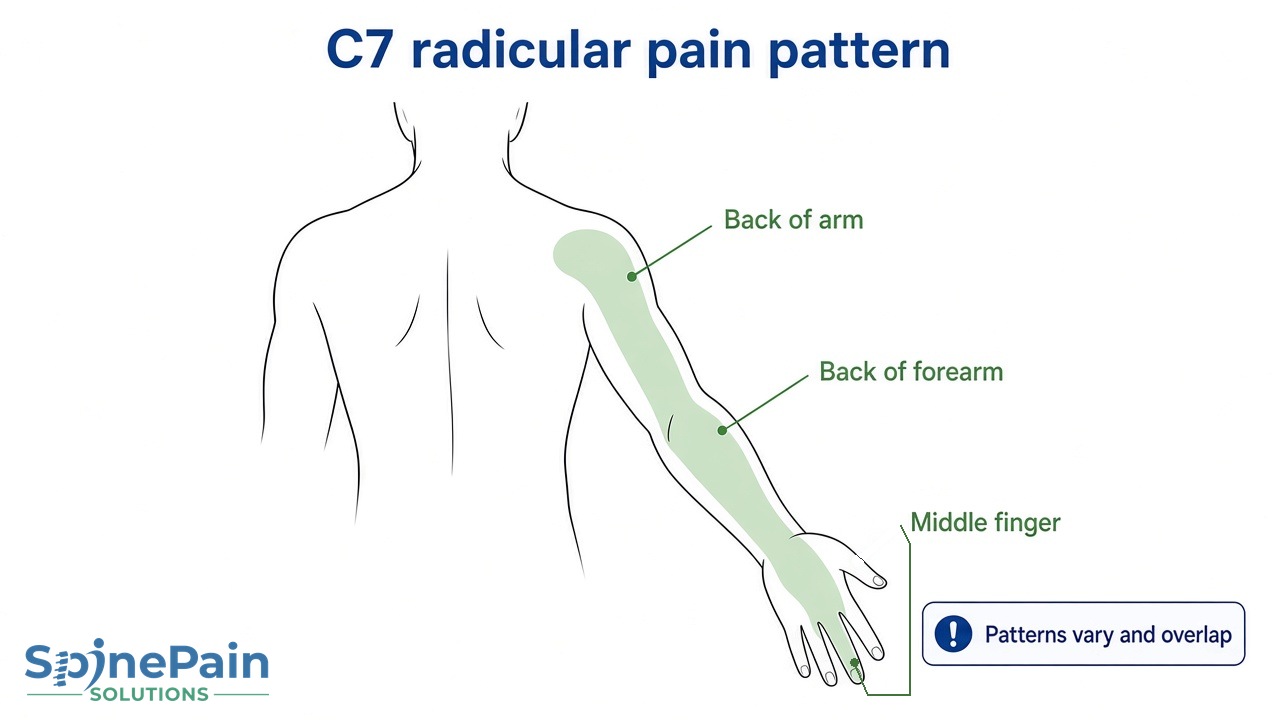
The C7 nerve root usually exits between the C6 and C7 bones. Symptoms may start in the neck or shoulder blade, travel down the back of the upper arm and forearm, and reach the middle finger. The thumb is not the main C7 sensory landmark. Real nerve symptoms may be patchy, and the middle finger can tingle for reasons other than a neck nerve problem.
A common complaint is that the arm aches behind the shoulder and the middle finger feels strangely numb while the patient is working at a desk. Others first notice that one arm is weaker when pushing themselves up from a chair. Because the triceps and hand muscles share work with other nerves, no single daily activity can confirm C7 involvement.
Strength, sensation, and reflex map
C7 plays an important role in straightening the elbow using the triceps muscle. A patient may find pushing open a heavy door, getting up from a chair with the arms, or doing a push-up harder on one side. The triceps reflex may be reduced. Wrist flexion and finger extension can also be affected, but the full strength pattern matters more than one movement. These muscles and reflex pathways receive contributions from more than one nerve root; a weak triceps or reduced reflex is not exclusive proof of C7 disease.
What Else Can Look Like C7 Radiculopathy?
Carpal tunnel syndrome can cause tingling in the middle finger, often at night or with wrist use. Radial nerve problems may cause weakness when straightening the wrist or fingers. A posterior interosseous nerve problem, a motor-branch disorder, can weaken finger extension without causing skin numbness; triceps and wrist-flexor strength are usually preserved. A more proximal radial nerve injury can have a different pattern. Shoulder and elbow disorders can cause arm pain without a true C7 nerve pattern. Cervicobrachial pain can also travel from the neck into the arm without confirmed nerve-root dysfunction.
Middle finger numbness is a helpful clue, not a diagnosis. If pain shoots down the arm when the neck is turned, cervical irritation is more likely. If symptoms begin at the wrist, occur mostly overnight, or involve several median-nerve fingers, carpal tunnel deserves attention. A patient can have both a neck and wrist condition. Tingling mainly in the little finger and the ulnar half of the ring finger suggests a different distribution, such as an ulnar nerve problem or C8 involvement, rather than the typical middle-finger C7 pattern. These are clues for the examination, not rigid borders. Read more about cervicobrachial pain versus radiculopathy, forearm pain, and arm numbness.
Where Is the C7 Nerve Root?
Seven small bones form the cervical spine. The C7 nerve root usually leaves the spinal canal through the opening at C6-C7, between the sixth and seventh cervical vertebrae. A herniated disc or narrowing of this opening can irritate the nerve.
The C7 nerve helps control several movements, especially straightening the elbow through the triceps muscle. It also contributes to wrist and finger movements and sensation in part of the hand. Nearby nerves share these functions, so one symptom cannot pinpoint a spinal level by itself.
What Does C7 Radiculopathy Feel Like?
- Radiating pain: Pain may start near the neck or shoulder blade and travel down the back of the upper arm and forearm.
- Middle finger tingling: Numbness or pins-and-needles can be noticeable in the middle finger, sometimes with neighboring fingers involved.
- Triceps weakness: Pushing a door or straightening the elbow against resistance may feel unusually difficult.
- Neck-related triggers: Looking up or turning the neck can reproduce arm pain in some patients.
- Reflex changes: The triceps reflex may be reduced on the affected side during an examination.
Some people have pain without numbness. Others have measurable weakness with only modest discomfort. C7 symptoms can overlap with C6 or C8 involvement, and they may not follow a textbook map.
Why middle finger tingling is helpful but not definitive
The middle finger is commonly associated with the C7 sensory pathway. However, the median nerve also supplies sensation to much of the middle finger. Tingling can come from carpal tunnel syndrome, another peripheral nerve problem, or a combination of problems in the neck and wrist. A clinician examines the whole arm rather than diagnosing C7 from one finger.
C7 Radiculopathy vs. Carpal Tunnel or Radial Nerve Problems
A major practical question is whether the trouble begins at the neck or farther down the arm. The table describes clues, not rules.
| Finding | C7 nerve root | Peripheral nerve condition |
|---|---|---|
| Where symptoms begin | May begin at neck or shoulder blade | Often hand, wrist, or arm |
| Tingling | Often middle-finger region | Median nerve can also affect middle finger |
| Weakness | May affect triceps and other C7 muscles | Pattern depends on nerve involved |
| Useful examination | Neck movement, triceps strength and reflex | Wrist/hand provocation and specific nerve testing |
Carpal tunnel syndrome often causes nighttime hand tingling, whereas a radial nerve injury may cause wrist or finger extension weakness. Neither finding is absolute. An examination, and sometimes electrodiagnostic testing, helps separate these conditions.
Can C7 Radiculopathy Make Your Arm Weak?
Yes. C7 contributes strongly to the triceps, the muscle on the back of the upper arm that straightens the elbow. You might find it harder to push yourself up from a chair using your arms, perform a push-up, or push open a heavy door. Wrist flexion and some finger-extension movements may also be affected.
Pain can make a muscle seem weak even when the nerve is working normally. A clinician compares both sides, checks specific muscle groups, and tests reflexes. New or worsening objective weakness deserves prompt evaluation. Do not rely on home strength tests to decide whether a nerve is damaged.
What Does a C6-C7 MRI Show?
MRI is not automatically needed for every stable, uncomplicated episode. It is often considered when symptoms fail to improve after about four to six weeks of appropriate nonsurgical care. It may be appropriate earlier depending on the examination, and is more urgent for progressive objective weakness, spinal cord findings, suspected infection or cancer, or significant trauma. Do not wait through worsening neurological symptoms merely to complete a treatment interval.
A cervical MRI can show a C6-C7 disc herniation, bone spurs, or narrowing of the opening where the C7 nerve exits. It can also assess the spinal cord. However, a report describing a “disc bulge” does not automatically establish the cause of pain.
The key questions are whether the abnormality is on the symptomatic side, whether it actually contacts or narrows the space around the C7 nerve, and whether the neurological examination fits. An MRI can show more than one abnormal level, and some findings are unrelated to symptoms. For more background, see our foraminal stenosis guide.
When might EMG or nerve conduction studies help?
These tests may be considered when symptoms could reflect carpal tunnel syndrome, radial neuropathy, another nerve-root level, or a more widespread nerve disorder. EMG looks for evidence of nerve-related muscle changes. Nerve conduction studies help evaluate nerves outside the spine. A normal study does not completely rule out cervical radiculopathy, particularly early or predominantly sensory cases. When testing for radiculopathy is needed, nerve-conduction studies are generally paired with needle EMG rather than used alone. Testing is not routine when the clinical diagnosis is clear; Dr. Sharma may refer you to an outside lab when the results could clarify the diagnosis.
Dr. Amit Sharma & our minimally invasive pain & spine team.
How Is C7 Radiculopathy Treated?
Many people improve with nonsurgical care. The plan depends on pain severity, duration, neurological findings, MRI results, and individual health risks.
Physical therapy and activity changes
An individualized program may include gentle cervical mobility, strengthening around the shoulder blades, graded activity, and carefully selected nerve-mobility exercises. Short-term adjustments to aggravating positions can help. Exercises that consistently increase radiating pain or weakness should be reviewed rather than forced.
Medication options
Depending on medical history, clinicians may consider appropriate pain-relieving or anti-inflammatory medicines. Kidney disease, blood pressure, stomach bleeding risk, medication interactions, and sedation risk affect which treatments are safe.
Cervical epidural steroid injection
For selected patients with persistent radicular arm pain despite appropriate conservative care, a cervical epidural steroid injection may be discussed. It aims to reduce inflammation around an irritated nerve. Relief varies and is not guaranteed; an injection does not remove a disc herniation or correct fixed narrowing. Cervical injections carry uncommon but potentially serious complications, so the risks and expected benefits must be reviewed carefully.
An injection should not delay surgical evaluation when there is progressive neurological weakness or evidence of spinal cord compression.
When is surgery considered?
A spine surgical consultation may be appropriate for progressive weakness, signs of spinal cord compression, or disabling symptoms that persist despite suitable nonsurgical treatment and match a compressive finding on imaging. The operation, if needed, depends on the anatomy and may involve decompression, disc replacement, or fusion.
When Should You Seek Urgent Care?
Call 911 for sudden arm weakness with facial droop or trouble speaking, or arm pain with chest pressure, shortness of breath, or sweating. Go to the emergency department for rapidly worsening weakness or the following severe neurological or systemic symptoms:
- Rapidly worsening arm or hand weakness.
- New trouble walking, repeated falls, or loss of balance.
- Increasing hand clumsiness, such as difficulty fastening buttons.
- New bladder or bowel dysfunction with neurological symptoms.
- Severe neck pain after trauma, or neck pain with fever and serious systemic illness.
These can suggest spinal cord involvement or another serious condition. They should not be treated as routine C7 nerve pain. New hand clumsiness or weakness that is not rapidly worsening still warrants prompt clinical assessment. Tell your clinician about a history of cancer, unexplained weight loss, immunosuppression, or severe persistent night pain, because these may change the urgency and workup.
How Dr. Sharma Evaluates and Treats C7 Symptoms
At SpinePain Solutions, Amit Sharma, MD begins with your story: exactly where the pain travels, which fingers tingle, what makes symptoms worse, and whether strength is changing. The examination checks neck movement, shoulder and elbow joints, arm muscles, sensation, and reflexes. This matters because a painful shoulder or trapped peripheral nerve can imitate a cervical nerve-root problem.
When useful, a cervical MRI shows the discs, nerve openings, and spinal cord. An MRI finding by itself does not prove that a nerve is causing your symptoms. If the pattern is unclear, Dr. Sharma may recommend EMG and nerve conduction studies performed at an outside lab. These tests can help separate a neck nerve problem from a wrist, elbow, or other peripheral nerve condition. A normal or early EMG does not always exclude radiculopathy.
Most treatment plans begin with a practical combination of activity changes, appropriate medication, and targeted physical therapy. Therapy may focus on neck control, shoulder blade strength, posture, and safe movement. Avoid forcing stretches or exercises that clearly worsen arm symptoms. The right pace depends on pain, strength, and neurological findings.
If radiating arm pain remains limiting despite reasonable conservative care, selected patients may consider an epidural steroid injection or selective nerve root block. The choice depends on imaging, examination, the suspected nerve, and the balance of potential benefit and risk. An injection may reduce inflammation and help with rehabilitation, but it does not remove a disc or guarantee relief.
When weakness is progressing, spinal cord involvement is suspected, or disabling symptoms persist despite appropriate treatment, Dr. Sharma can coordinate an opinion with our spine surgery partners. For a consultation, call 631-310-0000. SpinePain Solutions sees patients in Bay Shore, Commack, and Farmingdale.
Frequently Asked Questions
Is middle finger numbness always C7 radiculopathy?
No. Middle finger symptoms are common with C7 irritation, but carpal tunnel syndrome and other nerve conditions can also affect this finger. The neck, shoulder, arm, and hand examination helps locate the source.
When should I call 911 for neck or arm symptoms?
Call 911 for sudden arm weakness with facial droop, trouble speaking, chest pain, or other possible stroke or heart attack symptoms. Seek emergency care for rapidly worsening weakness, new trouble walking, loss of bladder or bowel control, or severe neck pain after major trauma.
Which disc level usually irritates the C7 nerve?
The C7 nerve commonly exits at C6-C7. A disc herniation or narrowed nerve opening there may cause symptoms, but the MRI finding must agree with the side and pattern of the examination.
Can C7 radiculopathy cause triceps weakness?
Yes. C7 contributes to elbow straightening and the triceps reflex. New difficulty pushing or straightening the arm needs an examination because pain and other nerve disorders can also affect strength.
Does C7 radiculopathy require an EMG?
Not routinely. Dr. Sharma may recommend EMG and nerve conduction studies performed at an outside lab if the diagnosis is uncertain or a peripheral nerve disorder may be present.
Dr. Amit Sharma & our minimally invasive pain & spine team.
What happens if physical therapy does not help?
Dr. Sharma may review MRI findings and consider an image-guided epidural steroid injection or selective nerve root block for selected patients. Persistent severe symptoms or progressive weakness may lead to an opinion from our spine surgery partners.
Daily Activities: Practical Ways to Reduce a C7 Flare
Notice which positions make symptoms travel farther down the arm. Long periods looking down at a phone, working with the head pushed forward, or lifting overhead may aggravate some people. Short movement breaks and a more neutral screen height may help. Do not assume that one posture is the cause for everyone.
When sleeping, choose a position that keeps the neck supported rather than sharply bent. Some people are more comfortable with the arm supported on a pillow. Avoid prolonged positions that trigger hand tingling. If a prescribed exercise causes new weakness or stronger radiating pain, stop and ask your treating clinician to reassess it.
Track changes that matter: whether tingling spreads, whether objects are harder to hold, whether pushing or lifting feels weaker, and whether symptoms improve between episodes. A short symptom diary can make the office examination more informative. Severe or progressive weakness should not wait for the next routine visit.
The Bottom Line
C7 radiculopathy is an important cause of neck-to-arm pain, middle-finger tingling, and triceps weakness. The most useful next step is not to assume that a tingling finger identifies the problem, but to match symptoms with a careful neurological examination and appropriate imaging.
At SpinePain Solutions, evaluation of neck-related arm pain focuses on identifying the actual source of symptoms and selecting care that fits the clinical findings. Our cervicobrachial syndrome versus cervical radiculopathy comparison explains why a broad neck-and-arm pain label is not the same as a confirmed nerve-root disorder.
Medical References and Related Reading
- Iyer S, Kim HJ. Cervical radiculopathy. Curr Rev Musculoskelet Med. 2016;9:272-280. doi:10.1007/s12178-016-9349-4.
- Kang KC et al. Cervical radiculopathy: Focus on characteristics and differential diagnosis. Asian Spine J. 2020;14:921-930. doi:10.31616/asj.2020.0647.
- American College of Radiology. Appropriateness Criteria: Cervical Pain or Cervical Radiculopathy.
For a broader explanation of neck-to-arm symptoms, see cervicobrachial pain and our cervical radiculopathy overview.



