

AC Joint Arthritis: Pain on Top of the Shoulder, Diagnosis, and Treatment
← Back to the shoulder pain locator
Quick Answer: AC Joint Arthritis
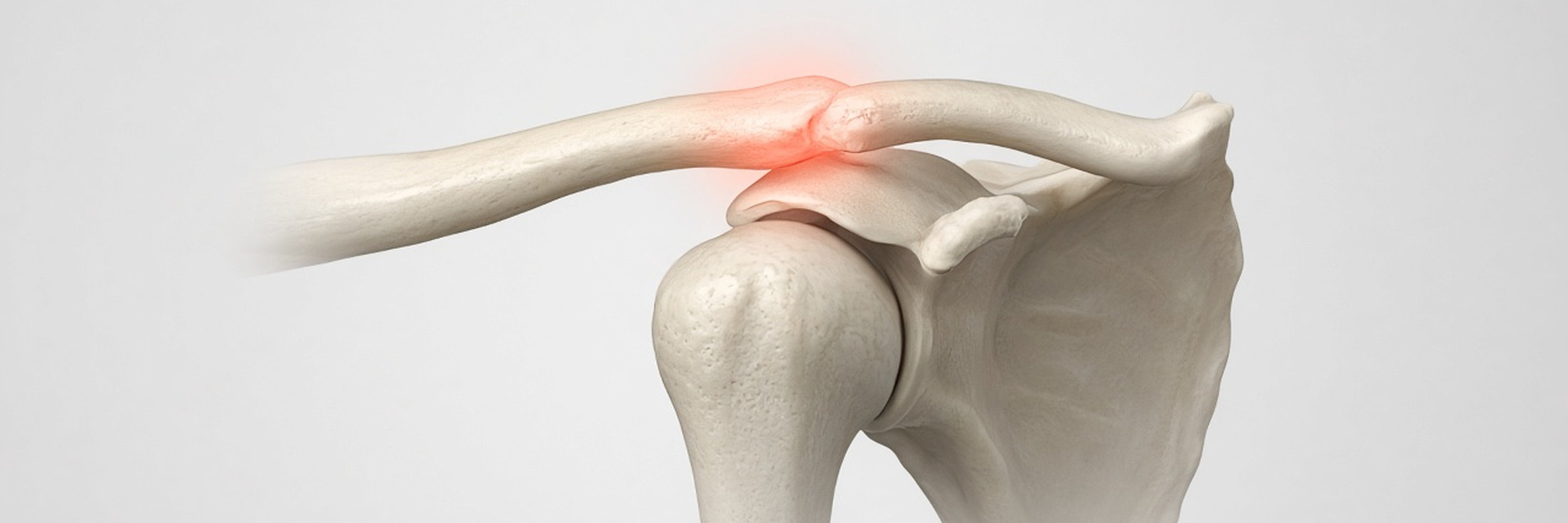
- The AC joint is the small joint on top of the shoulder, where the collarbone meets the acromion (part of the shoulder blade).
- Pain is often easy to point to with one finger. Reaching across the chest, pressing, or lying on that side may make it worse.
- Wear-and-tear changes on an X-ray are common and do not automatically prove the joint is the pain source.
- A small, image-guided AC joint injection can sometimes help confirm the source and ease symptoms for a time.
- Most people do not need surgery. A shoulder specialist may discuss options if well-localized pain persists.
- Call 911 or go to the nearest emergency room for a deformed shoulder after trauma, a cold or pale hand, or chest pain with shortness of breath. Bay Shore, Commack, Farmingdale / 631-310-0000.
Share this article
What Happens at the AC Joint?
The acromioclavicular joint, or AC joint, sits on top of the shoulder. It is where the collarbone (clavicle) meets the acromion. Arthritis here means the smooth cartilage has worn, and bone spurs or capsule irritation may develop. People can often point to the sore spot with one finger.
The shoulder is a team of parts that work together. These include the ball-and-socket joint (the glenohumeral joint), the acromioclavicular joint on top of the shoulder (the AC joint, where the collarbone meets a part of the shoulder blade called the acromion), the rotator cuff (the tendons that help lift and rotate the arm), the long head of the biceps tendon, the labrum (a rim of cartilage around the socket), the shoulder-blade muscles, and nerves from the neck. A problem in one part can change how the others share load. Imaging findings need to match the exam. A scan finding is not an automatic diagnosis.
How AC Joint Arthritis Feels
Pain is usually on the top of the shoulder. Reaching across the body, bench pressing, carrying a bag strap, or lying on that side may aggravate it. Symptoms can also show up when dressing, reaching into a cabinet, or exercising.
The timing matters. Gradual aching, sudden pain after a fall or a prior AC joint separation (a sprain of this joint, sometimes called a shoulder separation), and intermittent catching can each point toward different problems. Location helps, but it cannot make the diagnosis by itself.
Keep track of the movements that reliably bring on pain. Note whether symptoms travel below the elbow, whether you have numbness or tingling, and whether the arm can move farther when someone else gently supports it. These details can be more useful than a pain number alone.
Who Develops AC Joint Arthritis?
Age, repeated overhead or weightlifting activity, and a previous AC joint separation may raise the chance of this problem. Risk factors change probability, not certainty. A person may have several risk factors and still have a different source of pain.
How It Differs From Other Causes of Shoulder Pain
Rotator cuff disease
Rotator cuff tendinopathy or tears more often cause pain on the side of the shoulder and pain with raising the arm. Strength testing and the difference between active and passive motion help assess the cuff, although severe pain can make testing hard. See our guide to rotator cuff tendinopathy for this pattern.
Frozen shoulder and glenohumeral arthritis
Both can limit passive shoulder rotation (motion when someone else moves the arm). X-rays are especially helpful for identifying ball-and-socket arthritis. Frozen shoulder (adhesive capsulitis) is usually a clinical diagnosis after other important causes of stiffness have been considered.
Biceps tendon pain
Long-head biceps tendon problems more often cause pain at the front of the shoulder. The AC joint is higher, on top of the shoulder. Neither pattern is completely specific, and both conditions can be present at the same time.
Neck-related nerve pain
A pinched nerve in the neck (cervical radiculopathy) can send pain into the shoulder and arm, sometimes with tingling, numbness, or weakness. Neck pain usually does not reproduce isolated tenderness right over the AC joint. See our guides to cervical radiculopathy and C5 radiculopathy.
How the Diagnosis Is Made
The exam includes pressing on the AC joint, checking cross-body reaching, and assessing the rotator cuff, neck, and ball-and-socket motion. The clinician also looks at shoulder contour, active and passive motion, strength, and shoulder-blade movement. A single provocative test does not prove the diagnosis.
When are X-rays, ultrasound, or MRI helpful?
Plain X-rays can show joint narrowing or bone spurs, but these findings are common in people without pain. Ultrasound or MRI may help when another problem, such as a rotator cuff injury, might also be present. Advanced imaging is most useful when it answers a question that could change treatment. If symptoms and imaging disagree, the diagnosis should be reconsidered before an invasive procedure.
Dr. Amit Sharma & our minimally invasive pain & spine team.
Treatment Starts With the Right Diagnosis
First steps often include easing painful loading, temporarily reducing cross-body and heavy pressing exercises, and starting supervised rehabilitation. In a very painful phase, pushing hard through pain may worsen symptoms. As pain settles, loading and mobility work can be advanced in stages.
Medicine and activity changes
Acetaminophen, a topical anti-inflammatory medicine, or an oral anti-inflammatory drug may be options for some people. Kidney disease, heart risk, stomach bleeding, blood thinners, and other conditions can change what is safe. Medicine choices should be individualized after a review of your medical history.
Physical therapy and home exercise
A physical therapist can look at how the shoulder and shoulder blade move and can prescribe exercises that match the stage of recovery. Home exercises should be specific, tolerable, and advanced according to how the shoulder responds, rather than repeated without a plan.
When injections may help
A small-volume, image-guided AC joint injection with numbing medicine, sometimes with corticosteroid, can help show whether the joint is the pain source. It may also provide temporary relief. An AC joint injection is not the same as a glenohumeral (ball-and-socket) injection, a biceps tendon sheath injection, or a subacromial bursa injection. Relief after numbing medicine is useful information, but it is not a perfect test.
When a Shoulder Specialist Is Needed
If well-localized symptoms persist despite appropriate treatment, an orthopedic shoulder specialist may discuss surgery such as distal clavicle excision. Surgery is not needed for most people. Prompt specialty evaluation is especially important after recurrent instability, major weakness after trauma, progressive nerve problems, a displaced fracture, or a large lasting loss of function. A surgical consultation does not mean surgery is inevitable. It can clarify options and the risks of waiting.
What Recovery Can Look Like
Recovery depends on the diagnosis, the tissue involved, how stiff or weak the shoulder is, other medical conditions, and a rehabilitation plan you can tolerate. Improvement is often uneven. A brief flare after more activity does not always mean new structural damage. Steadily worsening weakness or a new deformity should prompt a recheck. Track practical milestones such as dressing, reaching a shelf, sleeping more comfortably, carrying light objects, and returning to work or sport.
How SpinePain Solutions Evaluates Shoulder Pain
At SpinePain Solutions, the evaluation starts with the symptom pattern and an exam of the shoulder and neck. Imaging is reviewed when it would change the plan. Care may include activity changes, physical therapy, and selected image-guided procedures when a pain source is clear. An orthopedic shoulder specialist is the right next step when structural repair or stabilization may be needed. An injection is not the right first step for every shoulder problem.
Dr. Amit Sharma is board certified in Pain Medicine and is the Founder and Director of SpinePain Solutions. He has performed more than 60,000 interventional procedures. He has been Chief, Division of Pain Medicine at Good Samaritan University Hospital since 2012 and is Medical Director of MICNY in Commack. He evaluates shoulder and neck pain patterns and selected image-guided options at Bay Shore, Commack, and Farmingdale (office locations). Plans stay based on the exam and conservative-first care. Call or text 631-310-0000. If symptoms suggest an emergency, call 911 or go to the nearest emergency room instead of waiting for an office visit.
Related reading: shoulder pain guide, rotator cuff tendinopathy, shoulder pain when sleeping, shoulder pain when reaching behind the back, C5 radiculopathy, and the Pain Locator.
When to Seek Urgent Medical Care
Call 911 or go to the nearest emergency room for a visibly deformed shoulder after trauma, a suspected dislocation or fracture, a cold or pale hand, loss of a pulse, rapidly worsening weakness, or sudden major numbness. A hot, swollen joint with fever or severe unexplained pain needs urgent evaluation for infection. Chest pain, shortness of breath, or other possible heart symptoms should not be blamed on a shoulder problem.
Frequently Asked Questions
1. Where does AC joint arthritis hurt?
It typically hurts on the top of the shoulder, near the outer end of the collarbone. Reaching across the body may also bring the pain on.
2. When is AC joint pain a medical emergency?
Call 911 or go to the nearest emergency room for a visibly deformed shoulder after an injury, a cold or pale hand, loss of a pulse, or chest pain, shortness of breath, or other possible heart symptoms. A hot, swollen joint with fever needs urgent same-day care. Call SpinePain Solutions at 631-310-0000 for non-emergency questions.
3. Does an X-ray prove the AC joint is causing pain?
No. Wear-and-tear changes are common even in people without pain. The exam, and sometimes a diagnostic injection, helps show whether the joint is the true source.
4. Can AC joint arthritis cause pain when sleeping?
Yes. Lying on the affected shoulder can put direct pressure on a painful AC joint. Other shoulder problems can also disturb sleep, so the pattern still needs an exam.
5. Is an AC joint injection different from a shoulder joint injection?
Yes. The AC joint is a small joint on top of the shoulder. It is separate from the deeper ball-and-socket joint (the glenohumeral joint).
6. When is surgery considered?
Surgery is usually considered only when clearly localized symptoms persist after a reasonable course of nonoperative care. One option some orthopedic specialists discuss is removing a small piece of the end of the collarbone (distal clavicle excision).
Dr. Amit Sharma & our minimally invasive pain & spine team.
Medical References and Further Reading
1. American Academy of Orthopaedic Surgeons (OrthoInfo). Arthritis of the Shoulder. https://www.orthoinfo.org/bodypart/shoulder/arthritis-of-the-shoulder/
2. American Academy of Orthopaedic Surgeons (OrthoInfo). Shoulder Separation. https://www.orthoinfo.org/bodypart/shoulder/shoulder-separation/
3. American College of Radiology. ACR Appropriateness Criteria: Chronic Shoulder Pain. https://acsearch.acr.org/docs/3101482/Narrative/
4. National Health Service (NHS). Shoulder pain. https://www.nhs.uk/symptoms/shoulder-pain/



