
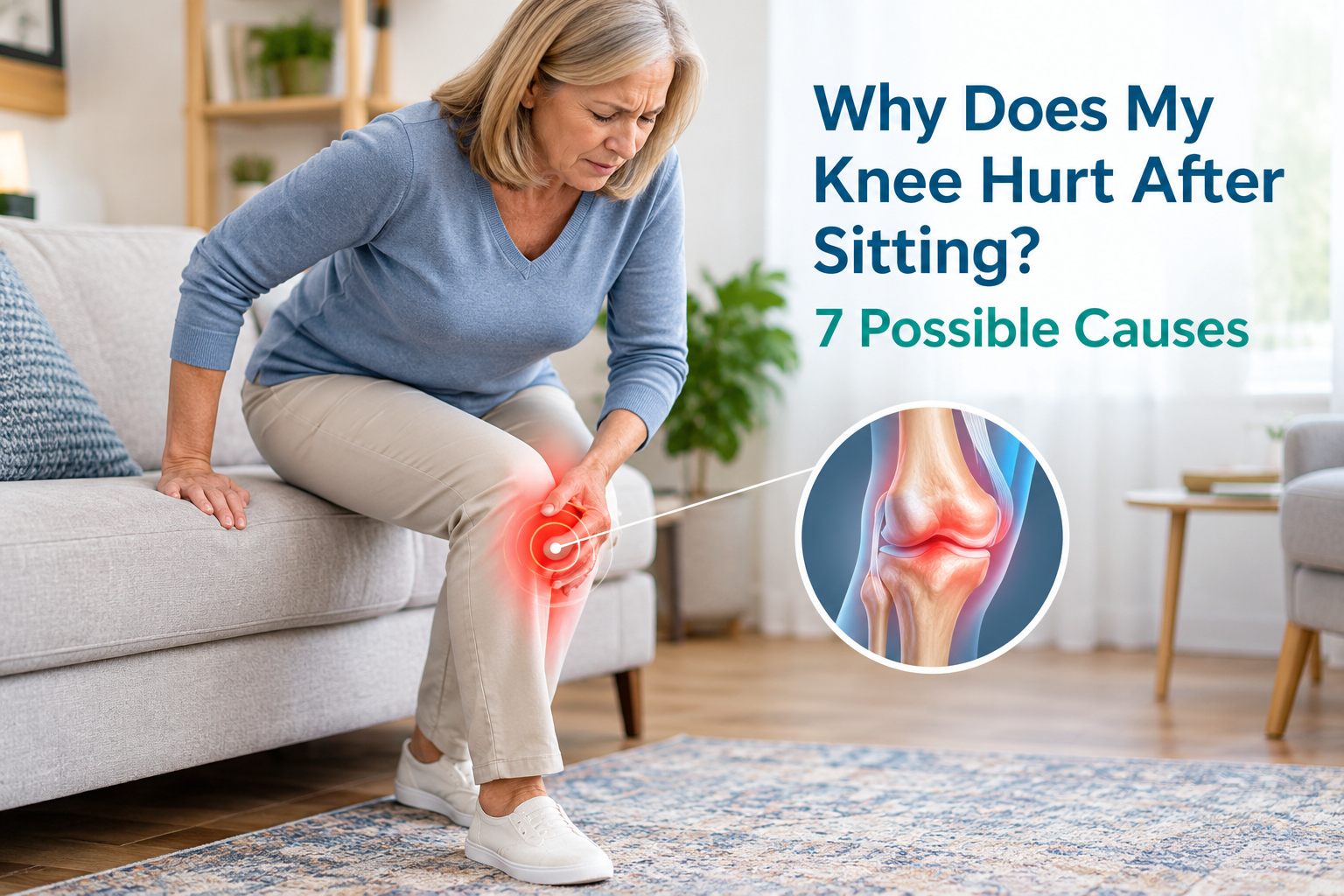
Why Does My Knee Hurt After Sitting? 7 Possible Causes
Knee pain after sitting can make the first steps out of a chair, car, or movie theater unexpectedly uncomfortable. The knee may feel stiff, ache behind the kneecap, or produce a sharp twinge when you stand. Sometimes the discomfort fades after a short walk. In other cases, it persists or is accompanied by swelling, catching, or weakness.
The key is to distinguish start-up pain, which often eases once you move, from pain caused by a structural injury, inflammatory joint disease, or a problem outside the knee. The same sit-to-stand movement can stress the kneecap, joint surfaces, tendons, and surrounding muscles in different ways.
Why Does Knee Pain After Sitting Happen?
Standing from a chair requires your quadriceps to straighten the knee while the joint supports increasing body weight. As you rise, the kneecap glides over the thighbone, the menisci distribute load, and tendons transmit force from muscle to bone. A painful structure may become noticeable precisely when it is loaded after a period of stillness.
Prolonged knee flexion can also irritate tissues around the kneecap. For other people, inactivity makes an arthritic knee feel temporarily stiff, so the first few steps hurt more than later ones. Neither response proves a specific diagnosis. A knee that locks mechanically or remains hot and swollen requires a different evaluation than one that simply loosens up with movement.
7 Possible Causes of Knee Pain When Getting Up From a Chair
1. Knee Osteoarthritis and Start-Up Stiffness
Osteoarthritis can affect the cartilage, underlying bone, joint lining, and other tissues of the knee. Patients may describe a dull ache or stiffness after sitting that improves as they begin walking. Discomfort may return with prolonged standing, stairs, or longer walks. Some people notice grinding or a reduced ability to fully straighten the knee.
Osteoarthritis becomes more common with age, but an X-ray showing cartilage loss does not automatically prove that arthritis is the only source of pain. The location of tenderness, range of motion, swelling, gait, and functional limitations still matter. Our knee pain overview explains why treatment should follow the dominant pain generator rather than the X-ray alone.
2. Patellofemoral Pain: Pain Behind or Around the Kneecap
Patellofemoral pain often produces an ache around or behind the kneecap, especially after sitting with the knees bent. It may also flare during squats, stairs, running, or repeated rising from low chairs. This prolonged-sitting pattern is sometimes called the movie-theater sign.
Patellofemoral pain is not synonymous with a torn cartilage surface or a permanently misaligned kneecap. Load tolerance, hip and quadriceps strength, training changes, and movement patterns can contribute. Exercise-based rehabilitation is usually more important than injections for an uncomplicated patellofemoral pain pattern.
3. Meniscus Irritation or Tear
The medial and lateral menisci are cartilage structures that help distribute force across the knee. A meniscal injury may follow twisting or develop gradually with degenerative changes. Pain can be felt along the inner or outer joint line and may become noticeable during a pivot, deep bend, or sit-to-stand transition.
Catching, recurrent swelling, or painful twisting can raise suspicion, but these symptoms are not unique to a meniscal tear. Degenerative meniscal findings are common on MRI, including in people whose pain comes from arthritis. True locking, when the knee physically cannot fully extend, deserves timely assessment and is different from a brief painful hesitation.
4. Patellar or Quadriceps Tendon Overload
The patellar tendon below the kneecap and the quadriceps tendon above it help straighten the knee. Tendon pain may be localized to the front of the knee and worsen with repeated chair rises, squats, jumping, or stairs. A sudden increase in exercise or repetitive loading may precede symptoms.
Tendinopathy generally responds to a graded loading program, not complete immobilization. A sudden pop, major swelling, or inability to actively straighten the knee after an injury raises concern for a tendon rupture and requires urgent evaluation.
5. Pes Anserine-Region Pain or Bursitis
Pain a few inches below the inner knee joint line may come from the pes anserine tendons or nearby bursa rather than the joint itself. It can be aggravated by rising from a chair, climbing stairs, or repeated walking. Localized tenderness helps distinguish this region from pain directly along the medial joint line.
The region can be painful from tendon irritation, bursitis, or both, and it may coexist with medial knee osteoarthritis. Read about pes anserine-region pain and targeted evaluation to understand why an injection into the bursa is not interchangeable with an injection inside the knee joint.
6. Inflammatory Arthritis or a Crystal-Related Flare
Inflammatory arthritis, gout, or calcium-pyrophosphate crystal disease can make the knee painful and stiff after rest. Clues include visible swelling, warmth, prolonged morning stiffness, or recurrent episodes of marked inflammation. Some patients have other painful joints or systemic symptoms.
A suddenly hot, swollen knee is not a routine start-up pain pattern. Infection must be considered, particularly with fever, recent surgery, immune suppression, or severe pain with even small movements. Joint aspiration may be needed to identify infection or crystals; an injection should not be given before a suspected infection is evaluated.
7. Pain Referred From the Hip or Lower Back
Sometimes the knee is not the original source of pain. Hip osteoarthritis can refer pain toward the front of the thigh or knee, while lumbar nerve-root problems can cause radiating pain, tingling, numbness, or weakness. If knee examination is relatively normal but hip rotation is restricted or back movement reproduces symptoms, the evaluation should expand beyond the knee.
A clinician may examine the hip and lower back as well as the knee, particularly when pain is poorly localized or neurological symptoms are present. See our arthritis evaluation and treatment guide for how different joint sources are assessed.
Where the Knee Hurts Provides Useful Clues
Ask yourself where you feel the pain most precisely when you rise. A one-finger location is often more helpful than saying that the entire knee hurts. These patterns are clues rather than self-diagnoses.
| Pain location | Possible explanation | Additional clue |
|---|---|---|
| Behind or around kneecap | Patellofemoral pain or patellofemoral arthritis | Long sitting, stairs, squatting |
| Inner or outer joint line | Osteoarthritis or meniscal disorder | Tenderness, twisting pain, swelling |
| Below inner joint line | Pes anserine tendons or bursa | Focal tenderness over upper inner shin |
| Just above or below kneecap | Quadriceps or patellar tendon | Pain with resisted straightening |
| Diffuse, hot, swollen joint | Inflammatory or infectious process | Urgent assessment if acute or fever present |
Why Do the First Few Steps Hurt More Than Later Steps?
This is commonly described as start-up pain. After a period of inactivity, the knee may feel stiff or uncomfortable under its first load. In osteoarthritis, symptoms can ease after gentle movement and return with prolonged activity. Patellofemoral pain may also become more noticeable when the knee has remained bent for a long time.
Do not assume that improvement after walking proves harmless arthritis. Persistent swelling, progressive loss of motion, a history of injury, or pain that never settles should change the plan. Likewise, a knee that actually collapses under you is a different complaint. Our guide to knee buckling is useful for that distinction.
Dr. Amit Sharma & our minimally invasive pain & spine team.
How Doctors Diagnose Knee Pain After Sitting
The evaluation begins with a detailed history: which knee hurts, how long you sit before pain starts, whether the first steps improve it, and whether stairs, squatting, kneeling, or driving produce the same symptom. Your clinician should ask about swelling, injury, fever, locking, giving way, prior knee surgery, and other painful joints.
Examination typically includes knee range of motion, tenderness, swelling or effusion, kneecap loading, ligament stability, functional sit-to-stand movement, and walking pattern. The hip and neurological examination may be important when symptoms do not fit a straightforward knee disorder. No single provocative maneuver establishes patellofemoral pain or a meniscal tear with certainty.
Do You Need an X-Ray or MRI?
For persistent knee pain, weight-bearing X-rays are often the most useful first imaging study. They can show joint-space narrowing, bone spurs, alignment changes, and other structural findings. A normal X-ray does not rule out every tendon, cartilage, or meniscal problem.
MRI is usually reserved for a question that X-rays and examination cannot answer, such as a suspected important internal injury, persistent unexplained symptoms, or planning treatment when the result would change management. The 2026 American College of Radiology chronic-knee-pain imaging update supports selecting imaging according to the clinical scenario rather than ordering MRI automatically.
What Helps Knee Pain After Sitting?
Treatment depends on the diagnosis and severity. For many mechanical knee problems, the foundation is a combination of activity modification, gradual strengthening, and management of any swelling or inflammation. A procedure should not be the default response to pain during one movement.
Break Up Long Periods of Sitting
If sitting is the main trigger, change position and gently move the knee at regular intervals. Before standing after a long drive or meeting, try several comfortable knee bends and straightens while seated. Avoid forcing the knee into painful deep flexion or standing suddenly on a leg that feels unstable.
Strengthen the Quadriceps and Hip Muscles
A structured exercise program may include gradually progressed sit-to-stands from a higher chair, controlled step-ups, quadriceps exercises, and hip strengthening. For patellofemoral pain, combining hip- and knee-focused exercise has better support than relying on passive treatments alone. For osteoarthritis, land-based or aquatic exercise can improve pain and function.
The starting difficulty matters. Someone with severe swelling, recent trauma, or suspected tendon injury should not be told to push through pain. A physical therapist can modify depth, speed, resistance, and frequency while monitoring the response.
Use Medication Selectively
Topical anti-inflammatory medication may be useful for knee osteoarthritis when medically appropriate. Oral anti-inflammatory drugs can help some patients but carry risks, including gastrointestinal bleeding, kidney problems, cardiovascular effects, and interactions with blood thinners. Medication decisions should account for medical history rather than treating all knee pain the same way.
When Are Knee Injections Appropriate?
For a symptomatic arthritic knee with persistent pain despite appropriate nonprocedural care, an intra-articular corticosteroid injection may provide short-term relief, particularly when inflammation is contributing. It does not rebuild cartilage or correct an unstable knee. Repeated injections should be considered carefully rather than scheduled automatically.
An injection inside the knee is different from treatment directed at an inflamed bursa or tendon outside the joint. Ultrasound can help assess the target in selected cases. Learn about the distinctions in our joint injection guide.
When Is a Specialist or Surgical Opinion Needed?
Persistent limitations despite a well-matched rehabilitation program deserve reassessment. Advanced osteoarthritis with unacceptable pain and function may lead to a discussion of knee replacement. True locking, major tendon injury, recurrent instability, or an acute structural injury may require earlier orthopedic evaluation. Pain management can be part of the pathway, but it should not delay treatment of a correctable mechanical problem.
A Safer Way to Get Up From a Chair
- Move toward the front of the seat and place both feet securely on the floor.
- Use a chair height that allows you to rise without an excessively deep knee bend.
- Lean your trunk slightly forward, then push through both legs in a controlled motion.
- Use stable armrests if balance or leg strength is limited; avoid pulling on an unstable object.
- Pause before walking if the knee feels stiff or unsteady, and use an appropriate walking aid when recommended.
These adjustments may reduce symptoms while you arrange appropriate care, but they are not a substitute for identifying a persistent underlying problem. Repeatedly avoiding knee movement can worsen deconditioning and make transfers harder over time.
When Should Knee Pain Be Checked Promptly?
Arrange medical evaluation when pain persists for more than a short period, limits routine activities, causes recurrent swelling, or steadily worsens. Seek urgent care for a newly hot, markedly swollen knee, especially with fever, or for an inability to bear weight after injury. A deformed knee or inability to actively straighten it after a sudden injury also needs urgent assessment.
Sudden calf swelling, redness, or tenderness may signal a blood clot, particularly after surgery or prolonged immobility. If it occurs with chest pain or shortness of breath, call emergency services. New progressive leg weakness, loss of bladder or bowel control, or saddle numbness points to a possible neurological emergency rather than ordinary knee arthritis.
What If the Knee Was Already Replaced?
Pain or stiffness when standing after knee replacement can reflect weakness or rehabilitation needs, but persistent or new pain should not automatically be labeled normal. Infection, loosening, instability, fracture, stiffness, and other causes may require assessment by the treating orthopedic team. New warmth, redness, fever, drainage, or rapidly worsening pain after replacement warrants prompt medical attention.
A pain-focused procedure should not replace evaluation for a treatable implant complication. If mechanical or infectious problems have been excluded, selected persistent pain cases may be discussed with an interventional pain specialist.
Dr. Amit Sharma & our minimally invasive pain & spine team.
Frequently Asked Questions
Why does my knee hurt when I stand up after sitting?
Knee pain after sitting may reflect osteoarthritis-related start-up stiffness, patellofemoral pain, meniscal irritation, tendon or bursal pain, or another cause. The location, duration of stiffness, swelling, and whether walking improves symptoms help narrow the diagnosis.
Why do my first few steps hurt, then my knee feels better?
Short-lived stiffness or pain that eases after several steps is often called start-up pain. It can occur with knee osteoarthritis and other mechanical conditions. Persistent swelling, prolonged morning stiffness, or worsening symptoms require a broader assessment.
Can sitting too long cause kneecap pain?
Yes. Keeping the knee bent for a long period can aggravate patellofemoral pain, especially when discomfort is around or behind the kneecap. This pattern is sometimes called the movie-theater sign, but it is not diagnostic by itself.
Is knee pain after sitting always arthritis?
No. Patellofemoral pain, meniscal disorders, tendinopathy, pes anserine-region pain, inflammatory arthritis, and pain referred from the hip or lower back can cause similar symptoms. Age and X-ray changes alone do not establish the cause.
Should I get an MRI for knee pain when getting up from a chair?
Not automatically. Examination and, when appropriate, weight-bearing knee radiographs are usually more useful first steps for chronic knee pain. MRI may help when there is a suspected significant internal injury, persistent unexplained symptoms, or a result that would change treatment.
Does knee pain after driving mean a meniscus tear?
Not necessarily. Prolonged knee flexion during driving can aggravate patellofemoral pain or arthritis. A meniscal problem becomes more concerning when there is joint-line tenderness, recurrent swelling, catching, or true locking, especially after a twisting injury.
What exercises help knee pain after sitting?
An individualized program that gradually strengthens the quadriceps and hip muscles and restores comfortable knee movement is often useful. Short movement breaks and progressive sit-to-stand practice can help, but exercise should be adjusted for swelling, injury, or severe pain.
When is knee pain after sitting an emergency?
Seek urgent assessment for a hot, markedly swollen knee with fever, inability to bear weight after injury, a visibly deformed knee, or rapidly worsening symptoms. Sudden calf swelling or pain with shortness of breath requires emergency assessment for a possible blood clot.
References
- American Academy of Orthopaedic Surgeons. Patellofemoral Pain Syndrome. OrthoInfo.
- Willy RW, et al. Patellofemoral Pain: Clinical Practice Guidelines. J Orthop Sports Phys Ther. 2019;49(9):CPG1–CPG95.
- American Academy of Orthopaedic Surgeons. Management of Osteoarthritis of the Knee (Non-Arthroplasty). Clinical Practice Guideline, 2021.
- Kolasinski SL, et al. 2019 American College of Rheumatology/Arthritis Foundation Guideline for Osteoarthritis. Arthritis Rheumatol. 2020.
- American College of Radiology. ACR Appropriateness Criteria: Chronic Knee Pain, 2026 Update. J Am Coll Radiol. 2026;23(8):1799–1809.



