
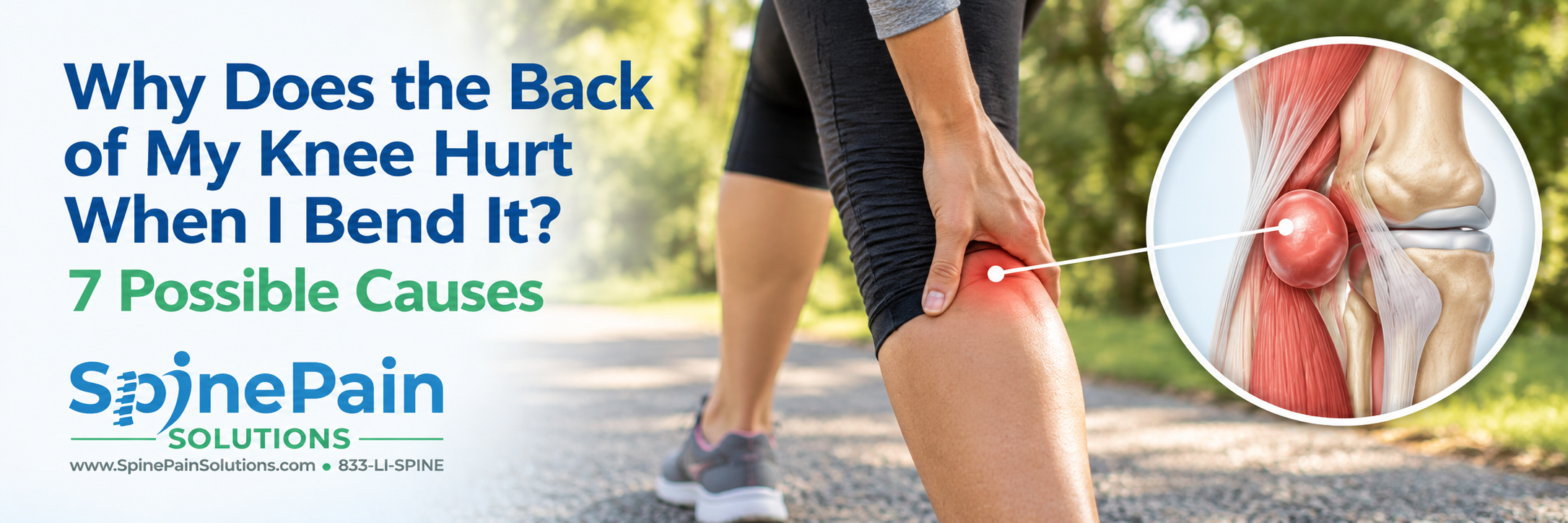
Why Does the Back of My Knee Hurt When I Bend It? 7 Possible Causes
Pain behind the knee when bending can make everyday movements unexpectedly difficult. You may feel a pulling sensation when squatting, pressure when bringing your heel toward your buttock, or a sharp pain when getting into a car. Some people notice a lump or swelling behind the knee; others have pain without any visible change.
The location matters, but it does not identify the diagnosis by itself. The back of the knee contains tendons, ligaments, nerves, blood vessels, and a fluid-filled space that can enlarge when the joint becomes irritated. Pain may begin in one of these structures or be referred from the knee joint or lower back.
Quick answer: Common explanations include a Baker’s cyst, meniscal injury, osteoarthritis with joint swelling, hamstring tendon irritation, calf muscle strain, or a posterior ligament injury. Occasionally, symptoms that seem to come from the knee are related to a nerve or circulation problem. Sudden calf swelling or a hot, red, painful leg should never be assumed to be an ordinary knee strain.
Why Does Bending Make the Back of the Knee Hurt?
When you bend the knee, the menisci shift, the hamstring tendons contract or stretch depending on the movement, and soft tissues in the hollow behind the knee change shape. Deep flexion also places pressure on the back of the joint. If the joint contains excess fluid, a swollen bursa or cyst may feel tight as the available space changes.
It is useful to distinguish pain with active bending (using your muscles to pull the heel backward) from pain with deep passive bending (when the knee is folded without much muscular effort). The former may implicate a tendon or muscle, while the latter may emphasize a joint or space-occupying problem. These are clues, not diagnostic tests you should force at home.
7 Possible Causes of Pain Behind the Knee When Bending
1. Baker's Cyst (Popliteal Cyst)
A Baker’s cyst is a pocket of joint fluid that expands into a bursa at the back of the knee. It is often associated with osteoarthritis, a meniscal tear, or another condition that increases fluid production inside the joint. A small cyst may cause no symptoms; a larger one can create fullness, pressure, or stiffness when you bend or straighten the leg.
Some patients can feel a smooth lump in the hollow behind the knee, particularly while standing. Others notice tightness after walking or prolonged standing. A cyst may change in size as knee inflammation fluctuates, and the size of the cyst does not always match the intensity of pain.
Important: A ruptured Baker’s cyst can cause sudden calf pain and swelling that resembles a blood clot. Because the two can look alike, new calf swelling requires prompt medical assessment rather than a home diagnosis.
2. Meniscus Tear or Degenerative Meniscal Change
The medial and lateral menisci are cartilage structures that distribute pressure inside the knee. A twisting injury can tear a meniscus, but degenerative changes also become more common with age and may develop without a memorable injury. Tears involving the back portion of a meniscus can cause pain toward the rear or joint line of the knee, especially with deep bending or twisting.
Clues include tenderness along the inner or outer joint line, swelling after activity, painful catching, or difficulty squatting. A knee that truly locks and cannot fully straighten needs prompt orthopedic assessment. Clicking by itself is common and does not prove a meniscal tear.
Not every meniscal abnormality seen on MRI causes pain. The imaging finding must fit the symptoms and examination, and many degenerative meniscal problems are initially managed without surgery.
3. Knee Osteoarthritis and Joint Inflammation
Osteoarthritis can irritate the joint lining and produce swelling, stiffness, and discomfort with weight-bearing movement. Although people often think of arthritis as pain in the front or inner knee, the discomfort can also be felt behind it. Extra joint fluid may contribute to a Baker’s cyst, so arthritis and a cyst frequently occur together rather than representing two unrelated diagnoses.
Morning stiffness that eases after movement, aching after longer walks, reduced knee motion, and intermittent swelling may suggest arthritis. Some patients have more difficulty with stairs or standing from a low chair. Weight-bearing X-rays can help assess joint-space narrowing when arthritis is suspected, but the severity of X-ray changes does not perfectly predict symptoms.
For a broader overview, see our knee pain resource and arthritis treatment guide.
4. Distal Hamstring Tendon Irritation or Strain
The hamstring muscles travel down the back of the thigh and attach near the knee. Tendons on the inner or outer back portion of the knee may become irritated after running, hills, repetitive lifting, sudden acceleration, or a change in training. A strain can also follow a forceful movement that stretches the muscle unexpectedly.
Tendon-related pain may be more noticeable when you actively bend the knee against resistance, climb stairs, or walk quickly. Tenderness often follows a specific tendon rather than forming a rounded swelling in the center of the knee crease. A sudden pop, bruising, or major weakness after an injury raises concern for a more significant tear.
Rehabilitation usually emphasizes gradual restoration of motion and strength. Aggressive stretching into sharp pain is not a shortcut to healing and may prolong symptoms.
5. Upper Calf Muscle Strain
The gastrocnemius calf muscle crosses the back of the knee before continuing toward the Achilles tendon. A strain near its upper attachment can feel like pain behind the knee, particularly after a push-off movement, sprint, awkward step, or sudden increase in walking or exercise.
Patients may feel tenderness just below the knee crease, pain when pushing off the foot, or discomfort when stretching the calf with the knee straight. Bruising can develop after a more substantial tear. A muscle strain usually has a recognizable mechanical trigger, but that history does not rule out another problem if swelling is unusual or symptoms are worsening.
New calf pain and swelling without a clear injury should not be labeled a pulled muscle until more serious causes, including a blood clot, have been considered.
6. Posterior Cruciate Ligament or Joint-Capsule Injury
The posterior cruciate ligament (PCL) helps prevent the shinbone from shifting too far backward relative to the thighbone. It can be injured when the front of a bent knee strikes a hard surface, during a fall, or in a sports collision. The tissues forming the back of the joint capsule can also become painful after trauma or forced movement.
These injuries are less common than arthritis or tendon irritation. They become more likely when pain began immediately after an accident, the knee swelled, or it feels unstable. An examination of ligament stability is important; a painful knee should not be repeatedly twisted or stress-tested at home.
If your main complaint is actual collapse rather than pain, our separate article on why a knee gives out when walking addresses that different symptom.
7. Referred Nerve Pain or Another Problem Outside the Knee
Not every sensation behind the knee begins inside the knee. Irritation of a nerve in the lower back may produce pain, tingling, or altered sensation extending through the thigh, knee, calf, or foot. Nerve-related symptoms are more concerning when accompanied by numbness, weakness, a burning or electrical quality, or changes triggered by back position.
Some patients have more than one problem, such as knee arthritis plus lumbar nerve irritation. A careful examination can prevent an incidental MRI finding from being mistaken for the only cause of pain. Our guide to diagnosing back pain explains why symptoms, neurological findings, and imaging need to agree.
Blood-vessel disorders can also cause pain around the back of the knee. They are not typical explanations for pain only during bending, but new swelling, unusual skin color, coldness, or a new pulsating lump changes the urgency of evaluation.
Dr. Amit Sharma & our minimally invasive pain & spine team.
What Does the Pattern of Pain Suggest?
A soft lump or pressure in the knee crease: A Baker’s cyst becomes more plausible, particularly with known arthritis or a swollen knee. A new or unusual lump still needs examination because not every mass behind the knee is a cyst.
Pain after twisting, with catching or joint-line tenderness: A meniscal problem moves higher on the list. A knee that cannot fully straighten should be evaluated promptly.
Pain after running or pushing off: A distal hamstring or upper calf injury may be responsible, especially if one tendon or muscle is distinctly tender.
Stiffness and swelling after activity: Osteoarthritis or another inflammatory joint problem may be contributing, sometimes together with a Baker’s cyst.
Burning, tingling, numbness, or weakness: A nerve source deserves consideration. See our circulation versus nerve pain comparison for additional clues, while remembering that symptoms alone cannot reliably exclude a vascular condition.
When Is Pain Behind the Knee an Emergency?
Seek prompt same-day medical assessment for new one-sided calf swelling, unexplained calf pain, warmth, redness or discoloration, especially after surgery, prolonged immobility, or with a history of blood clots. A ruptured Baker’s cyst and deep vein thrombosis (DVT) can look similar, and an examination or venous ultrasound may be needed to distinguish them. Do not massage the calf or assume it is safe to exercise through these symptoms.
Call emergency services for chest pain, sudden shortness of breath, fainting, or coughing up blood. A suddenly cold, pale, severely painful foot or rapidly worsening numbness or weakness also requires emergency assessment.
Other reasons for urgent evaluation include fever with a hot, markedly swollen knee; major trauma; inability to bear weight; a true locked knee; or a rapidly enlarging or pulsating lump behind the knee. These findings are not explained adequately by a routine overuse diagnosis.
How Doctors Diagnose Pain Behind the Knee
History and Physical Examination
The clinician first asks whether symptoms began after an injury, whether a lump is present, which movement reproduces pain, and whether the knee swells, locks, gives way, or feels numb. Examination may assess joint-line tenderness, range of motion, tendon strength, ligament stability, gait, and the back of the knee for swelling or a mass. The calf, pulses, and neurological function may also need assessment.
Distinguishing a painful but stable knee from true instability matters. Likewise, a lump that changes with knee position may suggest a fluid collection, but a new mass should not be diagnosed by appearance alone.
When X-ray, Ultrasound, or MRI Is Useful
Weight-bearing knee X-rays are often the starting point for persistent knee pain when arthritis or structural change is suspected. They do not show a Baker’s cyst directly.
Ultrasound can help characterize a swelling behind the knee and guide selected aspirations. If DVT is suspected, the appropriate test is usually a venous duplex ultrasound, not simply a routine musculoskeletal scan.
MRI may be appropriate when examination suggests an important meniscal, ligament, tendon, or other internal injury, or when symptoms persist despite reasonable care. It is not necessary for every patient with mild posterior knee pain, and incidental abnormalities must be interpreted cautiously.
What Helps Pain Behind the Knee When Bending?
Start With the Actual Cause
For mild, clearly mechanical symptoms without warning signs, temporarily reduce painful deep squats, kneeling, running, or repeated stairs. Gentle comfortable motion is usually preferable to prolonged immobilization. Ice may help after a recent strain or flare, and a clinician can advise whether topical or oral anti-inflammatory medication is appropriate given kidney disease, ulcers, blood thinners, and other medical considerations.
Physical therapy may focus on restoring knee motion, quadriceps and hamstring strength, calf flexibility, balance, and gradual return to loading. Exercises should be adjusted to the diagnosis; an acutely injured ligament or large symptomatic cyst may need a different starting plan than uncomplicated stiffness.
When an Injection or Procedure May Help
For an inflamed arthritic knee, a carefully selected intra-articular corticosteroid injection may provide temporary symptom relief and allow more comfortable rehabilitation. If a large Baker’s cyst is clearly responsible for persistent pressure or limited motion, ultrasound-guided aspiration may be considered in selected patients. The cyst can recur when the underlying joint problem remains active.
A symptomatic meniscal tear, major ligament injury, or significant tendon tear may require orthopedic consultation rather than an injection aimed at the wrong structure. Surgery is not automatically necessary for a Baker’s cyst or degenerative meniscal change. The priority is to treat the source of the excess fluid, mechanical symptoms, or instability.
For persistent joint-related symptoms, our arthritis treatment overview explains how rehabilitation, medication, injections, and orthopedic options are selected. If the pain is mainly inside the knee, the general knee pain guide provides broader context.
The Takeaway
Pain behind the knee during bending is a symptom, not a diagnosis. A Baker’s cyst is a recognizable possibility when the area feels full or swollen, but meniscal disease, arthritis, tendon injury, and less common causes can produce overlapping symptoms. The most useful next step is to identify whether the problem is a joint, tendon, ligament, nerve, or vascular issue before choosing a treatment.
Persistent pain, recurrent swelling, limited motion, or symptoms that interfere with daily activity deserve a focused examination. New calf swelling or other warning signs deserve faster evaluation, not a routine appointment several weeks away.
Dr. Amit Sharma & our minimally invasive pain & spine team.
Frequently Asked Questions
Is pain behind the knee when bending usually a Baker's cyst?
No. A Baker’s cyst is one possibility, especially when you notice fullness or a soft lump behind the knee. Meniscal problems, arthritis, tendon injuries, and other conditions can cause similar pain. An examination helps determine whether a cyst is present and whether it explains your symptoms.
Can a Baker's cyst go away without being drained?
Yes. Some Baker’s cysts shrink or resolve as the underlying knee inflammation improves. Drainage is generally reserved for selected symptomatic cases, and the cyst may return if arthritis or another joint problem continues to produce excess fluid.
Why does the back of my knee feel tight when I squat?
Deep bending compresses tissues behind the knee and increases load within the joint. A fluid-filled cyst, swollen joint, meniscal injury, or irritated tendon may become more uncomfortable during squatting. Pain location alone cannot identify the cause.
How can I tell a Baker's cyst from a blood clot?
You cannot reliably distinguish them at home. Both can cause pain or swelling behind the knee or in the calf, especially if a cyst ruptures. New one-sided calf swelling, warmth, redness, or unexplained pain needs prompt medical assessment and sometimes venous ultrasound.
Do I need an MRI for pain behind my knee?
Not always. The examination often determines whether initial knee X-rays, targeted ultrasound, or no immediate imaging is appropriate. MRI may be useful when a significant meniscal, ligament, or other internal injury is suspected or symptoms persist despite appropriate care.
Should I stretch the back of my knee if bending hurts?
Gentle movement may help uncomplicated stiffness, but do not force a painful stretch or massage a newly swollen calf. If there was an injury, marked swelling, unexplained calf pain, or concern for a clot, seek evaluation before beginning exercises.
References and Further Reading
- Mayo Clinic. Baker cyst: Symptoms and causes. Updated March 18, 2026.
- Mayo Clinic. Baker cyst: Diagnosis and treatment. Updated March 18, 2026.
- American Academy of Orthopaedic Surgeons. Baker’s Cyst (Popliteal Cyst).
- American College of Radiology. ACR Appropriateness Criteria: Chronic Knee Pain.
- American Academy of Orthopaedic Surgeons. Management of Osteoarthritis of the Knee (Non-Arthroplasty). 2021.
- Centers for Disease Control and Prevention. About Venous Thromboembolism (Blood Clots).



