

Peripheral Nerve Stimulation and Field Stimulation: Devices Compared
← Back to Peripheral Nerve Stimulation
Quick Answer: Peripheral Nerve Stimulation
- Peripheral nerve stimulation (PNS) places a thin wire, called a lead, near one painful nerve outside the spine. A mild electrical signal changes how that nerve sends pain messages.
- Peripheral field stimulation (PNfS) places leads under the skin across the painful area instead of next to one nerve. A spinal cord stimulator (SCS) places leads in the spine.
- There are two main paths: a 60-day treatment where the lead comes out at the end (SPRINT), or a short trial followed by an implanted system (for example Nalu, Freedom, or StimRouter).
- PNS works best when the pain can be traced to a specific nerve. It is usually considered after at least three months of other care has not helped enough.
- Seek urgent care for fever with spreading redness, or new weakness after a procedure. Call 911 for chest pain or trouble breathing. Bay Shore, Commack, Farmingdale / 631-310-0000.
Share this article
If you have nerve pain that has not improved with medicine, therapy, or injections, you may hear about a nerve stimulator. The names can be confusing: PNS, PNfS, SCS, SPRINT, Nalu, Freedom, StimRouter. This guide explains what each one is, how they differ, what the procedure and recovery are like, and how to decide whether any of them fits your pain.
It is written to be neutral about brands. Listing a device here does not mean it is right for you, and it does not mean every device is used at our practice. The best system is the one that matches your diagnosis, the nerve involved, and your goals.
What Peripheral Nerve Stimulation Does
Peripheral nerves are the nerves outside the brain and spinal cord. They carry feeling from your skin, muscles, and joints. After an injury, a surgery, or long-term irritation, a nerve can keep sending pain signals even after the tissue has healed.
Peripheral nerve stimulation, or PNS, places a very thin lead next to that nerve. The lead delivers a mild electrical signal. Most people feel it as a gentle tingling, pulsing, or buzzing in the painful area. The signal can change how the nerve and spinal cord pass pain messages to the brain.
PNS does not cut, burn, or destroy the nerve. It does not repair a torn tendon, remove arthritis, or free a trapped nerve. It changes the pain signal. That is why the most important step comes before any device is chosen: finding which nerve is actually causing the pain.
PNS, Field Stimulation, and Spinal Cord Stimulation Are Different Treatments
These three treatments all use mild electrical signals, but they work in different places and are chosen for different kinds of pain.
| Peripheral nerve stimulation (PNS) | Peripheral field stimulation (PNfS) | Spinal cord stimulation (SCS) | |
|---|---|---|---|
| Where the lead goes | Next to one specific nerve outside the spine | Under the skin, across the area that hurts | In the spine, over the spinal cord |
| Best suited for | Pain that follows one nerve, such as after surgery or injury | A well-defined patch of pain without one clear nerve | Wider pain, such as the low back and both legs |
| How it starts | A 60-day treatment, or a short trial before an implant | Usually a trial before an implant | A short trial, usually about 5 to 7 days |
| What stays in your body | Nothing after a 60-day course; a small implant if long-term | Leads and a power source or receiver if it is implanted | Leads plus an implanted battery called a pulse generator |
| Strength of research | Good for some specific conditions; varies by nerve | Smaller and less certain | Large body of research for selected conditions |
A fourth option, dorsal root ganglion (DRG) stimulation, places a lead next to a nerve root cluster just outside the spinal cord. In the United States, it is FDA approved for long-lasting leg pain from complex regional pain syndrome (CRPS). You can read more on our DRG stimulation and spinal cord stimulation pages, and in Is spinal cord stimulation worth it?.
Who May Benefit From Peripheral Nerve Stimulation
PNS works best when the pain can be mapped to a specific nerve or a small nerve region, and when other care has not given enough relief. A 2026 guideline from the North American Neuromodulation Society says PNS may be offered for specific conditions after conservative care has not helped for at least three months.
Conditions with the most research support
That guideline gave its strongest grade to a short list of conditions:
- Shoulder pain after a stroke (hemiplegic shoulder pain)
- Pain in the leg after an amputation
- Some types of chronic low back pain in people who have not had back surgery
- Low back pain linked to weak control of the deep back muscles called the multifidus
It gave a moderate grade to others, including occipital neuralgia, cluster headache, shoulder arthritis pain, long-term knee pain after knee surgery, cluneal nerve pain in the low back and buttock, pudendal nerve pain, and pain from a single injured nerve in the leg. For several other conditions, the evidence was not strong enough to recommend PNS.
Common reasons patients ask about PNS
- Nerve pain after a surgery, such as a knee replacement or hernia repair. See nerve pain after surgery and burning groin pain after hernia repair.
- Pain at the back of the head from the occipital nerves. See occipital neuralgia.
- Low back and buttock pain from the cluneal nerves. See cluneal neuropathy.
- Chronic knee or shoulder pain when a nerve block has helped for a short time. See knee pain and shoulder pain.
- Pain from a single injured nerve after trauma.
When PNS is usually not the right tool
- Pain that is spread widely through the body, or pain with no clear source
- A problem that needs a different fix first, such as a trapped nerve that needs release, an infection, or an unstable joint or spine
- Widespread nerve damage, such as many cases of peripheral neuropathy in both feet, unless a specific nerve target is found
- An active infection, or a bleeding problem that cannot be safely paused
- Some implanted heart devices, such as a pacemaker or defibrillator, which are listed as reasons not to use certain PNS systems
A trapped nerve may do better with a procedure that frees it, such as nerve hydrodissection. A nerve that responds to a block may also be treated with radiofrequency ablation. These options are part of our wider NeuroCare approach to nerve pain.
Temporary 60-Day PNS Versus an Implanted System
This is the biggest choice in PNS. The two paths have different goals.
The 60-day path: treatment, then the lead comes out
With a temporary system, a very thin coiled lead is placed through the skin with a needle, near the target nerve. A small stimulator sits on the skin on a sticky pad and connects to the lead. You use it for up to 60 days. Then the lead is gently pulled out at a follow-up visit. Usually nothing stays behind.
The idea is that weeks of steady stimulation may calm the nerve enough that relief lasts after the lead is gone. The FDA-cleared labeling for SPRINT includes sustained relief for up to 3 months after treatment ends for severe chronic pain of peripheral nerve origin. Some people keep relief longer. Others do not, and the pain can come back.
The implanted path: trial first, then a long-term system
With an implanted system, you usually start with a trial. A temporary lead is placed and you test stimulation at home. For Nalu and Freedom, the instructions limit the trial to no more than 30 days. If the trial helps enough, a permanent lead is placed under the skin through a small incision and stays in place.
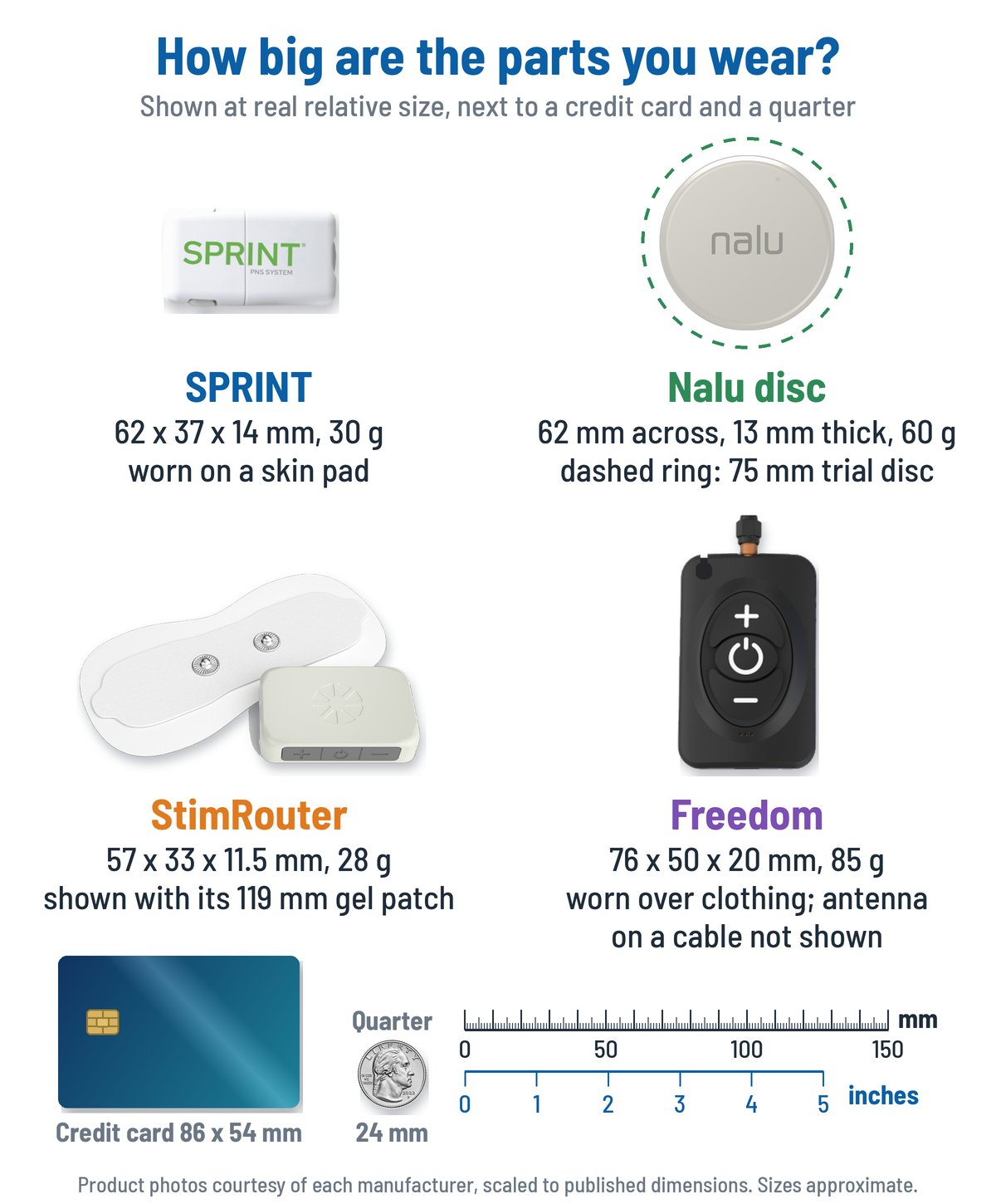
Several implanted PNS systems, including Nalu, Freedom, and StimRouter, have no battery inside the body. Instead, you wear a small outside device over the implant that powers it through the skin. That keeps the implant small, but it means wearing and charging the outside part when you want stimulation.
Neither path is more advanced than the other. A short course that gives lasting relief may be better than an implant. A long-term system makes sense when ongoing stimulation is needed.
Dr. Amit Sharma & our minimally invasive pain & spine team.
PNS Devices Compared: SPRINT, Nalu, Freedom, StimRouter, and ReActiv8
These are the main systems patients ask about in the United States. Details come from FDA records and each maker’s current instructions. Your doctor should confirm the exact model for you.
| Device (maker) | Type | What is inside your body | What you wear | MRI basics |
|---|---|---|---|---|
| SPRINT PNS (SPR Therapeutics) | Temporary, up to 60 days | A very thin coiled lead through the skin, removed at the end | A small stimulator on a sticky pad, with a handheld remote | No MRI while the lead is in. The lead is removed first. |
| Nalu (now part of Boston Scientific) | Trial, then implanted | Lead or leads plus a tiny implanted pulse generator with no battery | A Therapy Disc held over the implant with an adhesive clip, belt, or cuff | Implanted parts allow MRI, including full-body scans, only under set conditions. No MRI during the trial. |
| Freedom PNS (Curonix) | Trial, then implanted | An electrode array connected to a small implanted receiver, with no battery | A rechargeable transmitter in a wearable holder, worn over clothing | Permanent models allow MRI under set conditions; one 8-contact model is not safe at 3 Tesla. The trial lead is not MRI safe. |
| StimRouter (Bioventus) | Implanted | A thin lead; a newer option called TalisMann adds a small implanted receiver | A pulse transmitter on a gel patch on the skin | Lead allows MRI at 1.5 or 3 Tesla under set conditions. Outside parts stay out of the MRI room. |
| ReActiv8 (Mainstay Medical) | Implanted, for one type of low back pain | An implanted pulse generator and two leads near the nerves to the deep back muscles | A wireless activator held over the implant to start two 30-minute sessions a day | 1.5 Tesla full-body MRI only under set conditions, with the device off. |
SPRINT: a defined treatment period
SPRINT is FDA cleared for up to 60 days of use. It is cleared for severe chronic pain of peripheral nerve origin, and for chronic pain and pain after surgery or injury. It is not meant for the head and face. Skin irritation under the pad or bandage is the most common device problem. During treatment you limit motion near the lead for the first week, avoid swimming and baths, and turn stimulation off while driving.
Nalu: a small implant powered from outside
Nalu is FDA cleared for severe, long-lasting pain of peripheral nerve origin in adults. The implant is very small and has no battery. A Therapy Disc worn over it supplies power and settings. Boston Scientific completed its purchase of Nalu Medical in January 2026, so you may see either name.
Freedom PNS: formerly a Stimwave product
Freedom technology was first made by a company called Stimwave. Curonix bought the Freedom systems in 2022 and now makes and supports them. The Freedom PNS System received FDA clearance in 2024. If you already have an older Stimwave implant, bring your implant card and operative report, because older models and accessories may not match the current system.
StimRouter: a lead with an outside transmitter
StimRouter is FDA cleared for adults with severe, long-lasting pain of peripheral nerve origin, used along with other treatments such as medicine. It is not meant for the head and face. The outside transmitter sits on a gel patch on the skin over the lead. In 2025 the FDA cleared TalisMann, which adds a small implanted receiver to the StimRouter lead.
ReActiv8: a different goal for low back pain
ReActiv8 is different from the others. It is FDA approved to stimulate the nerves that control the multifidus, a deep back muscle, in adults with chronic low back pain linked to poor control of that muscle. It is for people who have not improved with medicine and physical therapy and who are not candidates for spine surgery. The aim is to make the muscle contract and help restore control, not only to block pain.
Peripheral Field Stimulation Explained
In peripheral field stimulation (PNfS), one or more leads are placed just under the skin across the area that hurts. The goal is to calm the small nerve endings in that patch, rather than one named nerve. It may be considered for a well-defined area of pain, such as part of the back or an area around a surgical scar.
The research on field stimulation is smaller than for nerve-targeted PNS. One randomized trial in people with back pain after spine surgery found that more people improved with field stimulation added to their medical care than with medical care alone. That trial stopped early, and few patients were followed for the long term. A 2026 review of the research called the overall evidence low in certainty.
If you are offered a stimulator for back pain, ask which kind it is. Stimulation near a named back nerve, muscle-control stimulation like ReActiv8, field stimulation under the skin, and spinal cord stimulation are four different treatments. Good results with one do not prove the others work.
What to Expect From Evaluation to Placement
Step 1: Finding the pain source
Dr. Sharma reviews where the pain is, how it feels, what makes it worse, past surgeries or injuries, and what treatments you have tried. The exam checks the nerves, joints, and muscles. Imaging or nerve testing may be used to rule out other problems. Nerve testing (EMG/NCS) is performed at an outside lab.
Step 2: A test nerve block, when it helps
A small injection of numbing medicine near the suspected nerve can show whether that nerve carries your familiar pain. Good short-term relief supports the plan. A block is not a perfect predictor, and it is not required in every case.
Step 3: Choosing the path
You and Dr. Sharma decide between a 60-day treatment, a trial for an implanted system, or a different treatment. You should know which nerve is the target, what will stay in your body, what you will wear, and what counts as success.
Step 4: The placement procedure
Placement is an outpatient procedure done under sterile conditions. Ultrasound or X-ray guidance helps place the lead near the target nerve. The skin is numbed. Sedation is planned for each person and may be none, local numbing only, light sedation, or deeper monitored anesthesia. During placement you may be asked where you feel the tingling, so the lead can be fine-tuned.
Step 5: Programming and follow-up
The device is set up before you go home, and you learn how to use it. Follow-up visits check the lead site, your pain, your activity, and the settings. For a 60-day course, the lead is removed at the end. For a trial, you decide together whether a permanent system makes sense.
Recovery and Daily Life With a Stimulator
- After a 60-day lead: Most people return to light daily activity soon. Limit motion near the lead for about a week so it does not slip out. Keep the bandage clean and dry, change it as instructed, and do not swim or soak in a bath. You disconnect the stimulator to shower.
- After an implanted system: Expect soreness at the small incision for a few days. Follow your written instructions about bending, lifting, and showering while the incision heals.
- Wearing the outside part: Systems powered from outside need the disc or transmitter worn over the implant when you want stimulation, plus regular charging.
- Driving: Ask before driving with stimulation on. SPRINT instructions say to turn stimulation off while driving.
- Work and exercise: When you return to work and heavier activity depends on the device, the location of the lead, and the kind of work you do.
Relief may start right away or build over several weeks. Keep a simple pain and activity diary. It helps you and your doctor judge whether the treatment is working.
Risks and Side Effects to Know About
PNS is minimally invasive, but no procedure is risk free. Possible problems include:
- Skin irritation or redness under the pad, patch, or bandage, which is the most common issue with the 60-day system
- Infection at the lead site or incision
- Bleeding or bruising
- The lead moving out of position, which can reduce relief
- A lead breaking, which can leave a small piece under the skin
- Uncomfortable stimulation, or a new area of tingling or soreness
- Nerve irritation or injury, which is uncommon
- Device problems that need reprogramming, repair, or removal
- Not enough relief, or relief that fades over time
Call the office the same day for redness, warmth, drainage, or fever. Turn the device off if stimulation becomes painful or feels like a shock, and call the office.
MRI, Surgery, and Other Medical Care
MRI safety depends on the exact device and model, not just the brand name. Here is what current instructions say:
- SPRINT: No MRI anywhere on the body while the lead is in. The lead and all parts must be removed first. A small retained lead piece can be scanned under set conditions.
- Nalu: The implanted pulse generator, leads, and anchor allow MRI, including full-body scans, under specific conditions. The Therapy Disc, remote, and charger must stay out of the MRI room. No MRI during the trial.
- Freedom PNS: Permanent models allow MRI under specific conditions. One 8-contact model is not safe at 3 Tesla. Trial leads are not MRI safe.
- StimRouter: The lead allows MRI at 1.5 or 3 Tesla under specific conditions. The outside parts must be removed.
- ReActiv8: 1.5 Tesla full-body MRI under specific conditions, with the device turned off.
Always carry your implant card. Tell any doctor, surgeon, dentist, or MRI team that you have a stimulator before a scan, a surgery, or a treatment that uses electrical current or heat.
How Long Relief Lasts and What the Research Shows
Results depend on the condition, the nerve, and the device. For SPRINT, the FDA asked the maker to publish a summary of 13 studies. In that summary, about 60 out of 100 people had at least half of their pain gone at the end of the 60-day treatment. Among people checked again 10 to 12 months later, about 47 out of 100 still had at least half of their pain gone. The studies were different from each other, so the numbers cannot predict what will happen for one person.
For implanted systems, the goal is ongoing relief while the device is in use. There are no strong head-to-head studies showing that one brand works better than another for all conditions. The right nerve target and the right patient matter more than the brand.
Questions to Ask Before You Decide
- Which nerve will be stimulated, or is this field stimulation under the skin?
- What is my diagnosis, and what other causes of my pain have been ruled out?
- Is this a 60-day treatment, a trial, or a permanent implant?
- What will stay in my body when treatment ends?
- Will I wear an outside device, and for how many hours a day?
- What are the MRI rules for this exact model?
- What happens if it helps, does not help, or helps and then fades?
- What other treatments could I try instead?
How SpinePain Solutions Evaluates PNS
Our starting point is the diagnosis, not a device. Dr. Sharma looks at where the pain is, what the exam and imaging show, how you responded to earlier treatments, and what you want to get back to doing. Only then do we compare a 60-day course, an implanted system, and other options such as therapy, a nerve block, hydrodissection, radiofrequency ablation, or spinal cord stimulation.
If a stimulator is not the right fit, we will tell you and explain why. Conservative care comes first, and not everyone with nerve pain needs a procedure. For a fuller overview of treatment and candidacy, see our peripheral nerve stimulation page.
When to Seek Urgent Medical Care
- Fever with spreading redness, warmth, or drainage at a lead site or incision: go to the emergency room or urgent care
- New weakness, numbness that is spreading, or loss of bladder or bowel control: go to the emergency room
- Chest pain, trouble breathing, or signs of a stroke: call 911
- Stimulation that shocks or hurts: turn the device off and call the office
Frequently Asked Questions
1. Is peripheral nerve stimulation the same as a spinal cord stimulator?
No. A spinal cord stimulator places leads in the spine, over the spinal cord, and usually uses an implanted battery. Peripheral nerve stimulation places a thin lead near one nerve outside the spine, closer to where the pain is. It is aimed at pain from a specific nerve, while a spinal cord stimulator covers wider areas such as both legs or the low back and legs.
2. When is a problem after a stimulator procedure an emergency?
Call the office the same day for redness, warmth, drainage, or a fever, because these can be signs of infection. Go to the emergency room for a high fever with spreading redness, or for new weakness, numbness, or loss of bladder or bowel control. Call 911 for chest pain, trouble breathing, or signs of a stroke. Turn the stimulator off if it shocks you or feels painful, and call the office.
3. Is the 60-day SPRINT treatment a trial for a permanent implant?
No. SPRINT is meant to be the treatment itself. The thin lead stays in for up to 60 days and is then removed, and some people keep relief after it comes out. A trial for a permanent system is different. It is a short test, often up to about 30 days with the devices that state a limit, to see whether a long-term implant makes sense.
4. Can I have an MRI if I have a nerve stimulator?
It depends on the exact device and model. SPRINT does not allow any MRI while the lead is in, so the lead is removed first. Several implanted systems, including Nalu, Freedom, StimRouter, and ReActiv8, allow MRI only under specific conditions, and the outside parts must stay out of the MRI room. Always show your implant card and tell the MRI team before any scan.
5. What is peripheral field stimulation?
Peripheral field stimulation, also called peripheral nerve field stimulation or PNfS, places one or more thin leads under the skin across the area that hurts, instead of next to one named nerve. It may be considered for a well-defined patch of pain, such as an area of the back. The research is smaller and less certain than for nerve-targeted PNS.
6. Does PNS cut or damage the nerve?
No. PNS does not cut, burn, or destroy the nerve. It sends a mild electrical signal near the nerve to change how pain messages travel. Nerve injury from the lead is uncommon, but it is one of the risks your doctor should explain.
7. Can a peripheral nerve stimulator be turned off or removed?
Yes. Every system can be turned off. The 60-day lead is removed at a follow-up visit at the end of treatment. Implanted systems can be removed later with a procedure if they stop helping or cause problems.
8. Will PNS let me stop my pain medicine?
Some people need less pain medicine when PNS works well, but no one can promise that ahead of time. PNS is one part of a care plan that may also include therapy, exercise, and other treatments. Do not stop or change any medicine without talking to the doctor who prescribes it.
Dr. Amit Sharma & our minimally invasive pain & spine team.
Related Guides on This Site
These live pages go deeper on single conditions or treatments. They do not mean every listed problem applies to you.
- peripheral nerve stimulation
- spinal cord stimulation
- DRG stimulation
- nerve hydrodissection
- NeuroCare nerve pain program
- nerve pain after surgery
- peripheral neuropathy
- is spinal cord stimulation worth it?
Getting an Evaluation on Long Island
Dr. Amit Sharma is board certified in Pain Medicine and is the Founder and Director of SpinePain Solutions. He has performed more than 60,000 interventional procedures. He has been Chief, Division of Pain Medicine at Good Samaritan University Hospital since 2012 and is Medical Director of MICNY in Commack. He evaluates chronic nerve pain and helps patients decide whether nerve stimulation, another treatment, or no procedure is the best fit. He sees patients in Bay Shore, Commack, and Farmingdale (office locations). Plans stay based on the exam and conservative-first care. Call or text 631-310-0000, or visit SpinePainSolutions.com. If symptoms suggest an emergency, call 911 or go to the nearest emergency room instead of waiting for an office visit.
Medical References and Further Reading
1. D’Souza RS, Bhatia A, Davanzo JR, et al. Evidence-Based Clinical Practice Guidelines on Implantable Peripheral Nerve Stimulation for Chronic Pain: A Consensus Report From a Multispecialty Working Group of the North American Neuromodulation Society. Neuromodulation. 2026. PMID: 42955018. https://pubmed.ncbi.nlm.nih.gov/42955018/
2. Consensus Guidelines from the American Society of Pain and Neuroscience for the Use of 60-Day Peripheral Nerve Stimulation Therapy. A NEURON Living Guideline Project. J Pain Res. 2025. PMID: 40590046. https://pubmed.ncbi.nlm.nih.gov/40590046/
3. U.S. Food and Drug Administration. 510(k) K211801: SPRINT PNS System. https://www.accessdata.fda.gov/scripts/cdrh/cfdocs/cfpmn/pmn.cfm?ID=K211801
4. U.S. Food and Drug Administration. 510(k) K232415: Nalu Neurostimulation System for Peripheral Nerve Stimulation. https://www.accessdata.fda.gov/scripts/cdrh/cfdocs/cfpmn/pmn.cfm?ID=K232415
5. U.S. Food and Drug Administration. 510(k) K233162: Freedom Peripheral Nerve Stimulator (PNS) System. https://www.accessdata.fda.gov/scripts/cdrh/cfdocs/cfpmn/pmn.cfm?ID=K233162
6. U.S. Food and Drug Administration. 510(k) K243678: TalisMann Neuromodulation System. https://www.accessdata.fda.gov/scripts/cdrh/cfdocs/cfpmn/pmn.cfm?ID=K243678
7. U.S. Food and Drug Administration. Premarket Approval P190021: ReActiv8 Implantable Neurostimulation System. https://www.accessdata.fda.gov/scripts/cdrh/cfdocs/cfpma/pma.cfm?id=P190021
8. Eldabe SS, Taylor RS, Goossens S, et al. A Randomized Controlled Trial of Subcutaneous Nerve Stimulation for Back Pain Due to Failed Back Surgery Syndrome: The SubQStim Study. Neuromodulation. 2019;22(5):519-528. https://pmc.ncbi.nlm.nih.gov/articles/PMC6767391/



