

C8 Radiculopathy: Pinky Finger Numbness, Inner Forearm Pain, and Weak Grip
Quick Answer: C8 Radiculopathy
- C8 is a nerve root that exits between the C7 and T1 bones, near the base of the neck.
- Pain or tingling may travel down the inner arm and forearm toward the little finger and ring finger.
- Weak finger bending, a weaker grip, or trouble holding small objects can occur.
- The same two fingers can go numb from an ulnar nerve problem at the elbow or wrist. A neck and arm exam helps tell these apart.
- Nerve-area maps (dermatomes) vary. A matching exam and MRI matter more than the map.
- Conservative care usually comes first. EMG/NCS, when needed, are performed at an outside lab.
- Selected image-guided injections may ease persistent root pain and create a window for physical therapy, which may help some people delay or avoid surgery.
- Rapidly worsening weakness, new trouble walking, or bowel/bladder change -> emergency care. Bay Shore, Commack, Farmingdale / 631-310-0000.
You notice a strange tingling in your little finger. Maybe the ring finger is numb too, your grip feels weaker, or a line of pain runs from your neck down the inside of your arm. These symptoms can come from the C8 nerve root in the neck. They can also come from a nerve squeezed near the elbow. Finding the right spot matters, because the care is different. This page is for learning, not a diagnosis.
What Is C8 Radiculopathy?
C8 radiculopathy means the eighth nerve root in the neck is irritated or pinched. The neck has seven bones but eight pairs of nerve roots. C8 leaves the spine between the C7 and T1 bones, where the neck meets the upper back. It carries feeling from part of the inner forearm and the little-finger side of the hand. It also helps power the muscles that bend the fingers and grip.
A disc herniation at C7-T1, or a tight opening where the nerve exits, can affect this root. But an MRI finding at that level is not always the cause. Your history, exam, and scan must fit together. C8 is involved less often than C7 or C6, the most common levels [Source]. Our cervical radiculopathy guide covers neck-to-arm nerve pain in general. This page stays on C8.
Doctors use two related terms. Radicular pain is pain from an irritated nerve root. Radiculopathy means the root is not working right. Signs include numbness, weakness, or a reflex change. Root pain can happen with little or no neck pain.
C8 Pain and Numbness Pattern: Where Does It Travel?
A typical C8 pattern may start near the lower neck or shoulder blade. It can run down the inner side of the arm, or a bit toward the back, to the forearm and hand. Tingling or less feeling often involves the little finger and the little-finger half of the ring finger. Some people have only hand symptoms and little neck pain. Others feel shooting pain when they turn or tip back the neck.
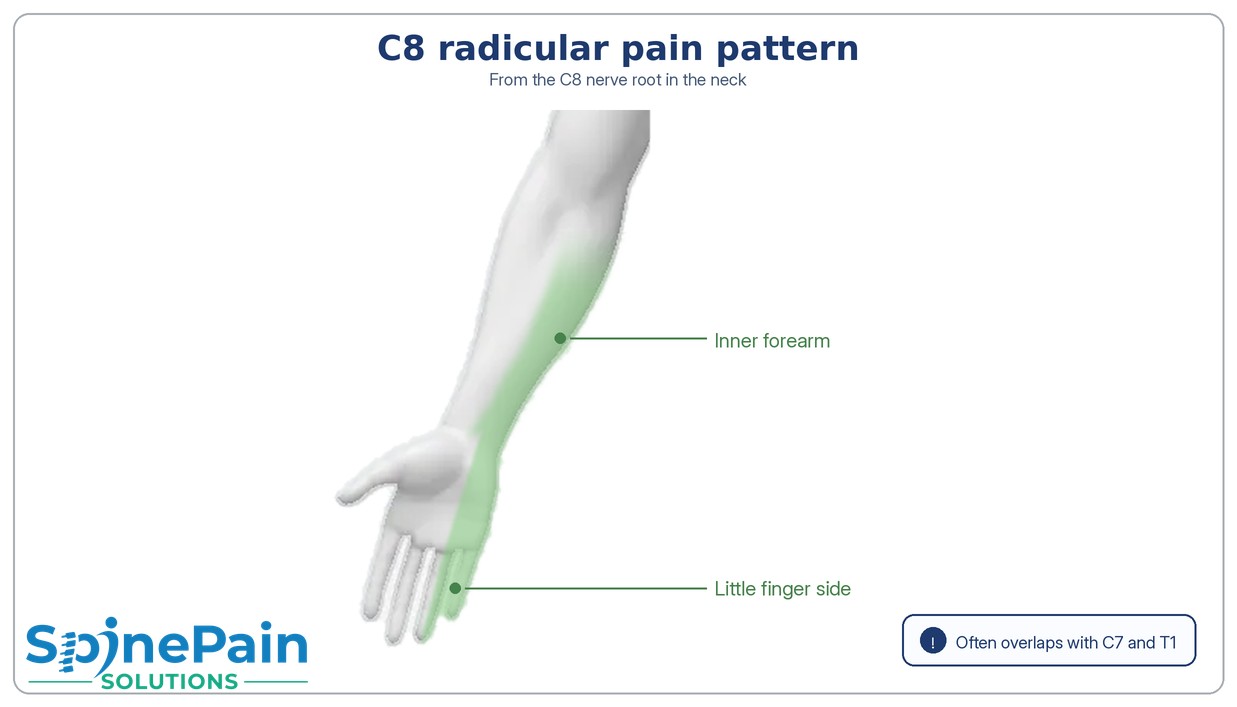
The skin map is a clue, not a fingerprint. Nearby nerve roots overlap, and studies show these maps vary between people [Source]. A nerve problem outside the spine can cause a nearly identical hand pattern. Pain in just those two fingers does not prove a neck problem. Numbness that reaches into the inner forearm, especially with pain set off by neck movement, points more toward a source higher up. The Pain Locator can help you describe where symptoms travel.
What kind of weakness can C8 cause?
C8 helps power the muscles that bend the fingers, including the ones that curl your fingertips around a handle. You may have trouble gripping a bag, opening a jar, or holding a pen firmly. The doctor may compare finger bending on both sides. He may also test muscles that get their nerve supply from different nerves. Some hand weakness can also come from the T1 root. So one weak movement alone cannot point to C8.
C6 often affects the thumb side of the hand. C7 often involves the middle finger and the triceps. C8 more often points to the little-finger side and finger bending. See C7 radiculopathy for comparison.
| Pattern | Where feeling changes | Weakness you may notice | Useful exam clue |
|---|---|---|---|
| C7 nerve root | Back of the arm, middle finger | Straightening the elbow (triceps) | Triceps reflex may be reduced |
| C8 nerve root | Inner forearm, little finger, little-finger half of the ring finger | Grip and finger bending | No single reliable reflex; strength and feeling pattern |
| T1 nerve root | Inner upper arm near the elbow | Small hand muscles | Less common; overlaps with C8 |
| Ulnar nerve (elbow or wrist) | Ring and little fingers; the forearm is usually spared | Hand muscles supplied by the ulnar nerve only | Worse with elbow bent or leaned on; nerve testing |
These are clues, not rules. A person can have a neck problem and an elbow problem at the same time.
C8 vs Ulnar Nerve Problems: The Most Important Look-Alike
The ulnar nerve runs behind the inner elbow through the cubital tunnel and on into the hand. Pressure at the elbow, or less often at the wrist, can numb the ring and little fingers. So this elbow problem, called cubital tunnel syndrome, is one of the most important to tell apart from C8. Spine surgeons also say these two can be hard to tell apart [Source]. See ulnar neuropathy.
Clues that favor an ulnar nerve problem
Symptoms may flare when the elbow stays bent, when you lean on it, or when you sleep with it tucked. That may point to a trapped ulnar nerve. Pain or tenderness at the elbow can add a clue. A nerve problem at the wrist may spare feeling over parts of the back of the hand. The doctor may check elbow position, finger spreading, and pinch strength. No single bedside test proves the diagnosis [Source].
Clues that favor a C8 nerve-root problem
Some clues point more to a root problem. Pain may start in the neck or shoulder blade. Neck movement may set off symptoms. Numbness may reach into the inner forearm. Weakness in muscles served by more than one nerve may also point to C8 or T1, not just the ulnar nerve. A person can have both conditions, so the exam should not force an either-or answer [Source].
Other look-alikes
- Other neck nerve-root problems.
- Irritation of the lower nerves near the collarbone, as in thoracic outlet syndrome. See also why an arm goes numb when raised.
- Pressure on the spinal cord in the neck (cervical myelopathy). It can cause clumsy hands, often both, with balance changes [Source].
- Carpal tunnel syndrome usually affects the thumb, index, and middle fingers instead. It is less typical for little-finger numbness alone.
- Problems that affect many nerves at once often affect both hands or the feet.
- Shoulder and elbow problems can cause arm pain without nerve-root signs. See forearm pain and cervicobrachial syndrome vs cervical radiculopathy.
How Dr. Sharma Evaluates C8 Symptoms
The visit starts with the timeline. Did the problem begin after lifting, sleeping in an odd position, or long elbow pressure? Does neck movement trigger pain? Are symptoms constant, or do they come and go? Have you started dropping things, and is the weakness getting worse? These details help show whether the problem is likely in the neck, elbow, wrist, or elsewhere.
Neck, shoulder, elbow, and hand exam
Dr. Sharma checks neck motion and the nearby joints. He tests feeling in the forearm and fingers and compares grip and finger strength. He also checks reflexes and looks for signs of spinal cord pressure. C8 does not have one reliable reflex of its own, so the strength and feeling findings matter most. Neck compression tests may bring on arm symptoms. They are read along with the rest of the exam.
When a neck MRI helps
MRI can show a C7-T1 disc herniation, a tight space around the C8 nerve, and any pressure on the spinal cord. It matters most when weakness can be measured, symptoms last, or the nerve exam is worrying. A scan is most often not the first step for new, stable symptoms without warning signs. This fits imaging guidance from the American College of Radiology.
A scan may also show age-related changes that are not causing your symptoms. Disc changes are common on neck MRIs of people with no pain [Source]. Treatment should not be based on a report alone. The North American Spine Society advises matching the exam with the imaging for neck nerve-root pain [Source].
When EMG and nerve conduction studies help
Sometimes the exam cannot clearly tell C8 from an elbow nerve problem. Then nerve testing can help. At SpinePain Solutions, EMG/NCS, when needed, are performed at an outside lab. These tests check how muscles and nerves work. They may find that the ulnar nerve is slow across the elbow. A normal test does not always rule out a root problem. This is true when it is early or mild, or when it mainly causes numbness. Timing and the muscles tested affect the results [Source].
Dr. Amit Sharma & our minimally invasive pain & spine team.
What Irritates the C8 Nerve Root?
A disc bulge or herniation at C7-T1 can irritate the C8 root. So can arthritis that narrows the nerve opening (foraminal stenosis). Less often, an injury or another problem in the lower neck is the cause. Symptoms can start suddenly or build over time. A disc problem may follow a strain, but many people cannot name a specific event. Disc wear and bone spurs become more common with age. Seeing them on a scan does not prove they cause the pain.
Less common causes include infection, a tumor, or an inflammatory disease. They deserve a look when symptoms are unusual or come with fever, serious illness, or a history of cancer. Shoulder and elbow problems can also cause arm pain without involving C8. A careful exam helps avoid spine procedures you do not need when the real problem is somewhere else.
Treatment: Start With the Right Diagnosis
If weakness is not getting worse, many people can start with care that does not involve surgery. Many neck nerve-root problems get better with time [Source]. The plan may include changing painful tasks and not holding the neck in one position too long. It may also include gentle physical therapy for the neck and shoulders, and medicines chosen for you [Source]. Anti-inflammatory drugs are not right for everyone. This is true for people with kidney disease, a risk of stomach bleeding, or some heart problems. If the exam shows clear nerve changes, therapy should not include forceful neck cracking or twisting.
If tests point to an ulnar nerve trapped at the elbow, the plan changes. Avoiding elbow pressure, not keeping the elbow bent at night, and an opinion from a hand or nerve specialist may fit better than a neck injection. This is why finding the affected nerve comes before choosing a procedure.
Care without surgery is not “doing nothing.” It is a set plan to calm the root, bring back motion, and protect hand use while many disc-related root problems heal.
Injections May Help Selected Neck Nerve-Root Pain
For selected people with lasting arm pain and a matching neck MRI, Dr. Sharma may discuss a cervical epidural steroid injection or a selective nerve root block. Reducing inflammation around an irritated C8 root can create a more comfortable window for physical therapy and daily hand use, and for some people that progress helps delay or avoid surgery. A selective block may also help clarify which root is involved. These procedures do not remove a disc herniation or widen a narrowed nerve opening, and benefit varies from person to person. They do not reliably reverse weakness that has already set in.
A 2025 review by the American Academy of Neurology looked at neck and low-back nerve-root pain. It found likely short-term gains in pain and function. Lasting relief is less certain [Source]. That is why we avoid outcome percentages on patient pages.
Before an injection, Dr. Sharma reviews the expected benefit, alternatives, and risks as part of informed consent. Benefits and risks depend on your anatomy, the approach, your health history, and the goal. Tell the team about blood thinners, diabetes, allergies, or an active infection. Do not stop prescribed blood thinners on your own. An injection should not delay a check of worsening hand weakness or spinal cord pressure.
Service pages: epidural steroid injection and selective nerve root block.
Worsening Weakness May Need a Spine Surgery Opinion
Sometimes there is major pressure on the nerve, ongoing loss of function, or severe pain despite good care. Then Dr. Sharma can arrange an opinion from our spine surgery partners. The goal is to protect nerve function, not to push surgery for every abnormal scan. A surgical opinion helps weigh the options. It does not mean an operation is certain.
When C8 Symptoms Need Urgent Attention
New hand weakness needs a prompt check, most of all if it is getting worse. Trouble with both hands, new balance problems, repeated falls, or loss of fine hand control can be a sign of spinal cord pressure. That is more than a single C8 root problem. Severe symptoms after a neck injury, fever with neck pain, or a sudden big change in nerve function also need urgent care.
Call 911 for sudden arm weakness with facial drooping, trouble speaking, or other signs of a stroke. Also call for any sudden, severe nerve emergency. Also call 911 for arm pain with chest pressure, shortness of breath, or sweating. Go to the ER for weakness that is getting worse fast, being unable to walk normally, or new loss of bladder or bowel control. Do not wait for a routine pain visit when these signs appear. Call 631-310-0000 for non-emergency questions.
Expert groups say to take warning signs seriously. They also note that one sign alone may not mean a serious problem [Source].
C8 Radiculopathy Care on Long Island
Dr. Amit Sharma is board certified in Pain Medicine and is the Founder and Director of SpinePain Solutions. He has performed more than 60,000 interventional procedures. He has been Chief, Division of Pain Medicine at Good Samaritan University Hospital since 2012 and is Medical Director of MICNY in Commack. He evaluates neck nerve-root patterns and image-guided options at Bay Shore, Commack, and Farmingdale (office locations). Plans stay based on the exam and conservative-first care. Call or text 631-310-0000.
More to read: our cervical radiculopathy guide, neck pain care, and nerve root pain pages.
Frequently Asked Questions
Can C8 radiculopathy make my pinky finger numb?
Yes. C8 irritation can cause tingling or less feeling in the little finger and part of the ring finger. Pressure on the ulnar nerve at the elbow can cause a similar pattern. So finger numbness alone does not make the diagnosis.
When should I call 911?
Call 911 for sudden weakness with facial drooping, trouble speaking, or other stroke-like symptoms, or for arm pain with chest pressure, shortness of breath, or sweating. Weakness that gets worse fast, a new inability to walk, or loss of bladder or bowel control also needs emergency care. Call SpinePain Solutions at 631-310-0000 for non-emergency questions.
Is C8 radiculopathy the same as cubital tunnel syndrome?
No. C8 radiculopathy starts at a nerve root in the neck. Cubital tunnel syndrome involves the ulnar nerve near the elbow. Both may affect the ring and little fingers. The exam, and sometimes EMG and nerve conduction studies, help tell them apart.
Which disc level usually affects C8?
The C8 nerve root exits between the C7 and T1 bones. A disc herniation or narrowing at C7-T1 can affect it. MRI findings must match your symptoms and exam.
Can C8 cause weak grip?
Yes. C8 helps power the muscles that bend the fingers. Some people have trouble gripping things or bending their fingers firmly. Weak grip can also have other causes and should be examined.
Does C8 radiculopathy need an EMG?
Not always. Nerve tests (EMG and nerve conduction studies) can help when the exam cannot clearly tell C8 from an ulnar nerve problem. At SpinePain Solutions, EMG/NCS, when needed, are performed at an outside lab.
Will I need surgery for C8 radiculopathy?
Not necessarily. Many people can start with conservative care if weakness is not getting worse. A surgical opinion matters more when weakness gets worse, the spinal cord may be pressed, or symptoms stay severe despite good care.
Who treats C8 radiculopathy on Long Island?
SpinePain Solutions evaluates C8 nerve-root patterns at Bay Shore, Commack, and Farmingdale. Call or text 631-310-0000.
Dr. Amit Sharma & our minimally invasive pain & spine team.
Medical References
- Stoker GE, Kim HJ, Riew KD, et al. Differentiating C8-T1 radiculopathy from ulnar neuropathy: a survey of 24 spine surgeons. Global Spine J. 2014. PMID 24494175.
- Silver S, Ledford CC, Vogel KJ, et al. Peripheral Nerve Entrapment and Injury in the Upper Extremity. Am Fam Physician. 2021. PMID 33630556.
- Jajeh H, Lee A, Charls R, et al. A clinical review of hand manifestations of cervical myelopathy, cervical radiculopathy, radial, ulnar, and median nerve neuropathies. J Spine Surg. 2024. PMID 38567008.
- Lee MWL, McPhee RW, Stringer MD. An evidence-based approach to human dermatomes. Clin Anat. 2008. PMID 18470936.
- Radhakrishnan K, Litchy WJ, O’Fallon WM, Kurland LT. Epidemiology of cervical radiculopathy. A population-based study from Rochester, Minnesota, 1976 through 1990. Brain. 1994. PMID 8186959.
- Iyer S, Kim HJ. Cervical radiculopathy. Curr Rev Musculoskelet Med. 2016. PMID 27250042.
- Kang KC, Lee HS, Lee JH. Cervical Radiculopathy Focus on Characteristics and Differential Diagnosis. Asian Spine J. 2020. PMID 33373515.
- Robblee J, Katzberg H. Distinguishing Radiculopathies from Mononeuropathies. Front Neurol. 2016. PMID 27468275.
- Bono CM et al.; North American Spine Society. An evidence-based clinical guideline for the diagnosis and treatment of cervical radiculopathy from degenerative disorders. Spine J. 2011. PMID 21168100.
- Nakashima H et al. Abnormal findings on magnetic resonance images of the cervical spines in 1211 asymptomatic subjects. Spine. 2015. PMID 25584950.
- Childress MA, Becker BA. Nonoperative Management of Cervical Radiculopathy. Am Fam Physician. 2016. PMID 27175952.
- Armon C, Narayanaswami P, Potrebic S, et al. Epidural Steroids for Cervical and Lumbar Radicular Pain and Spinal Stenosis Systematic Review Summary: Report of the AAN Guidelines Subcommittee. Neurology. 2025. PMID 39938000.
- Finucane LM et al. International Framework for Red Flags for Potential Serious Spinal Pathologies. J Orthop Sports Phys Ther. 2020. PMID 32438853.
- North American Spine Society. Evidence-Based Clinical Guidelines: Diagnosis and Treatment of Cervical Radiculopathy from Degenerative Disorders (PDF).
- American College of Radiology. ACR Appropriateness Criteria: Cervical Pain or Cervical Radiculopathy (narrative).
- American Academy of Physical Medicine and Rehabilitation. Cervical Radiculopathy. PM&R KnowledgeNow.
- American Academy of Physical Medicine and Rehabilitation. Electrodiagnosis of Radiculopathies (Cervical, Thoracic, and Lumbar). PM&R KnowledgeNow.
Medical disclaimer: This article is educational and is not a substitute for individualized medical evaluation. Decisions about injections, procedures, and surgery depend on examination, medical history, symptoms, imaging, and clinical judgment.



