
L3 Radiculopathy: Front-of-Thigh Pain and Care
← Back to the hip pain locator
L3 radiculopathy means irritation of the L3 nerve root (the nerve as it leaves the low back). It can send pain, tingling, or numbness toward the front of the thigh — a pattern that is different from classic sciatica below the knee. This page is education, not a diagnosis. Related guides: thigh pain, femoral neuropathy, and radiculopathy.
Quick Answer: L3 Radiculopathy
- L3 root irritation can cause front-of-thigh pain, tingling, or numbness (sometimes toward the knee).
- Hip-flexor or quadriceps strength may be affected; the knee-jerk (patellar) reflex may soften.
- Nerve-area maps (dermatomes) vary — a map is a clue, not a diagnosis.
- This is not classic sciatica; below-knee patterns are more often L4–S1.
- Femoral neuropathy is a different problem along the femoral nerve outside the spine.
- Conservative care usually comes first; EMG/NCS, when needed, are performed at an outside lab.
- Selected image-guided injections may ease persistent root pain and create a window for physical therapy, which may help some people delay or avoid surgery.
- Progressive weakness or bowel/bladder change -> emergency care. Bay Shore, Commack, Farmingdale / 631-310-0000.
L3 Radiculopathy Means the L3 Nerve Root Is Irritated
Spinal nerve roots leave the low back through small openings. When the L3 root is inflamed or crowded, symptoms can follow its usual path into the front of the thigh. Pain may feel sharp, burning, or electric. Numbness or tingling can appear even when back pain is mild.
For the broader idea of nerve-root pain in any region, see our radiculopathy overview.
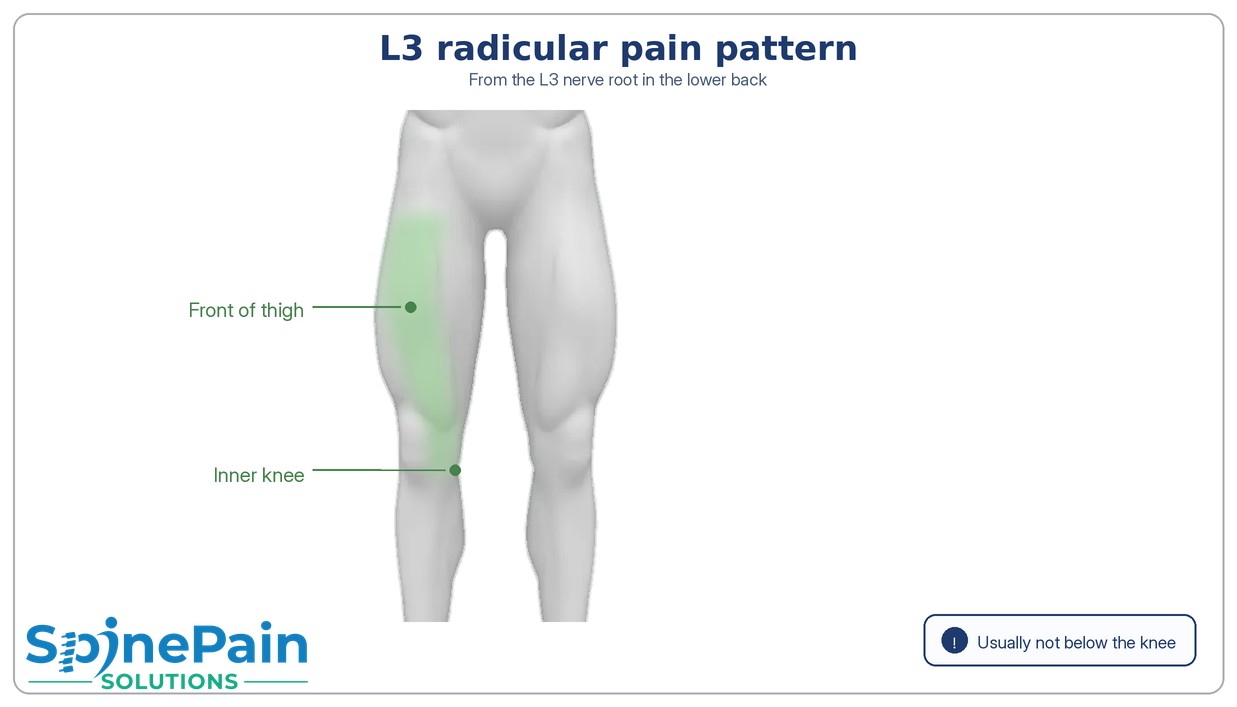
L3 pain runs across the front of the thigh to the inner knee (the L3 dermatome)
L3 patterns are not classic sciatica
L3 patterns usually stay toward the front of the thigh (anterior thigh), sometimes near the knee. Pain that travels well below the knee in a classic sciatica pattern is more often linked to L4, L5, or S1 roots. Compare those lower levels on our L4 vs L5 vs S1 and L5 radiculopathy pages. Below-knee education also lives at leg pain between the knee and ankle.
Motor clues for L3 often include lifting the knee toward the chest (hip flexion), squeezing the thighs together (hip adduction), and sometimes straightening the knee (quadriceps). The knee-jerk reflex (patellar) may be reduced when other findings fit. These are tendencies, not proof by themselves.
Nerve-Area Maps Vary Between People, So Maps Are Approximate
Published nerve-area maps (dermatomes) differ from each other, and people differ from the maps. Overlap is expected. An evidence-based review of these maps stressed variability and overlap rather than sharp borders [Source]. Sensory testing alone has limited accuracy for low-back nerve-root pain in systematic reviews [Source].
Our pain locator can help you describe where symptoms sit before a visit. It is not a diagnosis tool.
L3 Radiculopathy Is Different from Femoral Neuropathy
L3 vs femoral neuropathy is a common differential when front-of-thigh pain and quadriceps weakness show up together.
Front-of-thigh pain with quadriceps weakness can come from an L3 (or neighboring) root problem or from the femoral nerve outside the spine. The distinction matters because the work-up and next steps differ.
| Clue | L3 radiculopathy (often) | Femoral neuropathy (often) |
|---|---|---|
| Where symptoms sit | Front / inner thigh; sometimes toward the knee | Front of thigh; may include inner lower leg via the saphenous nerve branch |
| Quadriceps / straightening the knee | May be weak | Often weak |
| Inner thigh muscles (hip adductors) | May be weak (nerve-root or plexus territory) | Usually spared when only the femoral nerve is affected |
| Patellar reflex | May decrease | May decrease |
| Back / nerve-tension clues | More likely when a root is the driver | Less typical as the main story |
Bedside teaching and nerve-test reviews emphasize that weakness when squeezing the thighs together argues against a problem limited to the femoral nerve alone and toward a nerve-root or plexus problem [Source]. Dedicated femoral-nerve education: femoral neuropathy.
Thigh Pain Has Many Non-Nerve-Root Causes
Anterior thigh pain that feels nerve-related often points to L3 root irritation, femoral neuropathy, or a local hip/thigh problem — which is why maps alone are not enough.
Not every front-of-thigh ache is an L3 root. Muscle strain, hip joint arthritis, bursitis, referred pain from the hip or pelvis, and vascular problems can feel similar. Our thigh pain hub covers that broader list. This page stays on the L3 nerve-root framing so the pain-locator map and related searches have a clear home.
Evaluation Starts with History, Exam, and Imaging When Appropriate
A focused history and neurologic exam come first: strength, sensation, reflexes, and how walking, stairs, and rising from a chair feel. MRI is the usual advanced imaging choice when symptoms persist, worsen, or show neurologic deficits, consistent with appropriateness guidance for low-back presentations that include nerve-root features [Source].
North American Spine Society guidance on low-back disc herniation with nerve-root pain emphasizes matching exam findings with imaging before invasive steps [Source]. EMG/NCS can help when femoral neuropathy, a plexus problem, or unclear location is on the list; at SpinePain Solutions, EMG/NCS, when needed, are performed at an outside lab.
Conservative Care Comes First for Most L3 Flares
Time, activity modification, physical therapy, and medicines when safe remain first-line for many new and medium-term nerve-root presentations. Clinical practice guidance for low-back pain favors non-drug and noninvasive options before escalating [Source]. Chiropractic care can fit selected mechanical patterns as a partner. See pain management doctor or chiropractor.
Conservative care is not “doing nothing.” It is a structured attempt to calm the root, restore motion, and protect walking and stairs while many disc-related nerve-root problems improve.
Injections May Help Selected Low-Back Nerve-Root Pain
When thigh-dominant nerve-root pain stays disabling after a fair conservative try, an image-guided epidural steroid injection or selective nerve root approach may be discussed. Reducing inflammation around an irritated L3 root can create a more comfortable window for physical therapy and daily walking, and for some people that progress helps delay or avoid surgery. These procedures do not remove a disc herniation or widen a narrowed nerve opening, and benefit varies from person to person.
Systematic reviews show modest average benefits for selected nerve-root pain, with important differences between studies — which is why we avoid outcome percentages on patient pages [Source] [Source]. Before an injection, Dr. Sharma reviews the expected benefit, alternatives, and risks as part of informed consent. Tell the team about blood thinners, diabetes, allergies, or an active infection. An injection should not delay urgent care for worsening weakness.
Service pages: epidural steroid injection and selective nerve root block.
Dr. Amit Sharma & our minimally invasive pain & spine team.
Minimally Invasive Disc Procedures Are Reserved for Clear Targets
When a clear disc herniation matches the L3 pattern and nonsurgical care has not helped enough, surgery may be discussed. For some herniations that sit off to the side of the spine (lateral), our practice offers an endoscopic discectomy through a small incision, done from the side (an outside-in approach). For other patterns, we work with our spine surgery partners. Injections do not replace every operation, and the choice depends on your exam and imaging.
Red Flags Need Emergency Care
Call 911 or go to the ER for rapidly worsening leg weakness, new bladder or bowel loss, saddle numbness, fever with severe back pain, or sudden inability to walk. These can signal cauda equina syndrome or other emergencies. Learn more: cauda equina syndrome. Call 631-310-0000 for non-emergency questions.
International frameworks emphasize taking red flags seriously while recognizing that individual flags vary in predictive value [Source].
L3 Radiculopathy Care on Long Island
Dr. Amit Sharma is board certified in Pain Medicine and is the Founder and Director of SpinePain Solutions. He has performed more than 60,000 interventional procedures. He has been Chief, Division of Pain Medicine at Good Samaritan University Hospital since 2012 and is Medical Director of MICNY in Commack. He evaluates low-back nerve-root patterns and image-guided options at Bay Shore, Commack, and Farmingdale (office locations). Plans stay based on the exam and conservative-first care. Call or text 631-310-0000.
Searches for L2 L3 radiculopathy and L3-4 radiculopathy usually name the disc level next to an irritated root — the exam still has to match.
Frequently Asked Questions
What does L3 radiculopathy feel like?
It often means pain, tingling, or numbness toward the front of the thigh, sometimes toward the knee. Hip-flexor or quadriceps strength can be affected. Patterns vary between people, so this is a clue, not a diagnosis.
When should thigh or back symptoms send me to the emergency room?
Seek emergency care for rapidly worsening leg weakness, new bladder or bowel loss, saddle numbness, fever with severe back pain, or sudden inability to walk. Call SpinePain Solutions at 631-310-0000 for non-emergency questions.
Is L3 radiculopathy the same as sciatica?
No. Classic sciatica-style pain traveling below the knee is more often linked to L4, L5, or S1 roots. L3 patterns usually stay more toward the front of the thigh.
How is L3 radiculopathy different from femoral neuropathy?
Both can affect the front of the thigh and the quadriceps. Hip-adductor weakness favors a root or plexus problem over an isolated femoral nerve problem. Exam and, when needed, EMG help sort them.
What is L2-L3 or L3-4 radiculopathy?
Those phrases usually name the disc level next to an irritated root. A typical posterolateral disc can affect the traversing root at the next number, but foraminal disease can change which root is hit. The MRI location words and the exam must match.
Can L3 problems cause knee pain?
Yes. Front-of-thigh and knee-area symptoms can appear with L3 patterns. Hip joint pain and local knee problems can look similar, so the exam matters.
What treatments are tried before injections?
Most people start with activity changes, physical therapy, and medicines when safe. Image-guided injections are discussed when root pain stays disabling after a fair conservative try.
Who treats L3 radiculopathy on Long Island?
SpinePain Solutions evaluates L3 nerve-root patterns at Bay Shore, Commack, and Farmingdale. Call or text 631-310-0000.
Dr. Amit Sharma & our minimally invasive pain & spine team.
Medical References
- Lee MWL, McPhee RW, Stringer MD. An evidence-based approach to human dermatomes. Clin Anat. 2008. PMID 18470936.
- Tawa N, Rhoda A, Diener I. Accuracy of clinical neurological examination in diagnosing lumbo-sacral radiculopathy: a systematic literature review. BMC Musculoskelet Disord. 2017. PMID 28231784.
- Robblee JV, Katzberg HD. Distinguishing Radiculopathies from Mononeuropathies. Front Neurol. 2016. PMID 27468275.
- Kreiner DS et al.; North American Spine Society. An evidence-based clinical guideline for the diagnosis and treatment of lumbar disc herniation with radiculopathy. Spine J. 2014. PMID 24239490.
- Hutchins TA et al. ACR Appropriateness Criteria Low Back Pain: 2021 Update. J Am Coll Radiol. 2021. PMID 34794594.
- Qaseem A et al. Noninvasive Treatments for Acute, Subacute, and Chronic Low Back Pain: ACP Clinical Practice Guideline. Ann Intern Med. 2017. PMID 28192789.
- Chou R et al. Epidural Corticosteroid Injections for Radiculopathy and Spinal Stenosis. Ann Intern Med. 2015. PMID 26302454.
- Manchikanti L et al. Epidural Injections for Lumbar Radiculopathy and Spinal Stenosis: A Comparative Systematic Review and Meta-Analysis. Pain Physician. 2016. PMID 27008296.
- Finucane LM et al. International Framework for Red Flags for Potential Serious Spinal Pathologies. J Orthop Sports Phys Ther. 2020. PMID 32438853.
- Refai NA, Black AC, Tadi P. Anatomy, Bony Pelvis and Lower Limb: Thigh Femoral Nerve. StatPearls. PMID 32310525.



