
Big Toe Numbness: Could It Be the L5 Nerve?
- Posted on: Aug 21 2026
You notice numbness in your big toe. Maybe it also affects the top of your foot. Perhaps there is tingling, burning, or pain farther up the leg. Does that mean you have a pinched L5 nerve root?
It certainly can.
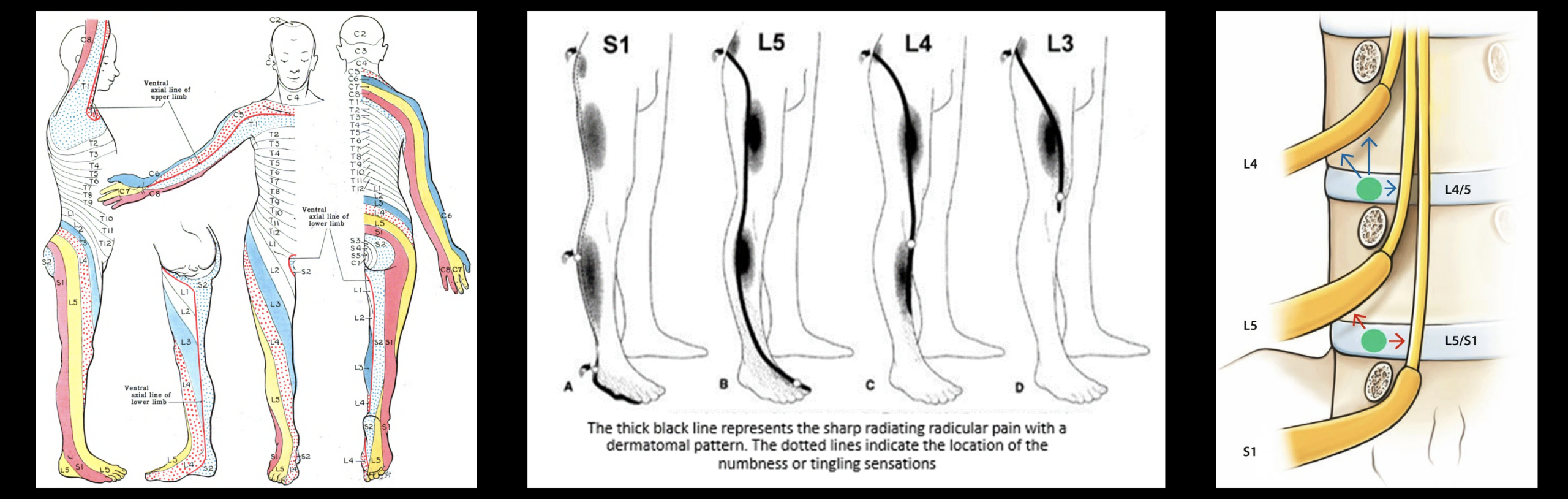
The L5 nerve root commonly supplies sensation toward the top of the foot, big toe, and first web space between the first and second toes. When L5 is irritated or compressed in the lower spine, numbness in that region can be one of the most useful clues.
But big toe numbness does not automatically mean the problem is coming from your back.
Peripheral nerves in the leg and foot can produce overlapping symptoms. Local foot problems, neuropathy, and other neurologic conditions can also alter sensation around the big toe.
The location of numbness tells us where to start looking. The rest of the neurologic examination tells us whether L5 is actually the likely source.
Quick Summary: Big toe and first-web-space numbness are commonly associated with the L5 nerve root, especially when symptoms also involve the outer leg or top of the foot. L5 becomes more likely if there is weakness lifting the big toe or foot. However, deep peroneal nerve problems and other peripheral nerve conditions can produce similar sensory symptoms, so numbness location alone cannot confirm the diagnosis.
Why the L5 Nerve Can Cause Big Toe Numbness
The L5 nerve root is one of the major lumbar nerve roots supplying the leg and foot.
Its typical sensory territory includes portions of the:
- Outer or anterolateral lower leg
- Top of the foot
- Big toe
- First web space between the big toe and second toe
When the L5 nerve root is inflamed or compressed, patients may describe numbness, tingling, burning, pins-and-needles, or altered sensation in these areas. L5 sensory loss commonly includes the dorsum of the foot and the first web space. [oai_citation:1‡NCBI](https://ncbi.nlm.nih.gov/books/NBK560878/?utm_source=chatgpt.com)
The symptoms do not have to begin in the toe. Many patients also notice pain traveling from the buttock or outer leg downward toward the foot.
Others have surprisingly little back pain and become concerned only when part of the foot or big toe starts feeling numb.
What Other L5 Symptoms Should You Look For?
Big toe numbness becomes more convincing for L5 radiculopathy when other findings point toward the same nerve.
Possible associated symptoms include:
- Pain traveling down the outer portion of the leg
- Burning or tingling on the top of the foot
- Numbness extending into the first web space
- Weakness lifting the big toe upward
- Weakness lifting the foot toward the shin
- Difficulty heel-walking
- Weakness turning the foot outward
- More severe weakness causing toe drag or foot drop
The L5 nerve root contributes to great-toe extension, ankle dorsiflexion, foot inversion and eversion, and other lower-extremity movements. That is why strength testing can provide more useful localization than numbness alone. [oai_citation:2‡NCBI](https://ncbi.nlm.nih.gov/books/NBK560878/?utm_source=chatgpt.com)
For the complete L5 pattern, see our L5 nerve root pain guide.
Does Big Toe Numbness Always Mean L5 Radiculopathy?
No.
This is the most important caution.
The big toe is supplied through peripheral nerves after the lumbar nerve roots have combined and traveled down the leg. A sensory problem can therefore occur anywhere along that pathway.
Possible causes include:
- L5 radiculopathy
- Deep peroneal nerve irritation
- Common peroneal neuropathy
- Peripheral neuropathy
- Local nerve compression in the foot or ankle
- Trauma
- Less commonly, other neurologic disorders
The diagnosis depends on determining whether the sensory problem is isolated to the foot or is part of a larger neurologic pattern.
L5 Radiculopathy vs Deep Peroneal Nerve Irritation
This is where the anatomy becomes particularly interesting.
The deep peroneal nerve also supplies sensation to the first web space between the big toe and second toe. Therefore, numbness in that small region can occur from a problem much farther down the leg rather than from the lumbar spine. [oai_citation:3‡PubMed Central (PMC)](https://pmc.ncbi.nlm.nih.gov/articles/PMC8567814/?utm_source=chatgpt.com)
Deep peroneal nerve irritation may also produce:
- First-web-space tingling or numbness
- Pain over the front of the ankle or top of the midfoot
- Symptoms aggravated by tight shoes
- Symptoms associated with ankle position or activity
So how can we tell the difference?
| Clue | L5 Radiculopathy | Deep Peroneal Nerve Problem |
|---|---|---|
| Symptoms above the ankle | May extend into outer leg or buttock | Usually more localized distally |
| First web space | Can be numb | Classic sensory territory |
| Big-toe extension | Can be weak | Can also be affected depending on lesion location |
| Hip abduction | May be weak because L5 contributes proximally | Should remain normal |
| Back/leg symptoms | May be present | Usually absent |
The deeper point is that the same patch of numb skin can be supplied through several levels of the nervous system. The examination therefore needs to test muscles and sensory regions outside the numb area as well.
Dr. Amit Sharma & our minimally invasive pain & spine team.
What About Common Peroneal Neuropathy?
The common peroneal nerve is particularly vulnerable where it passes around the fibular head near the outside of the knee.
Compression there can cause:
- Numbness over portions of the outer leg or top of the foot
- Weak ankle dorsiflexion
- Weak foot eversion
- Foot drop in more significant cases
Those findings overlap considerably with L5 radiculopathy.
One useful distinction is that L5 contributes to muscles that are not supplied by the peroneal nerve, including muscles involved in hip abduction and foot inversion. Testing those movements can help distinguish a lumbar nerve-root lesion from a peroneal neuropathy.
This differential is important enough that it deserves its own dedicated article rather than being reduced to one paragraph.
Can an L4-5 Disc Herniation Cause Big Toe Numbness?
Yes.
This is one of the most confusing relationships in lumbar spine anatomy.
A typical posterolateral or paracentral disc herniation at L4-5 often affects the traversing L5 nerve root.
Because L5 commonly supplies sensation toward the dorsum of the foot and big toe, an L4-5 disc problem can therefore produce big-toe numbness.
L4-5 disc herniation → traversing L5 nerve root → possible top-of-foot or big-toe symptoms.
The spinal level named on the MRI and the nerve root affected do not always have the same number.
Can L5-S1 Also Cause L5 Symptoms?
Yes, through a different anatomical mechanism.
The L5 nerve exits the spine through the L5-S1 neural foramen.
Foraminal stenosis, disc-height loss, bone spurs, spondylolisthesis, or a foraminal or far-lateral disc herniation at L5-S1 can compress the exiting L5 nerve root.
This means the same L5 nerve can be affected at two particularly important sites:
- L4-5: while the L5 root is traversing the canal
- L5-S1: while the L5 root is exiting the spine
This two-level anatomy is explained in greater depth on our L5 nerve root pain page.
What If Only the Big Toe Is Numb?
When numbness is extremely localized and there is no leg pain, weakness, back pain, or other neurologic symptom, the probability of a purely local or peripheral nerve problem becomes more important.
That does not exclude L5, but it changes the differential.
Questions worth asking include:
- Is the numbness only on the big toe or also between the first and second toes?
- Does it extend across the top of the foot?
- Is there pain or tingling farther up the leg?
- Is the big toe weak when lifted?
- Does tight footwear worsen the symptoms?
- Did the problem begin after prolonged kneeling, leg crossing, trauma, or ankle/foot injury?
- Are both feet involved?
Those details can shift the evaluation away from the spine or toward it.
What If Both Big Toes Are Numb?
Bilateral symptoms broaden the differential considerably.
When both feet or multiple toes are affected symmetrically, a localized single L5 nerve-root problem becomes less convincing.
Other possibilities may include:
- Peripheral neuropathy
- Metabolic or systemic neurologic conditions
- More central spinal narrowing affecting multiple nerve roots
- Medication-related or nutritional causes
- Other peripheral nerve disorders
The pattern matters. A single numb big toe and symmetrical numbness across both feet are very different neurologic presentations.
Does Big Toe Numbness Require an MRI?
Not automatically.
If symptoms strongly suggest lumbar radiculopathy, the need for imaging depends on the severity, duration, neurologic examination, and whether an intervention is being considered.
MRI becomes more important when:
- There is significant or progressive weakness
- Symptoms persist despite appropriate conservative treatment
- The diagnosis remains uncertain
- An epidural injection or surgical procedure is being considered
- There are concerning neurologic or systemic findings
If the examination instead suggests a peripheral nerve lesion, electrodiagnostic testing or evaluation of the peripheral nerve may sometimes provide more useful information than lumbar MRI alone.
What If My MRI Shows Several Abnormal Levels?
This is common, particularly as people get older.
An MRI may show:
- L4-5 disc bulging
- L4-5 lateral-recess stenosis
- L5-S1 disc collapse
- L5-S1 foraminal stenosis
- Facet arthritis at several levels
Big toe numbness does not tell us which MRI abnormality matters.
Instead, we ask whether the abnormality can anatomically affect L5 and whether the rest of the examination agrees.
Symptom location + strength testing + sensory examination + matching MRI anatomy
When several abnormalities remain plausible, a carefully selected selective nerve root block may sometimes provide additional diagnostic information.
When Big Toe Numbness Needs Prompt Evaluation
Numbness alone is not usually an emergency.
Prompt evaluation becomes more important if it is accompanied by:
- New or progressive foot weakness
- New foot drop
- Rapidly spreading numbness
- Difficulty walking
- Severe bilateral symptoms
- Bowel or bladder dysfunction
- Saddle or genital numbness
- Significant trauma
- Fever or systemic illness with severe back pain
New weakness matters particularly because sensory irritation and loss of motor function represent different levels of nerve involvement.
So, Is Your Big Toe Numb Because of L5?
It might be.
The suspicion becomes stronger when big-toe or first-web-space numbness occurs together with:
- Outer-leg or dorsal-foot symptoms
- Weak great-toe extension
- Weak ankle dorsiflexion or eversion
- Difficulty heel-walking
- An MRI lesion capable of compressing the L5 nerve
But if numbness is extremely localized to the foot, changes with footwear or ankle position, or occurs without any other L5 findings, a peripheral nerve problem deserves equal consideration.
The numb big toe is a clue. The neurologic pattern tells us what the clue means.
For a broader comparison of neighboring lumbar nerves, see L4 vs L5 vs S1 nerve root pain and L5 vs S1 radiculopathy.
Dr. Amit Sharma & our minimally invasive pain & spine team.
Frequently Asked Questions
Which nerve root causes big toe numbness?
The L5 nerve root is commonly associated with sensation over the top of the foot and toward the big toe and first web space. Big toe numbness is therefore a common clue to L5 involvement, although peripheral nerve conditions can produce similar symptoms.
Can an L4-5 disc herniation make the big toe numb?
Yes. A typical posterolateral L4-5 disc herniation can compress the traversing L5 nerve root. Because L5 supplies sensation toward the top of the foot and big toe, an L4-5 disc problem can produce big-toe numbness.
Can L5-S1 cause big toe numbness?
Yes. The L5 nerve exits through the L5-S1 neural foramen. Foraminal stenosis or a foraminal or far-lateral disc herniation at L5-S1 can compress the exiting L5 root and produce L5 sensory symptoms.
Is numbness between the big toe and second toe always L5?
No. The first web space is associated with the L5 sensory pattern, but it is also supplied peripherally by the deep peroneal nerve. The rest of the neurologic examination helps distinguish a lumbar nerve-root problem from a peripheral nerve lesion.
Can a peroneal nerve problem cause big toe numbness?
Yes. Deep peroneal nerve involvement can produce numbness or tingling in the first web space between the big toe and second toe. Common peroneal neuropathy can also cause sensory changes over portions of the top of the foot and may cause weakness or foot drop.
Can L5 radiculopathy cause big toe weakness?
Yes. Weakness extending the big toe upward is a useful clinical clue to L5 motor involvement. Significant L5 dysfunction may also weaken ankle dorsiflexion or foot eversion.
Does a numb big toe require an MRI?
Not necessarily. The need for MRI depends on the overall pattern, duration of symptoms, neurologic findings, and whether a spinal procedure or surgery is being considered. Isolated toe numbness may sometimes be better explained by a peripheral nerve or local foot problem.
When should I worry about big toe numbness?
Prompt evaluation is appropriate when numbness is accompanied by new or progressive weakness, foot drop, difficulty walking, rapidly spreading sensory loss, bowel or bladder changes, saddle numbness, significant trauma, or other concerning neurologic symptoms.
References
- Al Qaraghli MI, De Jesus O. Lumbar Disc Herniation. StatPearls. L5 radiculopathy sensory and motor findings, including dorsal-foot and great-toe involvement. NCBI Bookshelf
- Dydyk AM, et al. Radicular Back Pain. StatPearls. Review of lumbar radicular pain, L5 sensory distribution and motor findings. NCBI Bookshelf
- Fortier LM, et al. An Update on Peroneal Nerve Entrapment and Neuropathy. Review of superficial and deep peroneal nerve sensory and motor patterns, including first-web-space symptoms. PMC
- Nori SL, Stretanski MF. Foot Drop. StatPearls. Differential diagnosis and clinical features of L5-related foot weakness. NCBI Bookshelf
Tagged with: Big Toe Numbness, L5 Radiculopathy, Lumbar Radiculopathy, Nerve Pain, Sciatica
Posted in: News, Special Report