
Sciatica Stretches and Exercises for Pain Relief
Sciatica stretches and gentle exercises are a good first step for most nerve pain down the leg. Sciatica is pain that travels from the low back or buttock down the leg, often from a pinched nerve root (more about sciatica). This page covers how to do 7 moves safely, what to avoid and when to see a doctor first.
Quick Answer: Do Sciatica Stretches Help?
- Stay active. Guidelines advise keeping up your normal activities.
- Pick moves that ease your leg pain. No single stretch is best.
- Stop if pain spreads farther down your leg. Numbness between your legs, new bladder or bowel trouble, or weakness in both legs is an emergency.
Before You Start: Safety Rules
These sciatica stretches are general education, not a personal therapy plan. Start slowly with one round a day.
- Keep moving. Guidelines advise people with sciatica to keep up normal activities as much as they can [Source].
- Go gently. A mild stretch is fine. Never bounce or force a move.
- Watch where the pain goes. If pain moves up toward your back, that is usually a good sign. If it spreads farther down your leg, stop or make the move smaller [Source] [Source].
- Stop for new numbness or weakness. Get checked before you go on.
- Pregnant or recovering from surgery? Ask your doctor or physical therapist which moves are right for you.
Warning Signs: Get Care Before Exercising
Call 911 or go to the emergency room now if you have numbness in the groin, buttocks, genitals or inner thighs; new trouble peeing, or loss of bladder or bowel control; or weakness, numbness or tingling in both legs. These can be signs of cauda equina syndrome, and stretching does not treat it [Source].
See a doctor the same day if your foot suddenly drags, slaps the floor or makes you trip (foot drop). See L5 radiculopathy vs peroneal neuropathy. Also get checked soon for fever with back pain, a history of cancer, weight loss you cannot explain, or severe pain after a fall [Source]. Learn more about when back pain is an emergency.
Why Movement Helps Sciatica
Most sciatica is managed with conservative care first. Guidelines advise staying active and say an exercise program may be worth trying [Source].
The research is honest about limits. Reviews found exercise gave a small short-term benefit for leg pain over advice to stay active, with little difference over the long run [Source]. For sciatica from a herniated disc, stabilizing exercises helped more than no treatment [Source]. One trial found adding physical therapy did not change leg pain much at a year [Source]. So sciatica stretches are a sensible, low-risk way to stay active, not a quick fix.
Sciatica Stretches to Try at Home
The holds and reps for these sciatica stretches are common starting points, not amounts tested in studies.
1. Single Knee-to-Chest Stretch
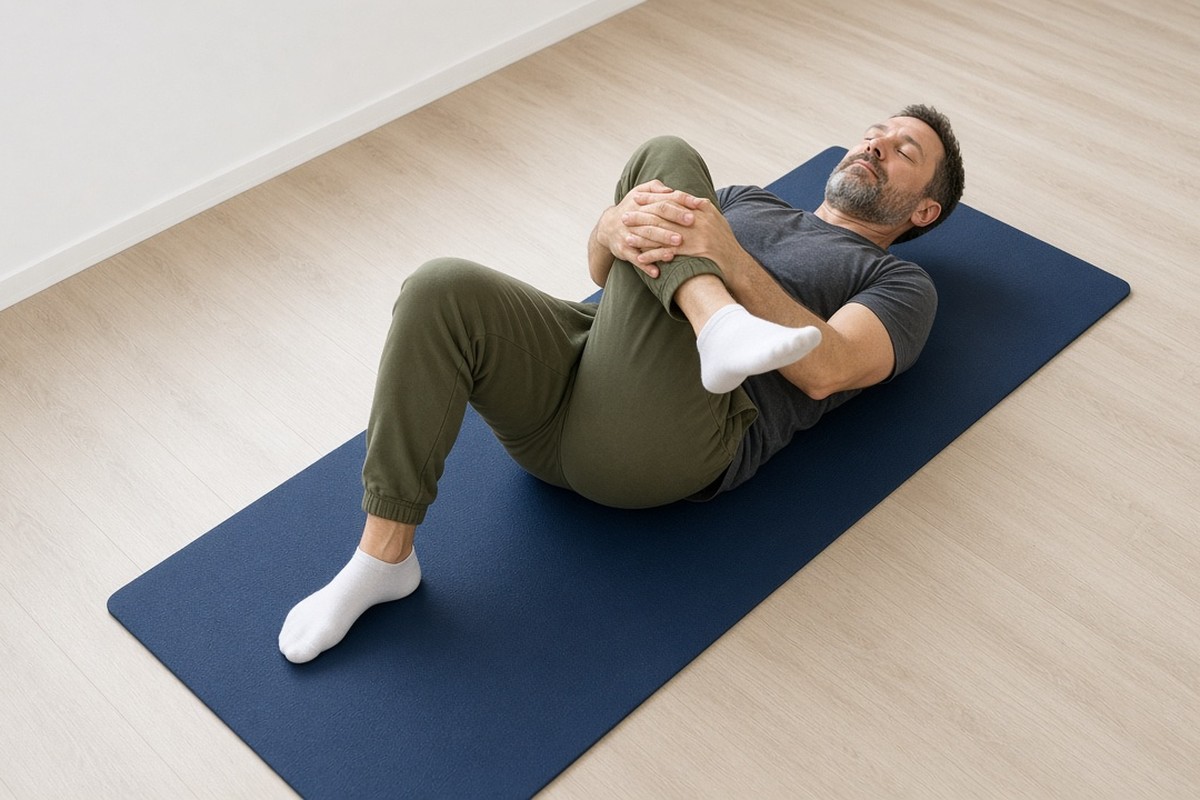
- Lie on your back with knees bent and feet flat.
- Hold behind your thigh or just below your knee and gently pull that knee toward your chest.
- Hold 15 to 30 seconds. Switch sides. Do 2 to 3 per side.
Skip it if bending forward makes your leg pain worse.
2. Figure-4 (Piriformis) Stretch
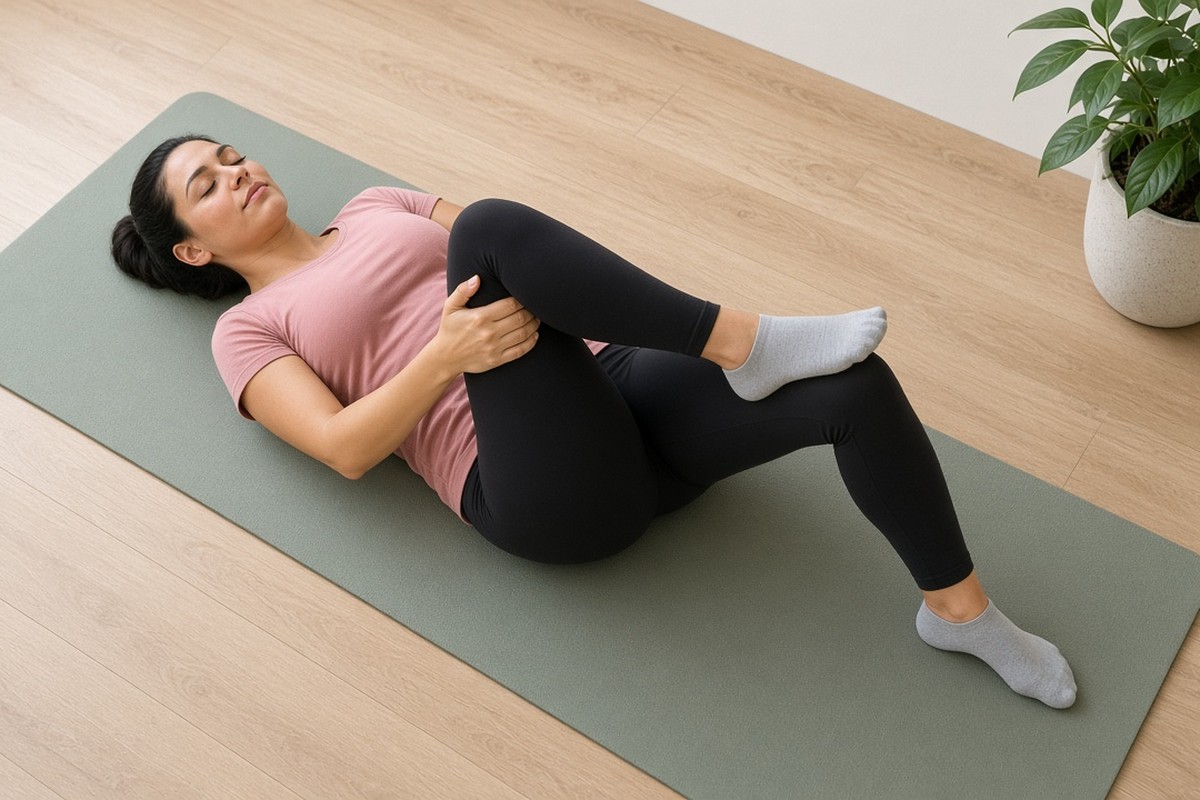
- Lie on your back with knees bent.
- Cross one ankle over the other knee to make a “4.”
- Hold behind the lower thigh and gently pull both legs toward you until you feel a stretch in your buttock. Hold 20 to 30 seconds. Do 2 to 3 per side.
You should feel this in your buttock, not down your leg. It is often used for piriformis syndrome.
3. Prone Press-Up
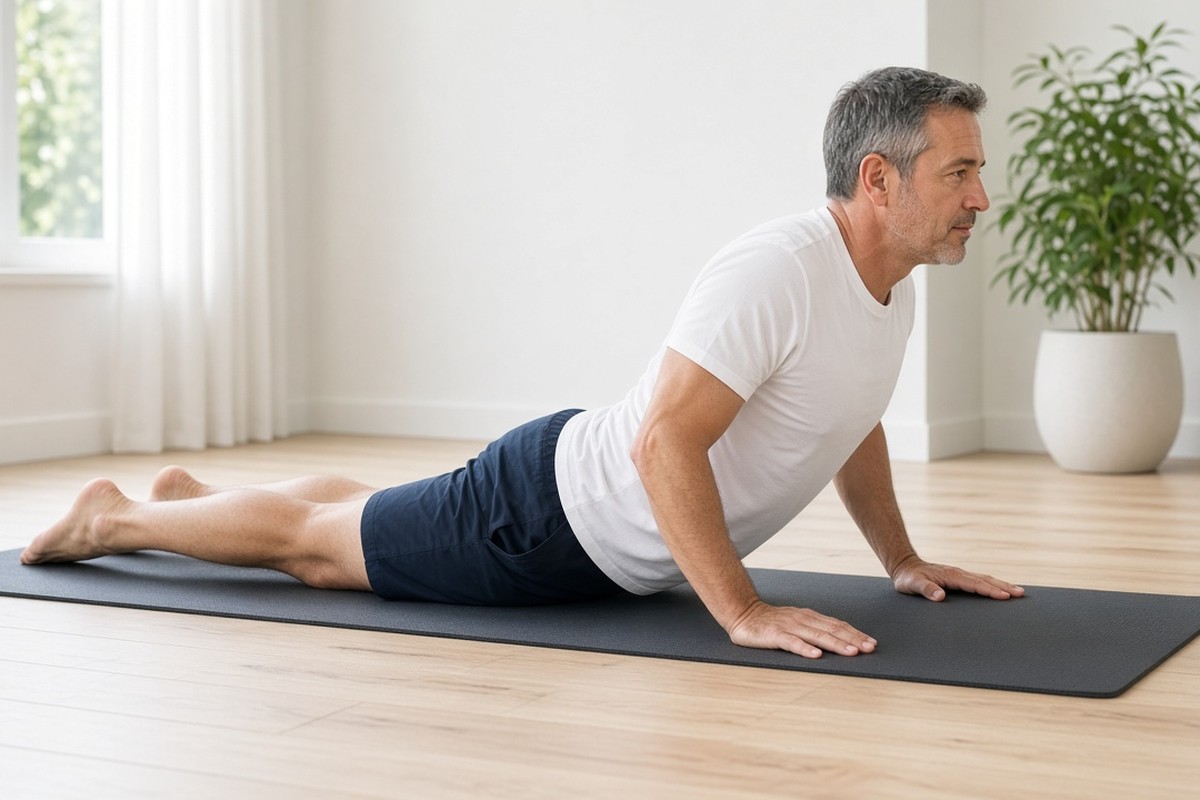
- Lie face down with your hands under your shoulders.
- Keep your hips down and slowly press your upper body up only as far as is comfortable.
- Lower slowly. Do up to 10 reps.
Some people with disc-related leg pain find that arching back eases their pain. Stop if pain spreads down your leg. With spinal stenosis, arching back often feels worse, so ask your doctor or physical therapist first.
4. Seated Sciatic Nerve Glide
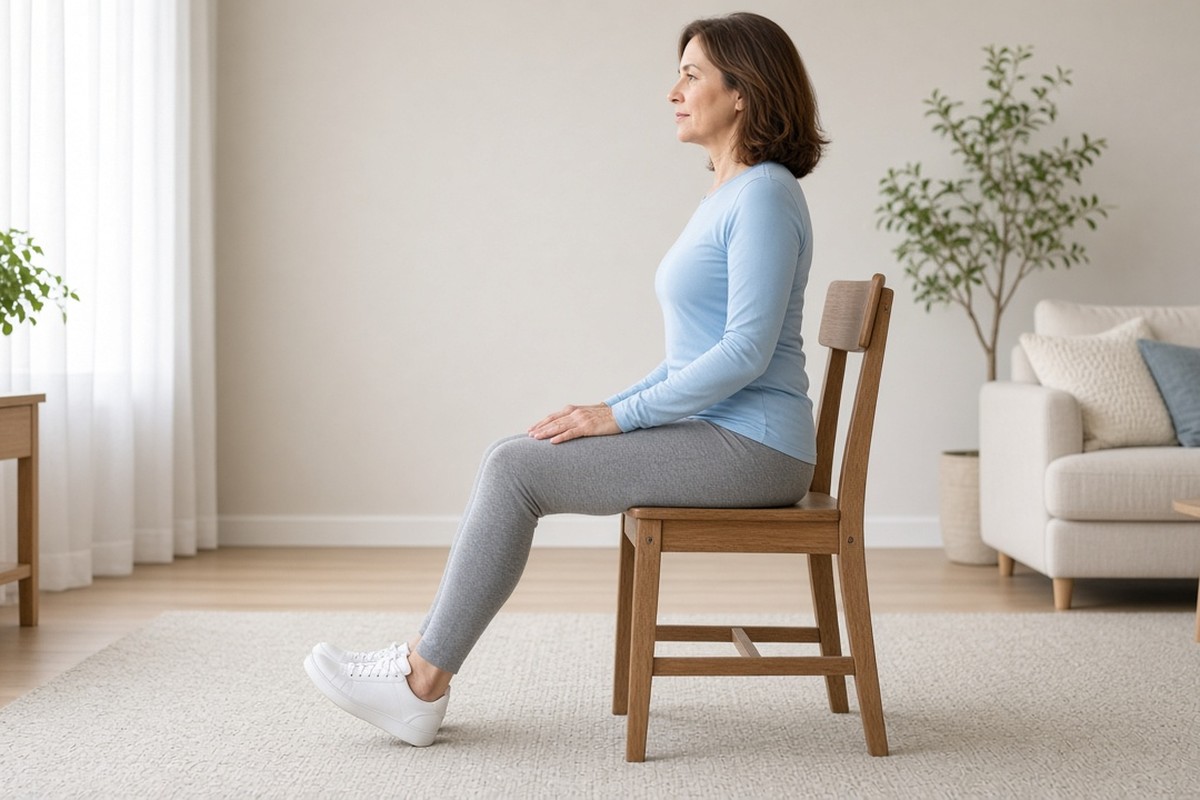
- Sit tall on a firm chair with your feet flat.
- Slowly straighten one knee as you look up a little.
- Bend the knee back as you lower your chin. Do 5 to 10 slow, small reps.
This is a gentle glide, not a stretch. Never force it or hold it. Reviews of nerve glides found some benefit, but the evidence is limited [Source]. Stop if it causes tingling that lingers.
Strength and Movement
Once pain settles a bit, simple strength moves help support your back and hips.
5. Pelvic Tilt
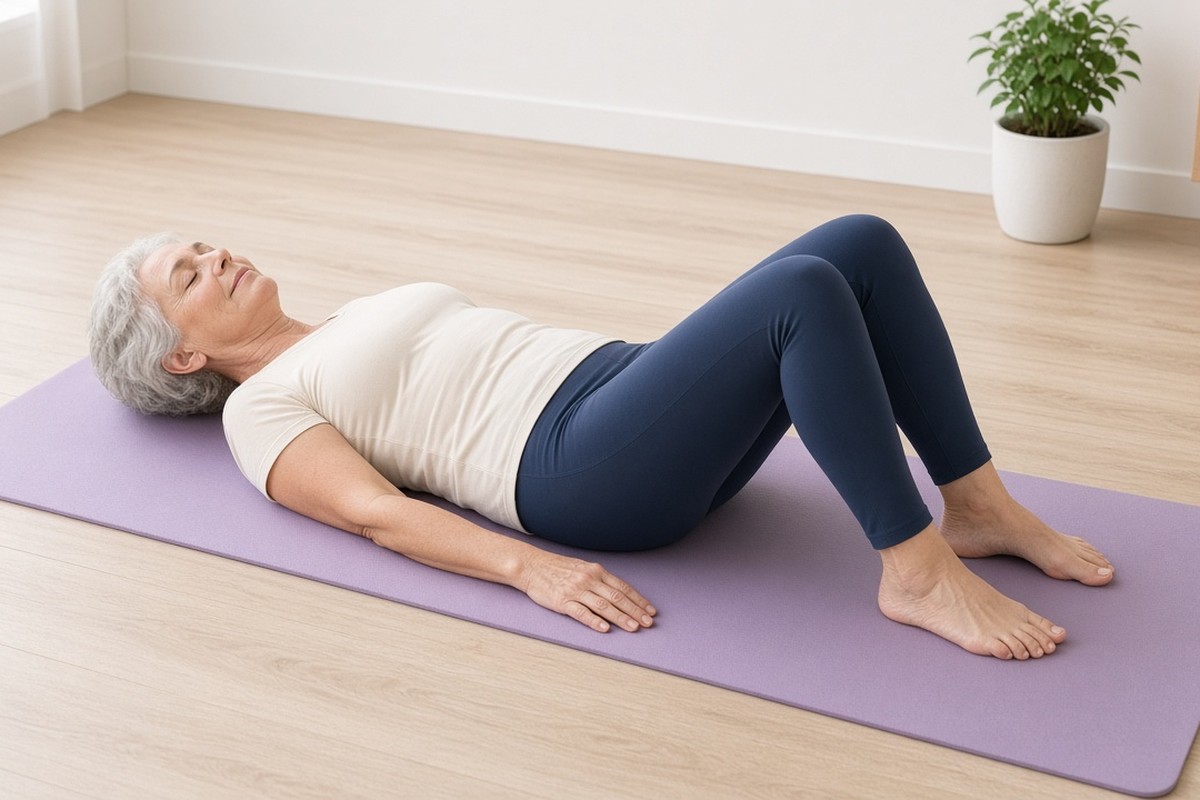
- Lie on your back with knees bent and feet flat.
- Gently tighten your belly and flatten your low back toward the floor.
- Hold 5 seconds and relax. Do 10 reps. Keep breathing.
6. Glute Bridge
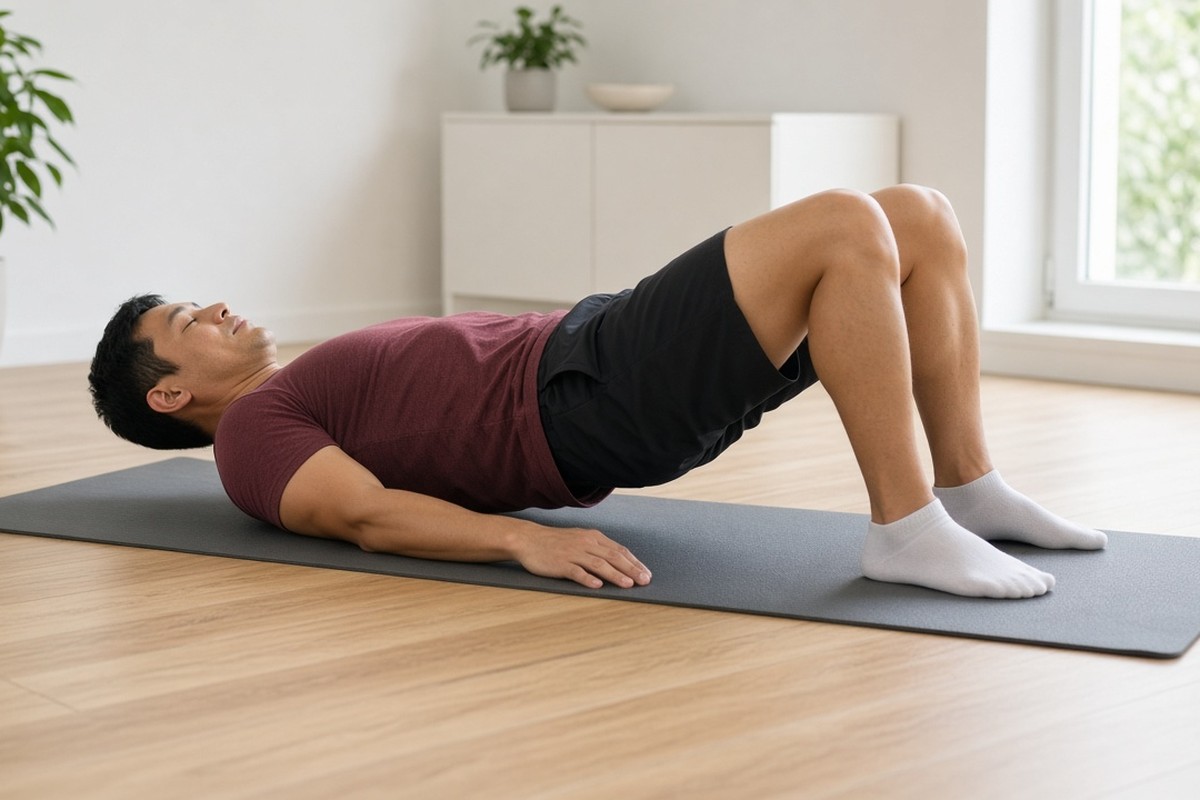
- Lie on your back with knees bent and feet hip-width apart.
- Squeeze your buttocks and lift your hips into a straight line from knees to shoulders.
- Hold 3 to 5 seconds and lower slowly. Do 8 to 12 reps.
7. Walking

- Walk at an easy pace on flat ground.
- Start with 5 to 10 minutes, once or twice a day.
- Add a few minutes every few days as you feel able.
If walking brings on leg pain that eases when you sit or lean forward, tell your doctor. That pattern can point to spinal stenosis.
Sciatica Stretches in Bed or a Chair
- In bed: knee-to-chest, pelvic tilts and a gentle figure-4 stretch work on a firm mattress.
- In a chair: the nerve glide and a seated figure-4 (ankle on the other knee, lean forward a little) work well.
- Older adults: if balance is a concern, use a sturdy chair and keep a hand on something steady.
- Getting up: roll onto your side, then push up with your arms.
Dr. Amit Sharma & our minimally invasive pain & spine team.
Exercises to Avoid During a Flare
There is no agreed list, so let your symptoms guide you. During a flare, many people limit:
- Toe-touches and hard hamstring stretches, which can pull on an irritated nerve
- Full sit-ups
- Heavy lifting, and twisting while lifting
- Any move that sends pain farther down your leg
- Long periods lying down. Stay gently active instead.
Is It Sciatica, Piriformis or SI Joint Pain?
Buttock and leg pain is not always a pinched nerve. Pain that goes below the knee with numbness or tingling points more to a pinched nerve root. Deep buttock pain with sitting may be piriformis-related (sciatica vs piriformis syndrome). Pain near the dimple at the low back may come from the SI joint (sciatica vs SI joint pain). A doctor’s exam helps sort this out.
When Sciatica Stretches Aren’t Enough
Many people with sciatica get better over weeks to months. In one large study, people who expected their problem to last a long time tended to do worse, so staying hopeful and active matters [Source]. See a doctor if your pain is not better after a few weeks, keeps coming back or limits daily life. If numbness lingers after the pain fades, see sciatica pain gone but leg still numb.
A doctor can look for the cause and suggest next steps, such as physical therapy tailored to you [Source]. For some people, an epidural steroid injection or a selective nerve root block may be discussed. Steroids are widely used this way, but the FDA has not approved them for injection into the spine (off-label use), so risks and benefits should be talked through first. If a disc keeps pressing on the nerve, a minimally invasive procedure such as endoscopic discectomy may be an option.
Getting Evaluated at SpinePain Solutions
At SpinePain Solutions, Dr. Amit Sharma, Chief, Division of Pain Medicine at Good Samaritan University Hospital, evaluates sciatica at our Bay Shore, Commack and Farmingdale offices (see office locations). Care starts with conservative steps like the ones on this page. See sciatica treatment on Long Island. Call 631-310-0000.
Frequently Asked Questions
What are the best stretches for sciatica?
No single stretch is best for everyone. Good places to start are the knee-to-chest stretch, the figure-4 stretch, pelvic tilts and walking. Favor the moves that ease your leg pain, and skip any move that sends pain farther down your leg.
When is sciatica an emergency?
Go to the emergency room now for numbness in the groin, buttocks or inner thighs, new trouble peeing, loss of bladder or bowel control, or weakness in both legs. These can be signs of cauda equina syndrome. A foot that suddenly drags or slaps the floor needs a doctor the same day.
Should I do sciatica stretches if it hurts?
Gentle stretching is usually fine if the pain stays mild. Stop if the pain gets sharp, spreads farther down your leg, or comes with new numbness or weakness.
Is walking good for sciatica?
For most people, yes. Walking keeps you active, which guidelines advise for sciatica. Start with short, easy walks on flat ground and add a few minutes at a time.
What exercises should I avoid with sciatica?
During a flare, many people do better if they limit toe-touches, full sit-ups, heavy lifting, twisting while lifting and hard hamstring stretches. Also avoid any move that sends pain farther down your leg.
Can I do sciatica stretches in bed?
Yes. Knee-to-chest, pelvic tilts and a gentle figure-4 stretch can be done on a firm mattress. Move slowly, and take your time getting up.
Is it sciatica or piriformis syndrome?
Both can cause buttock and leg pain, and a doctor’s exam helps tell them apart. Learn more about sciatica vs piriformis syndrome.
How long does sciatica take to get better?
Many people improve over weeks to months, though some take longer. Staying active and expecting to get better may help. See a doctor if your pain is not improving after a few weeks or keeps coming back.
Dr. Amit Sharma & our minimally invasive pain & spine team.
Medical References
- National Institute for Health and Care Excellence (NICE). Low back pain and sciatica in over 16s: assessment and management (NG59). NICE.
- Fernandez M, Hartvigsen J, Ferreira ML, et al. Advice to stay active or structured exercise in the management of sciatica: a systematic review and meta-analysis. Spine. 2015;40(18):1457-1466. doi:10.1097/BRS.0000000000001036. PubMed.
- Hahne AJ, Ford JJ, McMeeken JM. Conservative management of lumbar disc herniation with associated radiculopathy: a systematic review. Spine. 2010;35(11):E488-E504. doi:10.1097/BRS.0b013e3181cc3f56. PubMed.
- Luijsterburg PA, Verhagen AP, Ostelo RW, et al. Physical therapy plus general practitioners’ care versus general practitioners’ care alone for sciatica: a randomised clinical trial with a 12-month follow-up. Eur Spine J. 2008;17(4):509-517. doi:10.1007/s00586-007-0569-6. PubMed.
- Basson A, Olivier B, Ellis R, et al. The effectiveness of neural mobilization for neuromusculoskeletal conditions: a systematic review and meta-analysis. J Orthop Sports Phys Ther. 2017;47(9):593-615. doi:10.2519/jospt.2017.7117. PubMed.
- Konstantinou K, Dunn KM, Ogollah R, et al. Prognosis of sciatica and back-related leg pain in primary care: the ATLAS cohort. Spine J. 2018;18(6):1030-1040. doi:10.1016/j.spinee.2017.10.071. PubMed.
- Long A, Donelson R, Fung T. Does it matter which exercise? A randomized control trial of exercise for low back pain. Spine. 2004;29(23):2593-2602. doi:10.1097/01.brs.0000146464.23007.2a. PubMed.
- George SZ, Fritz JM, Silfies SP, et al. Interventions for the management of acute and chronic low back pain: revision 2021. J Orthop Sports Phys Ther. 2021;51(11):CPG1-CPG60. doi:10.2519/jospt.2021.0304. PubMed.
- Finucane LM, Downie A, Mercer C, et al. International framework for red flags for potential serious spinal pathologies. J Orthop Sports Phys Ther. 2020;50(7):350-372. doi:10.2519/jospt.2020.9971. PubMed.
- Dionne N, Adefolarin A, Kunzelman D, et al. What is the diagnostic accuracy of red flags related to cauda equina syndrome (CES), when compared to magnetic resonance imaging (MRI)? A systematic review. Musculoskelet Sci Pract. 2019;42:125-133. doi:10.1016/j.msksp.2019.05.004. PubMed.
Related resources: lower back stretches, sacroiliac joint dysfunction, transforaminal epidural steroid injection, piriformis injection.



