

L4 Radiculopathy: Knee Pain, Inner Shin Numbness, and Weakness
← Back to the hip pain locator
L4 radiculopathy means the L4 nerve root is irritated as it leaves the low back. It can make a knee hurt even when the problem starts in the spine. It can also send pain, tingling, or numbness down the inner shin. This page is education, not a diagnosis. Related guides: radiculopathy, knee pain, and leg pain between the knee and ankle.
Quick Answer: L4 Radiculopathy
- A pinched L4 root can cause pain, tingling, or numbness at the front of the knee and down the inner shin.
- Symptoms may start in the front of the thigh and may reach the inner ankle and the inner edge of the foot.
- Straightening the knee may feel weak, and the knee-jerk reflex may be reduced.
- L4 also helps lift the foot at the ankle, so foot weakness is not always L5.
- Nerve-area maps (dermatomes) vary. A matching exam and MRI matter more than the map.
- Knee arthritis, hip arthritis, and nerve problems outside the spine can look alike.
- Conservative care usually comes first. EMG/NCS, when needed, are performed at an outside lab.
- Selected image-guided injections may ease persistent root pain and create a window for physical therapy, which may help some people delay or avoid surgery.
- Progressive weakness or bowel/bladder change -> emergency care. Bay Shore, Commack, Farmingdale / 631-310-0000.
A Pinched L4 Nerve Root Can Feel Like a Knee Problem
Spinal nerve roots leave the low back through small openings. When the L4 root is swollen or crowded, symptoms can follow its path toward the knee and the inner lower leg. Some people feel an ache at the front or inside of the knee and think the knee joint is damaged. Others feel a strip of burning or tingling from the front of the thigh toward the inner shin. Some have almost no back pain. So a knee exam alone may not tell the whole story.
Doctors use two related terms. Radicular pain is pain from an irritated nerve root. Radiculopathy means the root is not working normally, with signs such as numbness, weakness, or a reflex change. A person can have pain without weakness, or weakness with little pain.
For the broader idea of nerve-root pain, see our radiculopathy overview.
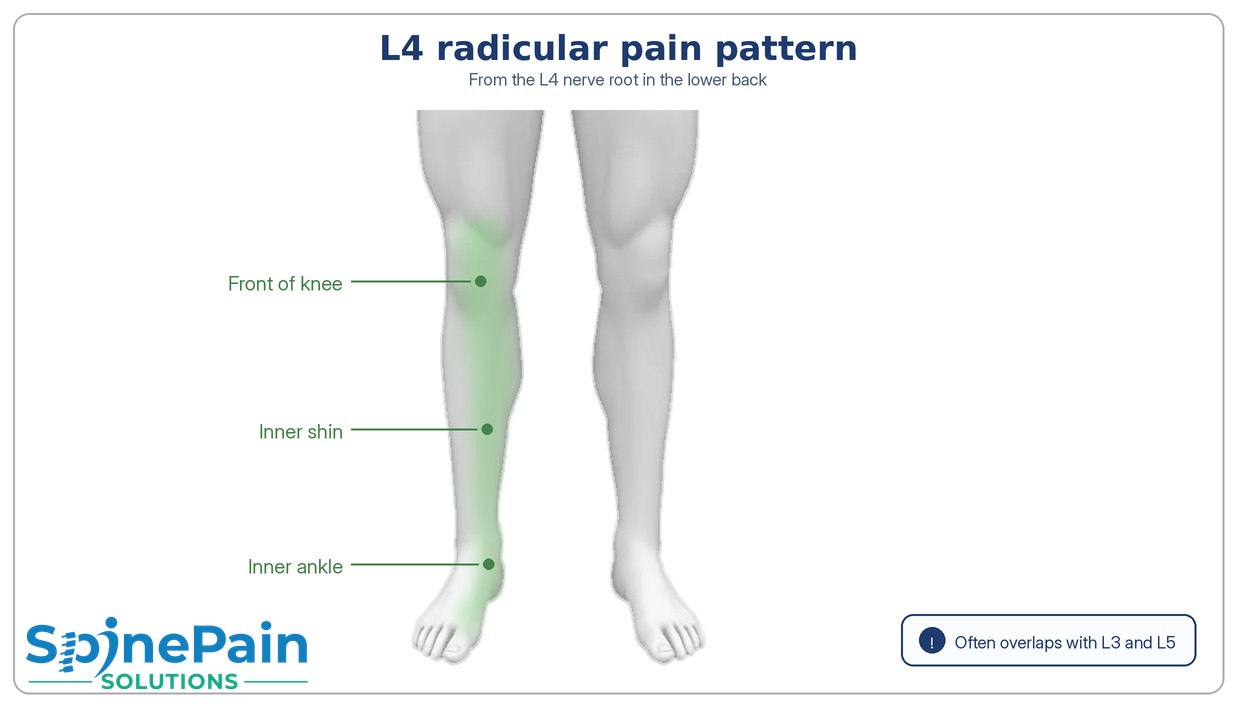
L4 pain runs from the front of the knee down the inner shin (the L4 dermatome)
Feeling changes often show up along the inner shin
L4 symptoms often involve the front of the thigh, the knee, and the inner lower leg (medial side). They may reach the inner ankle and the inner edge of the foot. People describe pins and needles, burning, a cold or wet feeling, or less feeling than usual.
The inner shin is often a more useful clue than the knee alone. Many knee problems cause pain at the joint, but they do not cause a strip of changed feeling below the knee.
L3 symptoms most often stay higher, across the front of the thigh toward the inner knee. See our L3 radiculopathy page. L5 symptoms more often run down the outer shin to the top of the foot and the big toe. See L5 nerve root pain and our side-by-side guide, L4 vs L5 vs S1 nerve root pain.
Weakness can affect straightening the knee and lifting the foot
The L4 root helps power the quadriceps, the large muscles on the front of the thigh that straighten the knee. It also helps power the tibialis anterior, the shin muscle that lifts the foot at the ankle. Each of these muscles gets input from more than one nerve root. So an L4 problem can weaken the knee, the ankle, or both. Not every case of foot drop comes from L5.
The knee-jerk reflex may be reduced
The knee-jerk (patellar) reflex may be weaker on the painful side. It is not a perfect test. A normal reflex does not rule out an L4 problem. Reflexes can also be weak for other reasons.
Daily-life clues can matter more than how bad the pain is
- A knee that feels weak, unsteady, or like it may buckle
- Trouble getting up from a low chair
- Extra effort on stairs
New or worsening weakness should be checked soon. A change in feeling, strength, or reflex means more when all three point to the same root.
Nerve-Area Maps Vary Between People, So Maps Are Approximate
Nerve-area maps (dermatomes) differ from each other. People also differ from the maps. Overlap is expected. A careful review of these maps found that borders vary and overlap. They are not sharp lines (Lee et al., 2008). In people with confirmed nerve-root pain, the pain often did not follow one textbook dermatome (Murphy et al., 2009). Reviews also show that testing feeling alone is not very good at finding which low-back root is involved (Tawa et al., 2017).
Our pain locator can help you describe where symptoms sit before a visit. It is not a diagnosis tool.
The Disc Level and the Nerve Root Often Have Different Numbers
The name L4 means the nerve root, not always the disc level. MRI reports name disc levels, such as L3-4 or L4-5. This often confuses people.
- At the L3-4 disc, a common type of disc herniation (to the back and side) may press on the traversing L4 root. This root runs past that disc on its way down.
- At the L4-5 side opening (foramen), narrowing or a disc far out to the side may press on the exiting L4 root as it leaves the spine. See foraminal stenosis.
Common causes include:
- A disc herniation
- A worn, flatter disc that narrows the opening
- Bone spurs near the facet joints
- Wear-related narrowing of the side channel (lateral recess)
An MRI finding matters only when its side, level, and anatomy match the exam. A mild bulge on a report does not prove it causes symptoms. Disc changes are common on MRIs of people with no pain (Brinjikji et al., 2015). The goal is to match three things: your symptoms, your exam, and the MRI. Learn more about disc herniation.
L4 Radiculopathy and Knee Arthritis Can Feel Alike
Knee arthritis often hurts with walking, stairs, squatting, or getting up from a chair. Swelling, a sore joint line, less knee motion, and stiffness after rest point to the knee. An L4 cause is more likely when pain spreads past the joint. Inner-shin tingling, a reflex change, or weakness also point to L4. Both problems can happen at once.
Other problems that can feel alike include:
- Femoral neuropathy. It can also weaken the quadriceps and change the knee reflex. Here the nerve is hurt outside the spine. This can happen after pelvic surgery, an injury, or pressure on the nerve. See femoral neuropathy.
- Hip arthritis. It can send pain into the front of the thigh or knee, often with groin pain and stiff hip turning.
- An L3 root problem. It can overlap with the thigh and knee part of the pattern.
- A pinched saphenous nerve. This branch of the femoral nerve carries feeling along the inner lower leg
- Nerve damage that often starts in both feet (peripheral neuropathy)
- Blood flow problems in the leg
| Clue | L4 radiculopathy (often) | Knee or outside-the-spine problem (often) |
|---|---|---|
| Where symptoms sit | Knee plus a strip down the inner shin; back pain is common | Knee arthritis stays at the joint; a single nerve follows its own path |
| Strength | Quadriceps may be weak; sometimes weakness lifting the foot | Knee arthritis: pain limits effort; femoral nerve: quadriceps weak |
| Knee-jerk reflex | May decrease | Usually normal with knee arthritis; may decrease with femoral nerve problems |
| Other clues | Back and nerve-tension signs | Knee swelling, joint-line tenderness, stiffness after rest |
Nerve-test reviews explain that the pattern of weakness and numbness helps tell a nerve-root problem from a single-nerve problem (Robblee and Katzberg, 2016). Sorting these out takes an exam, not a chart. See also conditions that mimic spine pain.
Evaluation Starts with History, Exam, and Imaging When Appropriate
The visit starts with your story. Where does pain start? How far does it travel? Is there numbness? Does the leg feel weak? Dr. Sharma checks the low back, hip, and knee. Symptoms can come from more than one place. Strength tests include straightening the knee and lifting the foot. The knee reflex, feeling along the inner leg, and the way you walk help find the source.
MRI is the usual advanced imaging choice when symptoms persist, worsen, or show nerve weakness. That fits appropriateness guidance for low-back pain with nerve-root features (American College of Radiology, 2021). The images are checked both at L3-4 and at the L4-5 opening, where the L4 root can be pinched. A normal or unclear MRI does not mean the symptoms are not real.
The North American Spine Society advises matching the exam with the imaging before any invasive step for a low-back disc with nerve-root pain (North American Spine Society, 2014). EMG/NCS can help tell an L4 root problem from femoral neuropathy or another nerve problem when the cause is unclear. At SpinePain Solutions, EMG/NCS, when needed, are performed at an outside lab. See MRI vs EMG for leg numbness.
Sometimes more than one level could explain the symptoms. Then a nerve root block, done with X-ray guidance, may add facts. It numbs one root for a short time. The result still has to be read with the rest of the picture. The goal is to avoid treating an MRI finding that does not matter and missing a hip, knee, or nerve problem.
Conservative Care Comes First for Most L4 Flares
For many new nerve-root flares, the first steps are time, activity changes, physical therapy, and medicines when safe. Low-back pain guidelines favor options without drugs or procedures before stepping up care (American College of Physicians, 2017). Chiropractic care can fit selected mechanical patterns as a partner. See pain management doctor or chiropractor.
A therapist may work on safe movement, core strength, and hip motion. They can also teach you how to avoid positions that make leg symptoms worse. Staying gently active is most often better than long bed rest. Medicine choices depend on your health history, your kidneys, other conditions, and other drugs you take.
Conservative care is not “doing nothing.” It is a structured plan to calm the root, restore motion, and protect walking and stairs while many disc-related nerve-root problems improve. If your knee feels like it gives way, ask your care team how to stay safe on stairs and rough ground.
Injections May Help Selected Low-Back Nerve-Root Pain
Sometimes nerve-root pain in the knee and shin stays disabling after a fair try of conservative care. Then an image-guided epidural steroid injection or a selective nerve root approach may be discussed. The goal is to calm inflammation around the irritated L4 root. This can create a more comfortable window for physical therapy and daily walking. For some people, that progress helps delay or avoid surgery. These procedures do not remove a disc herniation or widen a narrowed nerve opening, and benefit varies from person to person. They also do not promise that weakness will get better. The exact approach depends on your body and health risks.
Large research reviews show modest average benefits for selected nerve-root pain. Results differ between studies. That is why we avoid outcome percentages on patient pages (Chou et al., 2015; Manchikanti et al., 2016). Before an injection, Dr. Sharma reviews the expected benefit, alternatives, and risks as part of informed consent. Tell the team about blood thinners, diabetes, allergies, or an active infection. An injection should not delay urgent care for worsening weakness.
Service pages: epidural steroid injection and selective nerve root block.
Dr. Amit Sharma & our minimally invasive pain & spine team.
Minimally Invasive Disc Procedures Are Reserved for Clear Targets
When a clear disc herniation matches the L4 pattern and nonsurgical care has not helped enough, surgery may be discussed. A surgeon’s opinion may also make sense when weakness is marked or getting worse, when the nerve is badly pinched, or when symptoms stay severe. For some herniations that sit off to the side of the spine (lateral), our practice offers an endoscopic discectomy through a small incision, done from the side (an outside-in approach). For other patterns, we work with our spine surgery partners. Injections do not replace every operation, and the choice depends on your exam and imaging. Not every L4 finding on an MRI needs surgery.
Red Flags Need Emergency Care
Call 911 or go to the ER for rapidly worsening leg weakness, new bladder or bowel loss, saddle numbness, fever with severe back pain, or sudden inability to walk. These can signal cauda equina syndrome or other emergencies. Learn more: cauda equina syndrome. Call 631-310-0000 for non-emergency questions.
Get checked soon for new knee buckling, a leg that suddenly feels weak, or new trouble lifting the foot. This matters most if it is getting worse. A major injury, or past cancer with new nerve symptoms, also needs urgent care.
Expert groups say to take red flags seriously. They also note that one flag alone may not mean a serious problem (Finucane et al., 2020).
Bring Your MRI Images and a Symptom Timeline to Your Visit
Bring the MRI images if you have them, not just the written report. A short symptom timeline helps:
- When the knee or leg symptoms started
- Whether they travel below the knee
- What activities make them worse
- Whether the leg has buckled
Tell us about any past knee or hip care, shots, and therapy. If you already had an EMG at an outside lab, bring that report too. For a broader look at spine diagnosis, see our back pain guide.
L4 Radiculopathy Care on Long Island
Dr. Amit Sharma is board certified in Pain Medicine and is the Founder and Director of SpinePain Solutions. He has performed more than 60,000 interventional procedures. He has been Chief, Division of Pain Medicine at Good Samaritan University Hospital since 2012 and is Medical Director of MICNY in Commack. He evaluates low-back nerve-root patterns and image-guided options at Bay Shore, Commack, and Farmingdale (office locations). Plans stay based on the exam and conservative-first care. Call or text 631-310-0000.
Searches for L3-4 radiculopathy and L4-5 radiculopathy usually name the disc level next to an irritated root. The exam still has to match.
Frequently Asked Questions
What does L4 radiculopathy feel like?
It often causes pain, tingling, or numbness from the front of the knee down the inner shin. It can reach the inner ankle. The knee may feel weak or give way. Patterns vary between people, so this is a clue, not a diagnosis.
When should leg or back symptoms send me to the emergency room?
Seek emergency care for rapidly worsening leg weakness, new bladder or bowel loss, saddle numbness, fever with severe back pain, or sudden inability to walk. Call SpinePain Solutions at 631-310-0000 for non-emergency questions.
Can L4 radiculopathy cause knee pain?
Yes. A pinched L4 root can cause pain around the knee. It often comes with symptoms in the front of the thigh or inner lower leg. Knee arthritis and hip problems can feel the same, so the exam matters.
Is L4 radiculopathy the same as sciatica?
Not exactly. People often call any nerve pain down the leg sciatica. L4 pain tends to sit at the front of the knee and the inner shin. Classic sciatica runs down the back or outer side of the leg. That pattern is more often linked to L5 or S1.
How is L4 different from L3 and L5?
L3 most often stays on the front of the thigh toward the inner knee. L4 more often runs from the knee down the inner shin. L5 more often affects the outer shin, the top of the foot, and the big toe. These areas overlap, so the exam matters.
Which disc can pinch the L4 nerve root?
A typical L3-4 disc herniation can press on the traversing L4 root. At L4-5, a disc or narrowing at the side opening (foramen) can press on the exiting L4 root. The MRI findings and the exam need to match.
Can L4 cause foot drop?
It can add to trouble lifting the foot. L4 helps power the tibialis anterior, the shin muscle that lifts the foot. L5 problems are also a common cause, so foot weakness needs a full nerve exam.
Can L4 radiculopathy make my knee give out?
It can. The L4 root helps power the quadriceps, the muscles that straighten the knee. Weakness can make stairs or rising from a chair harder. Knee joint problems can feel similar, so the exam matters.
Does every L4 problem need an EMG?
No. An EMG may help when the exam and MRI do not agree. It may also help when a thigh nerve problem outside the spine is possible. At SpinePain Solutions, EMG/NCS, when needed, are performed at an outside lab.
Will an epidural injection repair the nerve?
No. For some people, an epidural injection may calm swelling around the nerve and ease leg pain. It does not remove a disc herniation, and it does not promise that weakness will recover.
What treatments are tried before injections?
Most people start with activity changes, physical therapy, and medicines when safe. Image-guided injections are discussed when root pain stays disabling after a fair conservative try.
Who treats L4 radiculopathy on Long Island?
SpinePain Solutions evaluates L4 nerve-root patterns at Bay Shore, Commack, and Farmingdale. Call or text 631-310-0000.
Dr. Amit Sharma & our minimally invasive pain & spine team.
Medical References
- Lee MWL, McPhee RW, Stringer MD. An evidence-based approach to human dermatomes. Clin Anat. 2008. PMID 18470936.
- Murphy DR, Hurwitz EL, Gerrard JK, Clary R. Pain patterns and descriptions in patients with radicular pain: does the pain necessarily follow a specific dermatome? Chiropr Osteopat. 2009. PMID 19772560.
- Tawa N, Rhoda A, Diener I. Accuracy of clinical neurological examination in diagnosing lumbo-sacral radiculopathy: a systematic literature review. BMC Musculoskelet Disord. 2017. PMID 28231784.
- Robblee JV, Katzberg HD. Distinguishing Radiculopathies from Mononeuropathies. Front Neurol. 2016. PMID 27468275.
- Kreiner DS et al.; North American Spine Society. An evidence-based clinical guideline for the diagnosis and treatment of lumbar disc herniation with radiculopathy. Spine J. 2014. PMID 24239490.
- Hutchins TA et al. ACR Appropriateness Criteria Low Back Pain: 2021 Update. J Am Coll Radiol. 2021. PMID 34794594.
- Qaseem A et al. Noninvasive Treatments for Acute, Subacute, and Chronic Low Back Pain: ACP Clinical Practice Guideline. Ann Intern Med. 2017. PMID 28192789.
- Chou R et al. Epidural Corticosteroid Injections for Radiculopathy and Spinal Stenosis. Ann Intern Med. 2015. PMID 26302454.
- Manchikanti L et al. Epidural Injections for Lumbar Radiculopathy and Spinal Stenosis: A Comparative Systematic Review and Meta-Analysis. Pain Physician. 2016. PMID 27008296.
- Brinjikji W et al. Systematic literature review of imaging features of spinal degeneration in asymptomatic populations. AJNR Am J Neuroradiol. 2015. PMID 25430861.
- Finucane LM et al. International Framework for Red Flags for Potential Serious Spinal Pathologies. J Orthop Sports Phys Ther. 2020. PMID 32438853.
- American Academy of Orthopaedic Surgeons (OrthoInfo). Herniated Disk in the Lower Back.
Medical disclaimer: This article is educational and is not a substitute for individualized medical evaluation. Decisions about injections, procedures, and surgery depend on examination, medical history, symptoms, imaging, and clinical judgment.



