

S1 Radiculopathy: Pain Down the Calf, Outer Foot Numbness, and Weak Toe Push-Off
← Back to the hip pain locator
S1 radiculopathy means the S1 nerve root is irritated or pinched near the base of the spine. It often sends pain down the back of the leg to the outer foot. It may also weaken the calf and change the ankle reflex. That can explain why a person with “sciatica” has trouble standing on tiptoe or pushing off when walking. This page is education, not a diagnosis. Related guides: sciatica, radiculopathy, and L5 nerve root pain.
Quick Answer: S1 Radiculopathy
- S1 radiculopathy means the S1 nerve root is irritated or pinched near the base of the spine.
- Pain often runs through the buttock, back of the thigh, and calf toward the outer foot.
- Numbness or tingling may affect the little-toe side of the foot or the sole.
- Rising onto your toes or pushing off when you walk may feel weak.
- The ankle (Achilles) reflex may be reduced. A normal reflex does not rule out S1.
- Nerve-area maps (dermatomes) vary. A matching exam and MRI matter more than the map.
- Conservative care usually comes first. EMG/NCS, when needed, are performed at an outside lab.
- Selected image-guided injections may ease persistent root pain and create a window for physical therapy, which may help some people delay or avoid surgery.
- Progressive weakness or bowel/bladder change -> emergency care. Bay Shore, Commack, Farmingdale / 631-310-0000.
S1 Radiculopathy Means the S1 Nerve Root Is Irritated
A sharp pain down the back of the leg can feel like plain sciatica. But when the pain reaches the outer edge of the foot, or the calf feels weak when you push off, the S1 nerve root needs a closer look.
S1 travels past the L5-S1 disc before it exits the sacrum
The S1 nerve root runs down inside the spinal canal, past the L5-S1 disc. Then it leaves through an opening in the sacrum, the bone at the base of the spine. It carries feeling from the back of the calf and the outer foot. It also helps power the calf muscles and the ankle reflex. A disc or a narrowed space can irritate the root, so pain may be felt far from the back.
A common cause is an L5-S1 disc herniation that presses on the S1 root as it passes. A herniation near the center, or just off center, can affect S1. A herniation in or beyond the side opening at L5-S1 more often affects L5 instead. So the disc level alone does not tell us which nerve is involved. See our disc herniation guide.
Doctors use two related terms. Radicular pain is pain from an irritated nerve root. Radiculopathy means the root is not working normally, with signs such as numbness, weakness, or a reflex change. Some people mainly have shooting pain. Others have tingling, loss of feeling, or weakness. Nerve-root pain can happen with little or no back pain.
S1 pain runs down the back of the leg to the outer foot (the S1 dermatome)
Pain and numbness often reach the calf and the side of the little toe
A common S1 pattern starts in the low back or buttock. It runs down the back of the thigh into the calf. It may go on past the outer ankle to the outside of the foot or the little toe. Some people feel burning or pins and needles on the sole. The exact path varies because nearby nerve roots overlap.
Pain may flare with coughing, sneezing, long sitting, or bending when a disc is pressing on the nerve. In other people, walking or standing brings on symptoms when a narrow spinal canal is the main problem. No single activity proves which nerve is involved.
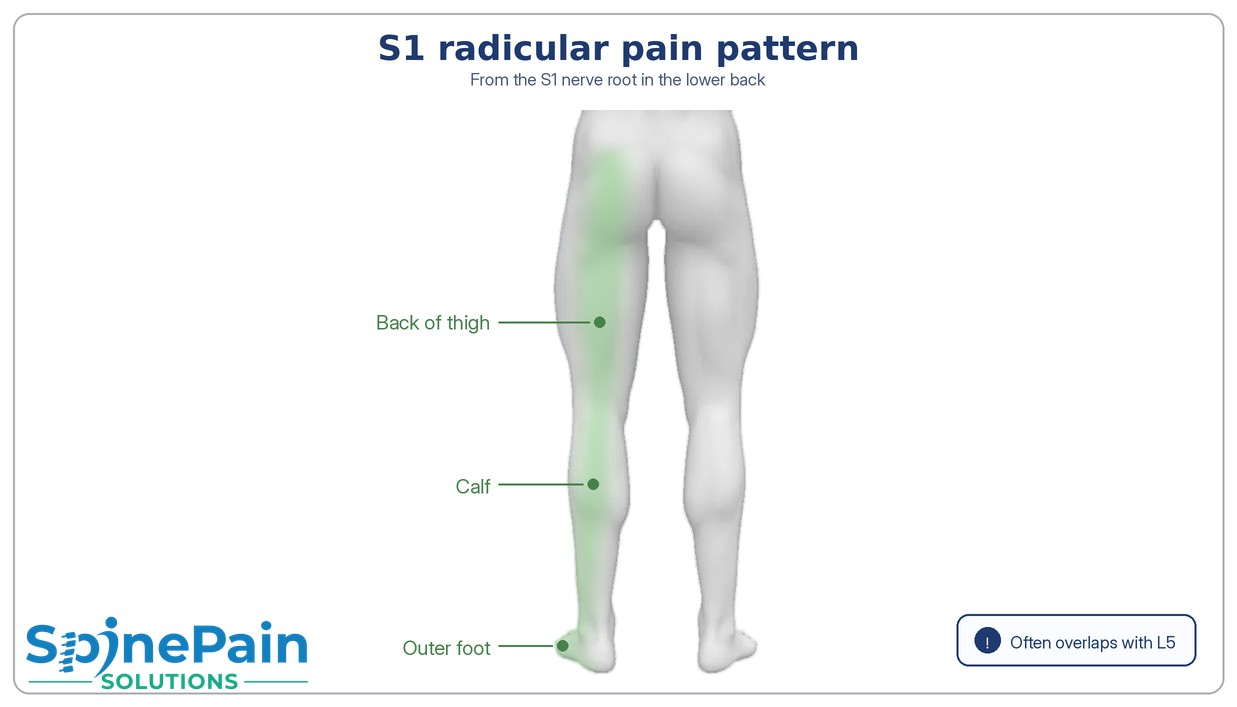
S1 weakness shows up when you push off
S1 helps power the calf muscles that point the foot down. You use them to stand on tiptoe, climb stairs, and push off when you walk. With real S1 weakness, rising onto the toes of one leg again and again may be hard on that side. Normal walking may still look fine.
The ankle (Achilles) reflex may be reduced
The doctor checks this reflex by tapping the tendon at the back of the ankle. It may be weaker on the painful side. Reflexes also change with age and other health problems, so this is only one part of the exam.
Important: The S1 map is a clue, not a home test. Pain in the calf or little toe can also come from a problem outside the spine.
Nerve-Area Maps Vary Between People, So Maps Are Approximate
Nerve-area maps (dermatomes) differ from each other. People also differ from the maps. Overlap is expected. A careful review of these maps found that borders vary and overlap. They are not sharp lines [Source]. In people with confirmed nerve-root pain, the pain often did not follow one textbook dermatome [Source]. Reviews also show that testing feeling alone is not very good at finding which low-back root is involved [Source].
Our pain locator can help you describe where symptoms sit before a visit. It is not a diagnosis tool.
S1 Affects Push-Off While L5 More Often Affects Foot Lifting
Nearby nerve roots can cause the same kind of symptoms, but their best clues differ. L5 often affects the top of the foot and the big toe. It can make it hard to lift the ankle or big toe, or to walk on your heels. S1 more often affects the outer foot, calf push-off, and the ankle reflex. It can make it hard to walk on your toes. L4 can affect the front of the thigh, the knee, or the inner shin, and can weaken knee straightening.
| Clue | S1 (often) | L5 (often) |
|---|---|---|
| Where symptoms sit | Back of calf, outer foot, little toe, sometimes the sole | Outer shin, top of foot, big toe |
| Weakness | Pushing the foot down; toe-walking; repeated toe raises | Lifting the foot or big toe; heel-walking |
| Reflex | Ankle (Achilles) reflex may decrease | No routine reflex that is reliable |
The overlap is large. Pain can cross these textbook borders, most of all when more than one level is involved. That is why Dr. Sharma does not name a nerve root from a drawing or an MRI label alone. For side-by-side detail, see L5 vs S1 radiculopathy and L4 vs L5 vs S1 nerve root pain.
Other Nerve, Joint, and Blood-Flow Problems Can Feel Like S1
Muscle, tendon, and joint problems
A hamstring injury can cause buttock or back-of-thigh pain. An Achilles tendon problem can make pushing off painful. Pain can limit effort even when the nerve is healthy. Sacroiliac (SI) joint pain and hip problems can also spread into the leg. These do not tend to cause the full S1 pattern of numbness, calf weakness, and a reduced ankle reflex. But they can happen at the same time.
Nerve problems outside the spine
- Piriformis or other deep buttock problems may irritate the sciatic nerve. See piriformis syndrome and sciatica vs piriformis syndrome.
- A tibial nerve problem, such as tarsal tunnel syndrome at the inner ankle, can cause tingling in the sole.
- A peroneal nerve problem more often affects the top of the foot or foot lifting, so it looks more like L5 than S1.
- Nerve damage in many nerves (peripheral neuropathy) often affects both feet, starting in the toes.
- Less often, a problem in the nerve network in the pelvis (sacral plexus) can affect several muscles and areas of feeling.
The exam and nerve tests help sort these out. Reviews of nerve tests explain that the pattern of weakness and numbness helps tell a nerve-root problem from a single-nerve problem [Source].
Calf pain with walking
Poor blood flow in the leg arteries can cause calf aching that eases with rest. See claudication. Spinal stenosis can also cause leg pain with standing or walking, and sitting or bending forward may help. These are clues, not proof. Your doctor may check the pulses in your feet and order blood-flow tests when needed.
Evaluation Starts with History, Exam, and Imaging When Appropriate
The exam starts with the pattern, not the MRI
Dr. Sharma asks how the pain began, where it travels, and whether numbness or weakness is getting worse. The exam checks how your low back moves, nerve-stretch tests, feeling along the foot, calf strength, heel raises when safe, and the ankle reflex. He also checks the hip, knee, ankle, and foot when they could explain the symptoms.
The exam also looks for signs that the problem is bigger than one S1 root. Weakness in several muscle groups, symptoms in both legs, balance changes, or odd reflexes can change the test plan.
MRI helps when symptoms persist or warning signs appear
A low-back MRI can show a disc herniation or narrowing near S1. A scan is most often not the first step for new, stable symptoms without warning signs. It may help when symptoms last despite fair care and a procedure or surgery is being considered. It is needed sooner for weakness that is getting worse. It is also needed sooner for concerns such as severe nerve pressure, infection, cancer, or a broken bone. This fits imaging guidance for low-back pain [Source].
A scan has to match the side and pattern of your symptoms. Disc changes are common on MRIs of people with no pain [Source]. A report that says “L5-S1 degeneration” does not prove S1 radiculopathy. The North American Spine Society advises matching the exam with the imaging before any invasive step for a low-back disc with nerve-root pain [Source].
Outside-lab nerve tests can clarify an unclear diagnosis
EMG and nerve conduction studies may help when the cause is unclear, when the scan and exam disagree, or when a nerve outside the spine may be involved. At SpinePain Solutions, EMG/NCS, when needed, are performed at an outside lab. Nerve conduction studies are most often paired with needle EMG when testing for a nerve-root problem. A normal EMG does not rule out S1 pain. This is especially true when symptoms are mainly pain or numbness, or when testing is done too early [Source]. See MRI vs EMG for leg numbness.
Conservative Care Comes First for Most S1 Flares
For many new nerve-root flares, the first steps are time, activity changes, physical therapy, and medicines when safe. Low-back pain guidelines favor options without drugs or procedures before stepping up care [Source]. Chiropractic care can fit selected mechanical patterns as a partner. See pain management doctor or chiropractor.
A therapist can pace exercise to your symptoms. A pain reliever or an anti-inflammatory medicine may help when safe. Kidney disease, stomach bleeding, blood pressure, pregnancy, and other drugs can change the choice. Long bed rest is most often not helpful.
Change the plan if a movement keeps pushing pain farther down the leg or causes new weakness. Your doctor may suggest ways to sit, lift, or walk that ease the nerve while you heal. Healing can take time. Care should be rechecked if the pattern changes.
Conservative care is not “doing nothing.” It is a structured plan to calm the root, restore motion, and protect walking while many disc-related nerve-root problems improve.
Injections May Help Selected Low-Back Nerve-Root Pain
Sometimes shooting leg pain stays disabling after a fair try of conservative care. Then an image-guided epidural steroid injection or a selective S1 nerve root block may be discussed. The goal is to calm inflammation around the pinched S1 root. This can create a more comfortable window for physical therapy and daily walking. For some people, that progress helps delay or avoid surgery. These procedures do not remove a disc herniation or widen a narrowed nerve opening, and benefit varies from person to person.
These shots aim mainly at pain that travels down the leg, not aching in the center of the back. A selective block may add clues about which nerve hurts, but it cannot prove the source by itself. A 2025 review by the American Academy of Neurology found likely short-term gains in pain and function for nerve-root pain. Lasting relief is less certain [Source]. Other large reviews show modest average gains. Results differ between studies. That is why we avoid outcome percentages on patient pages [Source] [Source]. An injection does not reliably reverse weakness.
Before an injection, Dr. Sharma reviews the expected benefit, alternatives, and risks as part of informed consent. Risks include a short pain flare, blood sugar changes, headache, bleeding, infection, and rare nerve injury. Tell the team about blood thinners, diabetes, allergies, or an active infection. Do not stop prescribed blood thinners on your own. An injection should not delay urgent care for worsening weakness.
Service pages: epidural steroid injection, transforaminal epidural steroid injection, and selective nerve root block.
Dr. Amit Sharma & our minimally invasive pain & spine team.
Worsening Weakness May Need a Spine Surgery Opinion
An opinion from our spine surgery partners may be needed when weakness is marked or getting worse. It may also help when severe symptoms last despite fair nonsurgical care and match nerve pressure on the MRI. An abnormal scan alone is not a reason for surgery. A surgical opinion helps weigh the options. It does not mean an operation is certain. Care is based on your symptoms, how long they have lasted, your exam, your health history, and your scans, not the nerve-root label alone.
Red Flags Need Emergency Care
Call 911 or go to the ER for rapidly worsening leg weakness, new bladder or bowel loss, saddle numbness, fever with severe back pain, or sudden inability to walk. These can signal cauda equina syndrome or other emergencies. Learn more: cauda equina syndrome. Call 631-310-0000 for non-emergency questions.
New trouble starting urination or emptying the bladder also needs emergency care. Get checked soon for new or growing foot or calf weakness, especially if you cannot push off or rise onto your toes as before. Do not wait for a routine visit when weakness is getting worse. Severe pain after a major fall or injury needs urgent care. Tell your doctor about cancer, a weak immune system, or weight loss you cannot explain. These can change how fast tests are needed.
A painful or swollen calf can also have causes that are not in the spine. Sudden calf swelling, redness, or warmth should be checked promptly. Chest pain or shortness of breath needs emergency care.
Expert groups say to take red flags seriously. They also note that one flag alone may not mean a serious problem [Source].
S1 Radiculopathy Care on Long Island
Dr. Amit Sharma is board certified in Pain Medicine and is the Founder and Director of SpinePain Solutions. He has performed more than 60,000 interventional procedures. He has been Chief, Division of Pain Medicine at Good Samaritan University Hospital since 2012 and is Medical Director of MICNY in Commack. He evaluates low-back nerve-root patterns and image-guided options at Bay Shore, Commack, and Farmingdale (office locations). Plans stay based on the exam and conservative-first care. Call or text 631-310-0000.
A visit aims to answer three questions. Does the pattern fit S1? Is the nerve losing function? What care makes sense now? Sometimes the answer is more therapy and watching. Other times it is an MRI review, nerve testing at an outside lab, a shot, or a surgeon’s view. An exam is needed before any treatment plan.
Searches for L5-S1 radiculopathy usually name the disc level next to an irritated root. The exam still has to match.
Frequently Asked Questions
What does S1 radiculopathy feel like?
It often causes pain from the buttock down the back of the thigh and calf toward the outer foot. The outer foot near the little toe, or the sole, may tingle or feel numb. Pushing off or rising onto your toes may feel weak. Patterns vary, so this is a clue, not a diagnosis.
When should leg or back symptoms send me to the emergency room?
Seek emergency care for rapidly worsening leg weakness, new bladder or bowel loss, saddle numbness, fever with severe back pain, or sudden inability to walk. Call SpinePain Solutions at 631-310-0000 for non-emergency questions.
Can S1 radiculopathy cause numbness in the little toe?
Yes. S1 irritation can change feeling along the outer foot and the side of the little toe. The exact area varies and overlaps with other nerves.
Can S1 radiculopathy cause weakness without much back pain?
Yes. Some people mainly have calf weakness, a weak push-off, or leg symptoms with little low-back pain. New weakness, or weakness that is getting worse, needs a prompt check.
How is S1 different from L5?
L5 more often affects the top of the foot and the big toe, and can make it hard to lift the foot or big toe. S1 more often affects the back of the calf and the outer foot, and can make it hard to push off or walk on the toes. The ankle (Achilles) reflex may be reduced with S1. These areas overlap, so the exam matters.
Does an L5-S1 disc herniation always affect the S1 nerve?
No. Where the disc sits matters. A common type of herniation near the center at L5-S1 may press on the S1 root as it passes. A herniation out in the side opening at L5-S1 more often affects L5.
Can an EMG be normal with S1 radiculopathy?
Yes. An EMG may be normal when symptoms are mainly pain or numbness, when changes are mild, or when testing is done too early. It is one part of the work-up, not the whole answer. At SpinePain Solutions, EMG/NCS, when needed, are performed at an outside lab.
Will an epidural injection fix S1 weakness?
Not reliably. An epidural injection may ease nerve pain in some people. It does not remove pressure from a disc or bone, and it does not reliably reverse weakness. Worsening weakness needs a prompt recheck.
What treatments are tried before injections?
Most people start with activity changes, physical therapy, and medicines when safe. Image-guided injections are discussed when root pain stays disabling after a fair conservative try.
Who treats S1 radiculopathy on Long Island?
SpinePain Solutions evaluates S1 nerve-root patterns at Bay Shore, Commack, and Farmingdale. Call or text 631-310-0000.
Dr. Amit Sharma & our minimally invasive pain & spine team.
Medical References
- Lee MWL, McPhee RW, Stringer MD. An evidence-based approach to human dermatomes. Clin Anat. 2008. PMID 18470936.
- Murphy DR, Hurwitz EL, Gerrard JK, Clary R. Pain patterns and descriptions in patients with radicular pain: does the pain necessarily follow a specific dermatome? Chiropr Osteopat. 2009. PMID 19772560.
- Tawa N, Rhoda A, Diener I. Accuracy of clinical neurological examination in diagnosing lumbo-sacral radiculopathy: a systematic literature review. BMC Musculoskelet Disord. 2017. PMID 28231784.
- Robblee JV, Katzberg HD. Distinguishing Radiculopathies from Mononeuropathies. Front Neurol. 2016. PMID 27468275.
- Kreiner DS et al.; North American Spine Society. An evidence-based clinical guideline for the diagnosis and treatment of lumbar disc herniation with radiculopathy. Spine J. 2014. PMID 24239490.
- Hutchins TA et al. ACR Appropriateness Criteria Low Back Pain: 2021 Update. J Am Coll Radiol. 2021. PMID 34794594.
- Brinjikji W et al. Systematic literature review of imaging features of spinal degeneration in asymptomatic populations. AJNR Am J Neuroradiol. 2015. PMID 25430861.
- Qaseem A et al. Noninvasive Treatments for Acute, Subacute, and Chronic Low Back Pain: ACP Clinical Practice Guideline. Ann Intern Med. 2017. PMID 28192789.
- Armon C, Narayanaswami P, Potrebic S, et al. Epidural Steroids for Cervical and Lumbar Radicular Pain and Spinal Stenosis Systematic Review Summary: Report of the AAN Guidelines Subcommittee. Neurology. 2025;104(5):e213361. PMID 39938000.
- Chou R et al. Epidural Corticosteroid Injections for Radiculopathy and Spinal Stenosis. Ann Intern Med. 2015. PMID 26302454.
- Manchikanti L et al. Epidural Injections for Lumbar Radiculopathy and Spinal Stenosis: A Comparative Systematic Review and Meta-Analysis. Pain Physician. 2016. PMID 27008296.
- Finucane LM et al. International Framework for Red Flags for Potential Serious Spinal Pathologies. J Orthop Sports Phys Ther. 2020. PMID 32438853.
- American College of Radiology. ACR Appropriateness Criteria: Low Back Pain (narrative).
- American Academy of Physical Medicine and Rehabilitation. Lumbar Radiculopathy. PM&R KnowledgeNow.
- American Academy of Physical Medicine and Rehabilitation. Electrodiagnosis of Radiculopathies (Cervical, Thoracic, and Lumbar). PM&R KnowledgeNow.
Medical disclaimer: This article is educational and is not a substitute for individualized medical evaluation. Decisions about injections, procedures, and surgery depend on examination, medical history, symptoms, imaging, and clinical judgment.



